Most Northern Virginia homeowners believe their power strips protect their electronics. They do not — at least not the way they think. A $25 power strip from a big-box store provides minimal protection against the voltage spikes that actually damage electronics in the DMV region. Understanding the real threat and the right defense could save thousands of dollars in appliances, HVAC equipment, and smart home devices. Here is what actually works.
Key Takeaways
- Whole-house surge protectors (SPDs) install at your main electrical panel and clamp transient voltages before they reach any circuit in your home — protecting every outlet, hardwired appliance, and HVAC system simultaneously.
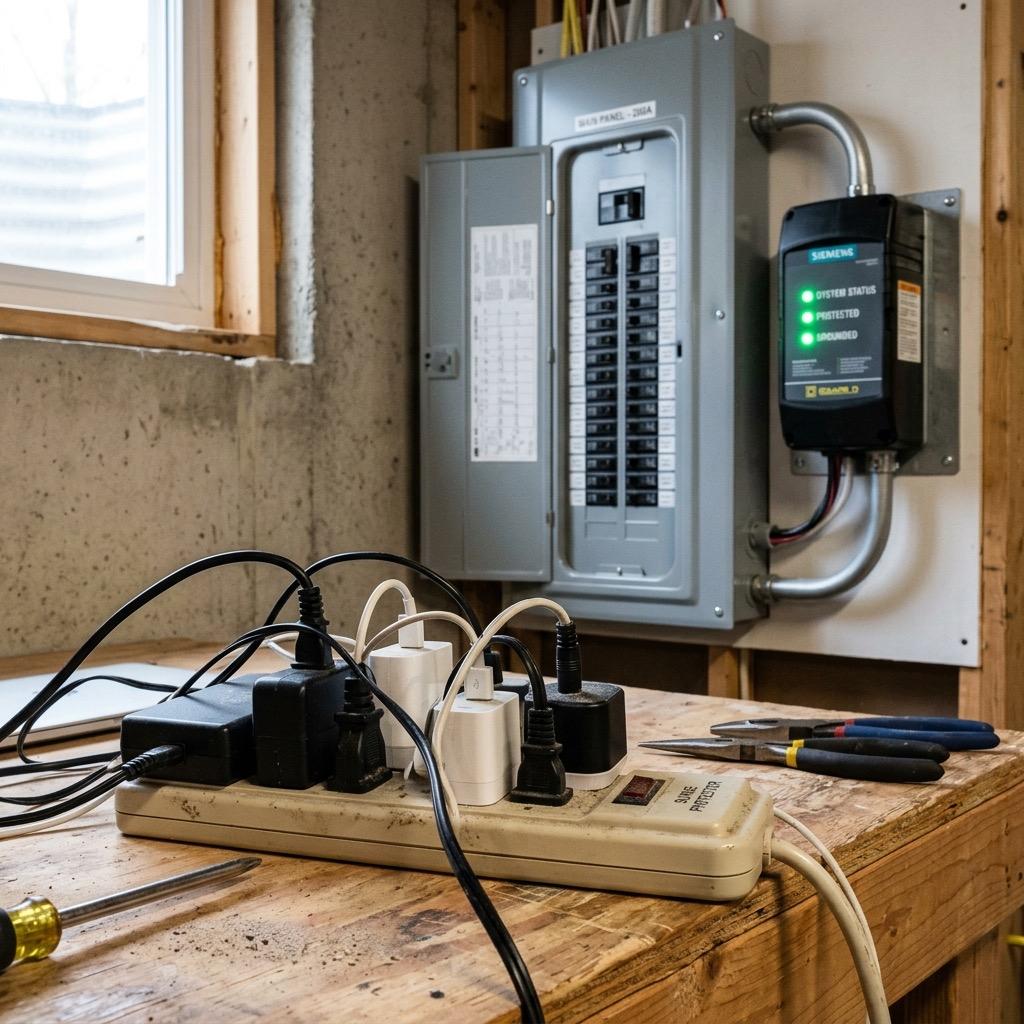
- Power strips with surge protection only protect devices plugged into them, cannot protect hardwired appliances (HVAC, water heaters, refrigerators), and have limited clamping capacity compared to panel-level SPDs.
- Northern Virginia experiences among the highest lightning flash densities on the East Coast, with Fairfax and Loudoun counties averaging 20–25 lightning events per square mile annually.
- A whole-house SPD costs $200–$600 installed; power strips are $15–$75 each. The combination of both provides the most comprehensive protection.
- The 2020 NEC (adopted by Virginia) added Section 230.67 requiring surge protection on all new residential services starting in 2023, reflecting the industry consensus that SPDs are essential, not optional.
The Surge Threat in Northern Virginia
Power surges — rapid, brief increases in voltage above normal 120V levels — come from two sources: external (lightning strikes and utility grid switching) and internal (large motors cycling on and off within your home). Northern Virginia sits in a region with one of the most active lightning climates in the northeastern United States, driven by summer thunderstorm systems tracking from the Appalachians through the Shenandoah Valley and across the Piedmont into the DMV suburbs.
According to data from the National Lightning Safety Institute and Vaisala National Lightning Detection Network, Loudoun County and Fairfax County average 20–25 ground flash events per square mile annually. The Insurance Institute for Business and Home Safety reports that lightning-related property damage costs U.S. homeowners approximately $900 million annually, with home electronics and appliances accounting for over $400 million of that figure. In a single summer storm season in Northern Virginia, voltage transients from nearby strikes can silently degrade semiconductor components across your entire home before any single device visibly fails.
Whole-House SPD vs Power Strip: Technical Comparison
| Feature | Whole-House SPD (Panel Mount) | Surge-Protecting Power Strip |
|---|---|---|
| Protection location | Main electrical panel (service entrance) | Individual outlet/device only |
| Surge current capacity | 40,000–120,000+ amps (kA) | 500–6,000 amps typical |
| Clamping voltage | 400–700V (ANSI/UL 1449 Type 1/2) | 330–500V (UL 1449 Type 3) |
| Protects hardwired appliances | Yes (HVAC, water heater, etc.) | No |
| Protects every outlet | Yes | No — only plugged-in devices |
| Response time | Nanoseconds | Nanoseconds (similar) |
| Installed cost | $200–$600 | $15–$75 per strip |
| Lifespan after major surge | MOV components degrade; indicator light | MOVs deplete; often no indicator |
| NEC 230.67 compliance | Yes (Type 1 or Type 2) | No (not a service entrance SPD) |
| Professional installation required | Yes | No |
Critical Warning: Most inexpensive power strips labeled "surge protector" have minimal Metal Oxide Varistor (MOV) capacity. After absorbing one significant surge event, the MOVs are depleted and the strip provides zero surge protection — while still functioning as a normal power strip. There is often no indication that protection has failed. The Insurance Information Institute estimates that 70% of "surge protector" power strips in use in U.S. homes are providing no actual surge protection.
A professional electrical inspection identifies hidden hazards before they become emergencies. Our licensed electricians provide thorough safety inspections throughout Northern Virginia. Call (703) 997-0026 to schedule yours.
How Whole-House SPDs Work
A whole-house surge protective device (SPD) mounts directly at or adjacent to your main electrical panel. When a transient voltage spike arrives at your service entrance — whether from a lightning strike nearby, utility switching, or grid disturbances — the SPD's Metal Oxide Varistors (MOVs) and/or Transient Voltage Surge Suppressors (TVSSs) clamp the spike by diverting excess current to your grounding system before it can travel to any circuit in your home.
The critical technical distinction: whole-house SPDs are classified as UL 1449 Type 1 or Type 2 devices with surge current ratings measured in thousands of amps (typically 40kA to 120kA). The highest-rated power strip surge protectors handle 6kA or less. A nearby lightning strike can generate 20,000 to 200,000 amps. The math is clear about which device is actually equipped for this threat.
Virginia's adoption of the 2020 NEC introduced Section 230.67, which mandates surge protection at the service entrance for all new and significantly upgraded residential electrical services. This code change reflects decades of consensus among electrical engineers that panel-level SPDs are essential infrastructure, not optional accessories.
Pro Tip: The best whole-house SPD installations use a "layered protection" approach: a Type 1 SPD at the service entrance (before the main breaker), a Type 2 SPD at the main panel or subpanel, and Point-of-Use protection (quality power strips) at sensitive electronics. Each layer handles surges the previous layer did not fully suppress. This is the approach we recommend for high-value homes in McLean, Great Falls, Middleburg, and other premium Northern Virginia addresses with significant electronics investments.
What Power Strips Actually Protect — And Their Limitations
A quality surge-protecting power strip from APC, Tripp Lite, or Belkin has genuine value as a second line of defense. Strips rated at 3,000–6,000 joules with UL 1449 Type 3 listing can suppress residual transients that bypass or overwhelm a whole-house SPD. They are also the only option for protecting laptop chargers, monitors, and other electronics from internal surges generated by nearby devices on the same circuit.
What power strips cannot do: protect any hardwired equipment (your HVAC system, pool pump, well pump, hardwired lighting controls, and smart home hubs connected to wired Ethernet cannot be plugged into a strip), absorb the full energy of a nearby lightning event without failing immediately, or protect the wiring infrastructure between your panel and the outlet.
According to the NFPA, hardwired appliances represent 40–60% of the total value of electrical equipment in a typical American home. HVAC systems alone represent $5,000–$25,000 in a Northern Virginia home. A power strip protects zero dollars of that investment. A whole-house SPD protects all of it.
The Cost of Not Having Whole-House Protection
In a typical Northern Virginia summer, we receive calls every week during July and August from homeowners whose HVAC systems, refrigerators, or smart home panels have failed after nearby lightning events. The claim process is exhausting and not always fully covered. Common damage costs from a significant surge event: HVAC control board replacement ($400–$1,200 plus $300–$500 labor), smart thermostat and home automation hub replacement ($200–$800), refrigerator control board ($350–$700), pool equipment and pumps ($500–$2,000), and whole-home generator control system ($800–$2,500).
Total potential exposure from one surge event: $3,000–$10,000 in a well-equipped Northern Virginia home. A whole-house SPD installation from AJ Long Electric costs $200–$600. The math strongly favors protection.
Insurance Note: Some Northern Virginia homeowner's insurance policies require documented surge protection installation to qualify for full electronics replacement coverage under power surge claims. Check with your insurer — particularly if you have a home entertainment system, wine cellar refrigeration, or other high-value electronics. Professional installation with a permit provides the documentation needed for insurance purposes.
Choosing the Right Whole-House SPD
When specifying a whole-house SPD for a Northern Virginia home, look for: surge current capacity of at least 80kA for standard homes, 120kA+ for premium installations; UL 1449 Type 1 or Type 2 listing; thermal fusing to prevent fire if MOVs fail; end-of-life indicator so you know when replacement is needed; and clamping voltage at or below 600V.
Top-rated whole-house SPDs for Northern Virginia residential use include the Siemens FS140 (120kA, excellent for Siemens panels), Leviton 51120 (120kA, panel-agnostic), and Square D Homeline SDSB80112PG (80kA, Square D panel integration). All are available through licensed electrical contractors and should be installed by a professional who can properly connect to your panel's grounding system.
Our Recommendation
Every Northern Virginia home should have a whole-house SPD installed at the main electrical panel. This is not an up-sell — it is standard protective infrastructure, required by Virginia code for new construction and backed by strong financial logic for existing homes. Add quality point-of-use power strips for electronics and computers as a second layer. Do not rely on power strips alone.
AJ Long Electric installs whole-house surge protectors throughout Northern Virginia as standalone projects or as add-ons during panel upgrades, EV charger installations, and generator installations. Installation typically takes 1–2 hours. Call (703) 997-0026 to schedule surge protection for your home before the next summer storm season.
Tags:

Written by
Matt Long
Master Electrician
Our team of licensed electricians brings over 40 years of combined experience serving Northern Virginia. We're committed to providing expert electrical solutions with a focus on safety, quality, and customer satisfaction.
Reviewed by AJ Long Electric Master Electricians · VA License #2705031092 · View Credentials