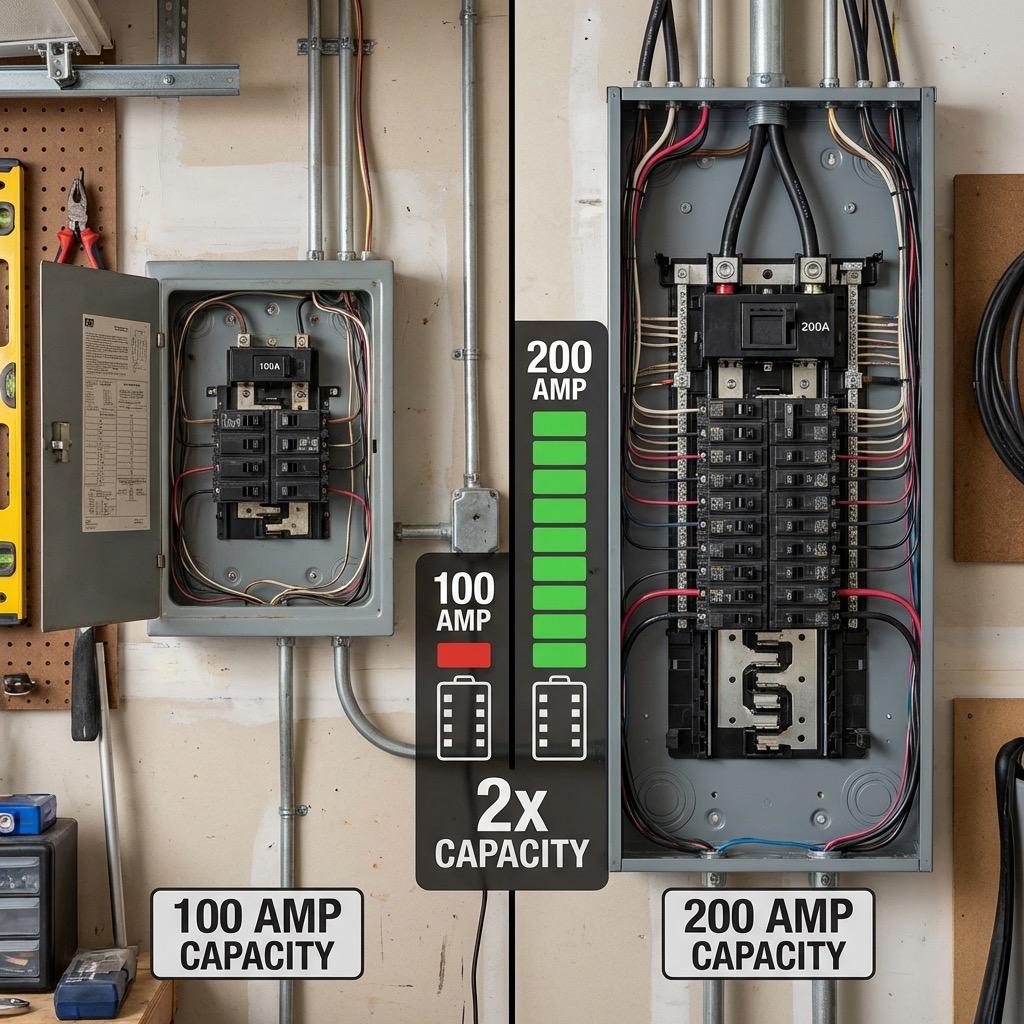
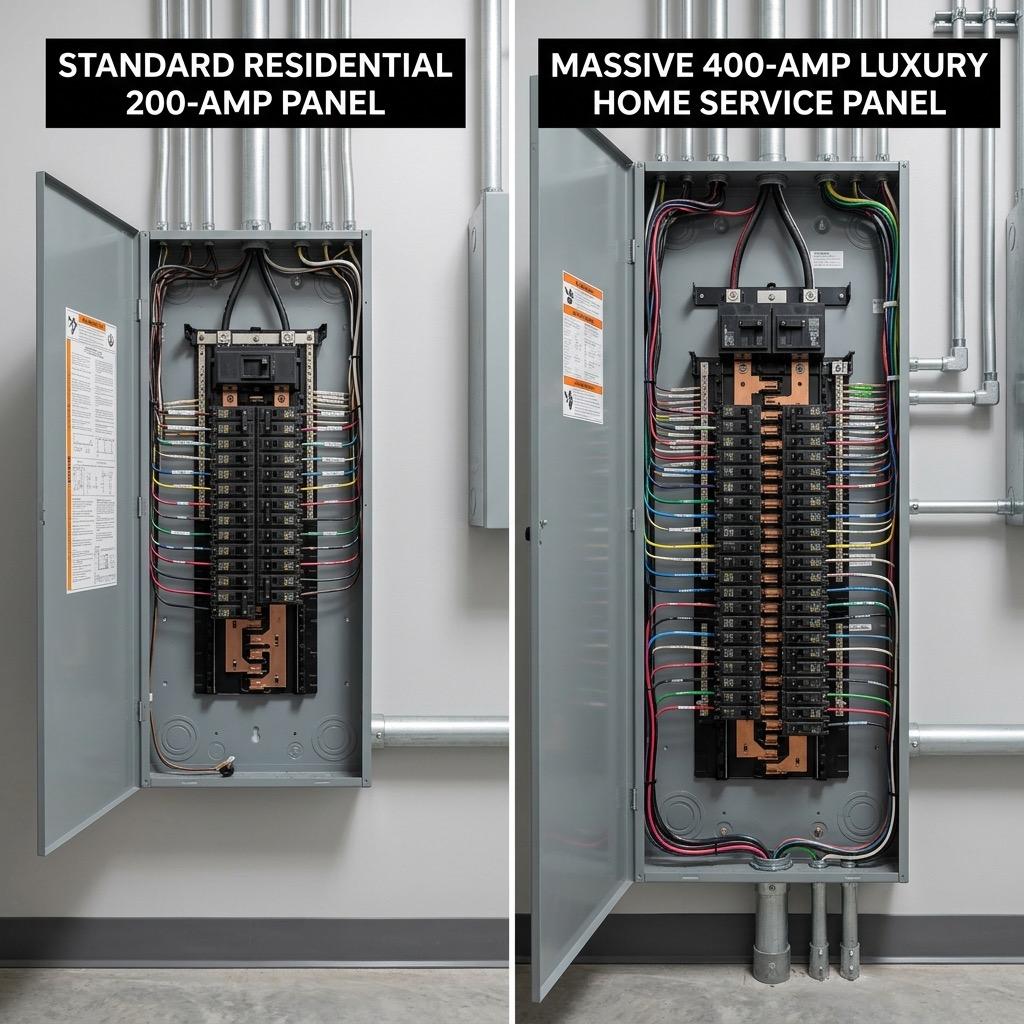
As Northern Virginia homeowners add EV chargers, home additions, heat pumps, and whole-home generators, the question of panel capacity has never been more relevant. Whether you are upgrading from a 100-amp service or planning a major renovation, choosing between a 200-amp and 400-amp panel can mean the difference between a future-proof home and a second upgrade in five years. Here is the definitive guide for NoVA homeowners.
Key Takeaways
- 200-amp service is the current standard for single-family homes and comfortably handles most modern households, including one EV charger, central AC, and typical appliances.
- 400-amp service is warranted for large homes over 4,000 sq ft, multi-unit properties, homes with two or more EV chargers, or those planning full electrification with heat pumps and induction cooking.
- In Northern Virginia, a 200-amp panel upgrade costs $3,500–$6,500 installed; a 400-amp service runs $7,500–$14,000 or more depending on utility coordination and meter configuration.
- Dominion Energy requires advance coordination for 400-amp service; expect 2–6 weeks of scheduling lead time beyond the electrician's work.
- Most Fairfax, Loudoun, and Prince William County homes built between 1960–2000 are ideal candidates for a 200-amp upgrade and can stop there unless major electrification is planned.
Understanding Electrical Service Sizes
Your electrical service size determines the maximum amperage your home can draw from the utility at any moment. Every appliance, light, and outlet in your home shares this capacity. The service enters through a meter base, passes through a main breaker, and distributes to individual circuits via your panel. When total demand exceeds service capacity, breakers trip, appliances malfunction, and safety is compromised.
In Northern Virginia, Dominion Energy serves the vast majority of homes. Their residential service tiers are 100-amp (legacy), 200-amp (standard), and 400-amp (large/high-demand). According to the U.S. Energy Information Administration, the average Virginia home uses approximately 1,200 kWh per month — but modern all-electric homes with EVs and heat pumps can easily triple that figure.
200 Amp vs 400 Amp: Head-to-Head Comparison
| Factor | 200-Amp Service | 400-Amp Service |
|---|---|---|
| Maximum capacity at 240V | 48,000 watts | 96,000 watts |
| Suitable home size | Up to ~4,000 sq ft | 4,000+ sq ft or high-demand loads |
| EV chargers supported | 1–2 (with load management) | 3+ (no restrictions) |
| Installed cost (NoVA) | $3,500–$6,500 | $7,500–$14,000+ |
| Panel circuit spaces | 40–80 spaces | 80–200 spaces (often dual panels) |
| Utility coordination required | Minimal | Yes — Dominion lead time 2–6 weeks |
| Meter configuration | Single meter base | Often dual 200A meters or CT metering |
| Permit complexity | Standard residential | More complex; may require engineer stamp |
| Best for | Most single-family homes | Large homes, multi-units, full electrification |
Northern Virginia Context: The majority of homes built in Fairfax County, Loudoun County, and Prince William County between 1970 and 2000 have 150-amp or 200-amp service already. If you are simply replacing an aging panel or adding a single EV charger, upgrading within the 200-amp tier is almost always sufficient. We find 400-amp requests are concentrated in newer construction over 4,500 sq ft and properties with detached ADUs or multi-car EV charging setups.
Outdated or overloaded electrical panels are a safety risk. Our team specializes in 200-amp upgrades throughout Northern Virginia, with same-day panel assessments available. Call (703) 997-0026 to get started.
When 200-Amp Service Is the Right Choice
For the vast majority of Northern Virginia single-family homes, 200-amp service is the right answer. Here is why: at 240 volts, 200 amps delivers 48,000 watts of total capacity. With demand factors applied (not every load runs simultaneously), this comfortably supports central air conditioning (3–5 kW), electric range (8–10 kW), electric dryer (5–6 kW), water heater (4–5 kW), one Level 2 EV charger (7.2–9.6 kW), plus lighting and general outlets — all running at once.
According to the National Electrical Manufacturers Association (NEMA), 200-amp service handles the electrical needs of approximately 85% of new single-family residential construction in the United States. For homes in Alexandria, Arlington, Reston, and Herndon where lot sizes are moderate and homes range from 1,500 to 3,500 square feet, 200-amp is almost always appropriate.
Pro Tip: If your existing panel is a Federal Pacific Stab-Lok, Zinsco, or Pushmatic, upgrading it to a new 200-amp panel is urgent regardless of capacity concerns. These panels have documented defects that cause breakers to fail to trip under overload conditions — a leading cause of electrical fires in homes built in the 1960s through 1980s. We encounter them regularly in Burke, Springfield, and Annandale neighborhoods.
When 400-Amp Service Is Justified
Four scenarios reliably justify a 400-amp service upgrade in Northern Virginia:
Large homes over 4,000 square feet: Homes in premium Loudoun County and western Fairfax neighborhoods often have 5,000–8,000 sq ft with multiple HVAC zones, large kitchens, home theaters, and substantial outdoor lighting. A load calculation for these homes regularly approaches or exceeds 200-amp capacity.
Multi-EV households: Two Level 2 EV chargers at 40 amps each plus a 240V dryer and central AC can push you to the edge of 200-amp capacity. Three or more EV chargers — increasingly common as families replace both vehicles — definitively require 400-amp service or sophisticated load management.
Full electrification plans: Homeowners replacing gas appliances with electric alternatives (heat pump HVAC, induction range, heat pump water heater, electric dryer) are adding 15–25 kW of load. The Virginia Clean Economy Act and state incentives are accelerating this trend across the DMV region. A 200-amp service can often accommodate one or two major electrification steps, but full conversion frequently warrants 400-amp.
ADUs and additions: Adding a detached garage apartment, in-law suite, or significant addition over 1,000 square feet often triggers the need for a separate sub-service or a 400-amp main service feeding two panels.
Important: Do not upgrade to 400-amp service "just in case" without a proper load calculation. The additional $4,000–$8,000 in upfront cost, extended Dominion Energy coordination time, and greater installation complexity rarely make sense for homes with typical electrical demand. AJ Long Electric performs thorough load calculations before recommending any service size.
The Load Calculation: What Determines Your Actual Need
The National Electrical Code (NEC) Article 220 and Virginia's adopted amendments require an engineer-reviewed load calculation for service upgrades. This calculation accounts for general lighting load (3 VA per square foot), small appliance circuits, large appliances at nameplate ratings, HVAC equipment (100% of largest motor plus 100% of other loads), and EV charging (continuous load at 100%).
A common result in Northern Virginia: a 3,200 sq ft home with gas appliances and one EV charger calculates to approximately 140–160 amps of demand, well within 200-amp service. The same home with two EVs, a heat pump, and electric cooking calculates closer to 220–250 amps — pointing directly to 400-amp service.
Cost Breakdown: What to Expect in Northern Virginia
Panel upgrade costs in the DMV region reflect local labor rates and Dominion Energy coordination requirements:
200-amp panel upgrade (from 100A or 150A): $3,500–$6,500 depending on panel location, number of circuits, and whether the meter base requires replacement. Permits in Fairfax, Loudoun, and Prince William counties typically run $150–$350.
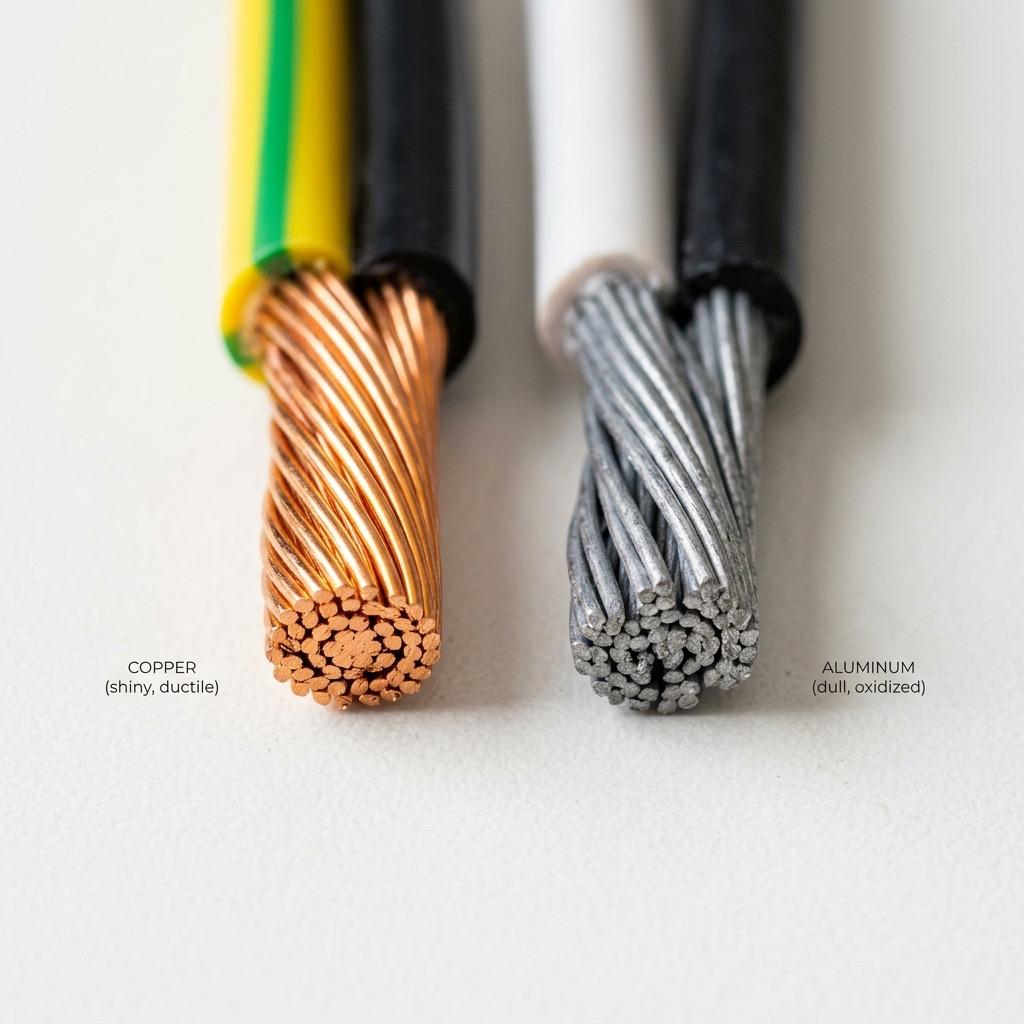
400-amp service installation: $7,500–$14,000 for most residential applications. This includes the 400-amp main disconnect or dual 200-amp configuration, service entrance conductors (typically 350-500 kcmil aluminum), new meter base, and utility coordination fees. Underground service or significant trenching adds $3,000–$8,000.
For homeowners on the fence, a 200-amp upgrade with a proper subpanel and conduit stub-out for future 400-amp expansion can be a cost-effective middle ground, spending $5,000–$7,500 now and preserving the option to upgrade later without completely redoing the service entrance.
The Installation Process in Virginia
Either upgrade requires a licensed electrical contractor to pull permits with your local jurisdiction (Fairfax County, Loudoun County, City of Alexandria, etc.), coordinate with Dominion Energy for meter disconnection and reconnection, install the new service entrance equipment and panel, and schedule a final inspection with the county inspector. The entire process typically takes 1–3 days for a 200-amp upgrade and 3–7 days for a 400-amp installation due to the additional utility coordination.
Virginia Code references: The 2023 Virginia Uniform Statewide Building Code adopts the 2020 NEC with Virginia amendments. Service entrance conductors must meet Table 310.12 sizing requirements, and all service work requires permit and inspection in every Northern Virginia jurisdiction.
Our Recommendation
Start with a professional load calculation. Most Northern Virginia homeowners upgrading from 100-amp or replacing a failing panel will find 200-amp service entirely sufficient for their current and anticipated needs. If your household includes or plans to include multiple EVs, comprehensive electrification, or a large home addition, invest in 400-amp now rather than paying twice.
AJ Long Electric performs free load calculations as part of every panel upgrade consultation. We serve all of Northern Virginia including Fairfax County, Loudoun County, Prince William County, and the cities of Alexandria and Falls Church. Call us at (703) 997-0026 to schedule your assessment.
Tags:

Written by
Matt Long
Master Electrician
Our team of licensed electricians brings over 40 years of combined experience serving Northern Virginia. We're committed to providing expert electrical solutions with a focus on safety, quality, and customer satisfaction.
Reviewed by AJ Long Electric Master Electricians · VA License #2705031092 · View Credentials