Modern homes are filled with sensitive electronics that are vulnerable to voltage spikes, from computers and smart TVs to refrigerators with digital controls and HVAC systems with electronic circuit boards. A single power surge can destroy thousands of dollars worth of equipment in an instant. Surge protectors are the primary defense against these damaging voltage events, yet many homeowners do not fully understand how they work, what the different types offer, or how to build a comprehensive surge protection strategy. This guide explains the science behind surge protection and helps you choose the right approach for your Northern Virginia home.
Key Takeaways
- Surges can come from external sources like lightning and utility grid events, or internal sources like large motor startups.
- Point-of-use surge protectors and whole-house surge protectors serve different roles and work best together.
- The joule rating indicates how much energy a surge protector can absorb over its lifetime before it needs replacement.
- Surge protectors degrade with each surge they absorb and eventually need replacement.
- A whole-house surge protector installed at your panel provides the first layer of defense for your entire electrical system.
What Is a Power Surge
A power surge is a brief spike in voltage that exceeds the normal 120 volts delivered to your outlets. Surges can range from barely above normal voltage to thousands of volts, and they can last from microseconds to milliseconds. While their duration is brief, the energy they carry can be enormous. When this excess voltage reaches your electronics, it can overwhelm and destroy the delicate semiconductors and circuit boards inside them. The damage may be instantaneous and obvious, as when a device simply stops working after a storm, or it may be cumulative and subtle, gradually degrading components over time until they fail prematurely.
External Sources of Surges
Lightning is the most dramatic source of power surges. A direct strike on a power line can send tens of thousands of volts through the distribution system. Even lightning that strikes near power lines, rather than directly on them, can induce surges through electromagnetic coupling. In Northern Virginia, where afternoon thunderstorms are common from May through September, lightning-induced surges are a real and recurring threat.
Utility grid events are another external source. When the power company switches transformers, reroutes power during maintenance, or restores power after an outage, the transitions can create voltage spikes. Tree branches falling on power lines, vehicle accidents involving utility poles, and any event that briefly interrupts and restores the power supply can generate surges.
Internal Sources of Surges
Perhaps surprisingly, the majority of surges that affect your electronics originate inside your own home. Every time a motor-driven appliance like an air conditioner, refrigerator, washing machine, or garage door opener cycles on or off, it creates a small voltage transient on the circuits sharing its electrical service. These internal surges are individually small but occur thousands of times per year. Over time, their cumulative effect degrades sensitive electronics, shortening the lifespan of circuit boards in appliances, computers, and entertainment equipment.
Northern Virginia's summer thunderstorm season, combined with an aging utility infrastructure in some areas, makes surge protection particularly important for homes in the region. Dominion Energy's distribution network serves millions of customers, and grid switching events are a routine part of system management. A whole-house surge protector at your panel catches these utility-side surges before they reach your equipment.
How Surge Protectors Work
Metal Oxide Varistors (MOVs)
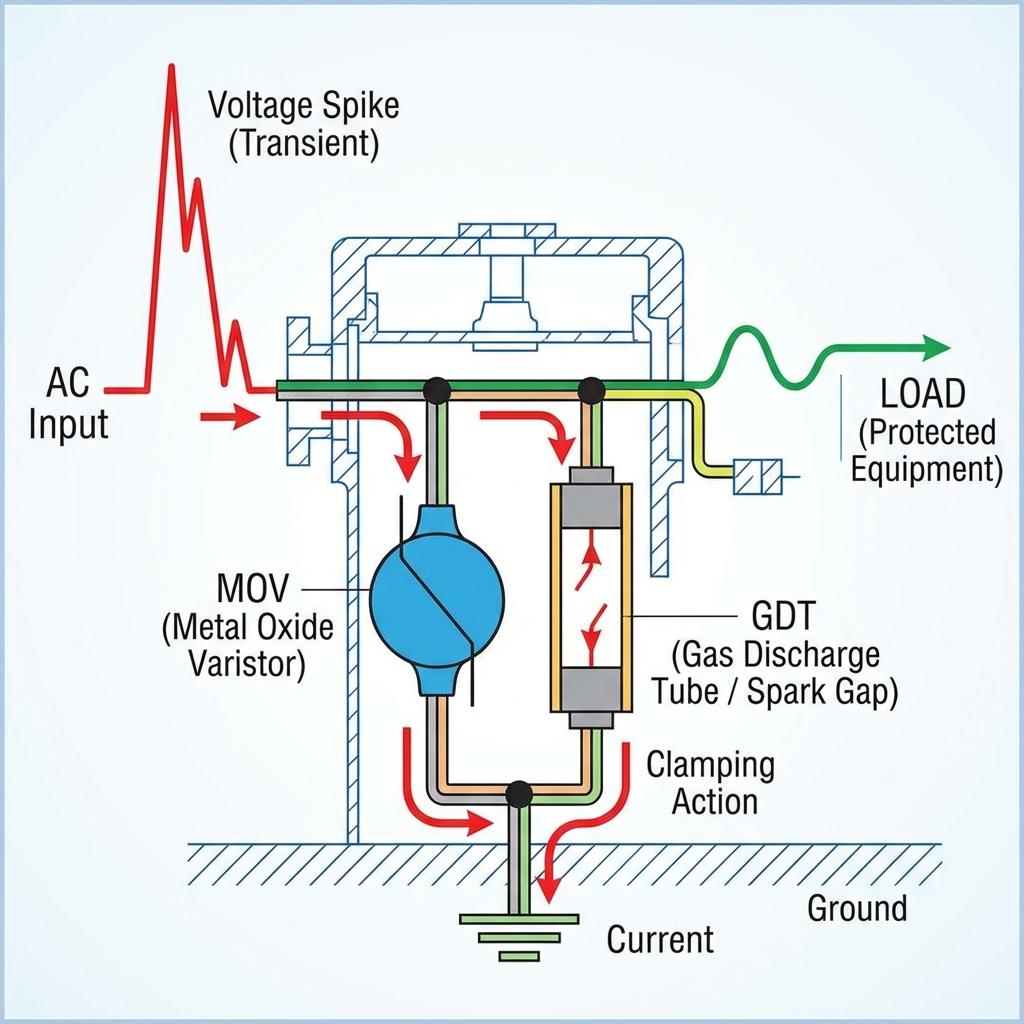
Most surge protectors use components called metal oxide varistors to divert excess voltage. An MOV is essentially a variable resistor that changes its behavior based on voltage. Under normal voltage conditions, the MOV has very high resistance and essentially does nothing, allowing current to flow normally to your devices. When voltage exceeds a threshold, called the clamping voltage, the MOV's resistance drops dramatically, creating a low-resistance path that diverts the excess energy to the ground wire, away from your equipment.
Whether it is a simple repair or a major electrical project, our licensed team is ready to help. Serving all of Northern Virginia with transparent pricing and expert workmanship. Call (703) 997-0026 today.
The Clamping Voltage
Clamping voltage is the voltage level at which the surge protector begins to divert energy. A lower clamping voltage means the protector activates sooner, letting less excess voltage through to your devices. For a 120V system, good surge protectors have clamping voltages in the range of 330 to 400 volts. While this seems much higher than 120 volts, remember that normal household voltage fluctuates, and the clamping voltage needs to be high enough not to trigger during normal variations but low enough to catch genuine surges.
Response Time
Response time is how quickly the surge protector reacts after voltage exceeds the clamping threshold. Surges can develop in nanoseconds, so the protector must respond almost instantly. Quality surge protectors respond in one nanosecond or less. Slower response times allow more damaging energy to pass through to your equipment before the protection activates.
Types of Surge Protection
Point-of-Use Surge Protectors (Power Strips)
These are the familiar power strip-style surge protectors that plug into wall outlets and provide multiple protected outlets. They are affordable, easy to install, and effective for protecting individual devices or equipment groups. When shopping for point-of-use surge protectors, look for a joule rating of at least 1,000 for basic electronics and 2,000 or more for expensive equipment. Check that the clamping voltage is 400 volts or lower. Verify that the protector has indicator lights showing protection status, since a surge protector that has absorbed its maximum energy no longer provides protection. And consider models with diagnostic LEDs that indicate grounding status, wiring faults, and protection presence.
Whole-House Surge Protectors
A whole-house surge protector, also called a Type 2 surge protective device, installs directly at your electrical panel. It monitors every circuit in your home simultaneously, catching surges as they enter your electrical system from the utility supply. Whole-house units are rated for much higher surge currents than point-of-use strips, typically 40,000 to 80,000 amps per phase, and they protect equipment that is not connected to point-of-use strips, including hardwired appliances like HVAC systems, water heaters, garage door openers, and built-in lighting.
Installation requires a licensed electrician because the device connects directly to the panel's bus bars. The installation is typically straightforward and can usually be completed in one to two hours. The protector mounts on or adjacent to the panel and connects through a dedicated two-pole breaker.
For comprehensive protection, use both a whole-house surge protector at your panel and point-of-use protectors at your most valuable electronics. The whole-house unit handles the large external surges from lightning and utility events, while the point-of-use units provide fine-grained protection against smaller internal surges and let-through voltage that passes the whole-house unit. This layered approach, sometimes called cascaded surge protection, provides the most complete defense.
Type 1 Surge Protectors
Type 1 devices install between the utility meter and your panel, protecting against surges before they even enter your home's electrical system. These are less common in residential installations but provide an additional layer of protection for homes in lightning-prone areas or locations with known utility power quality issues.
Key Specifications Explained
Joule Rating
The joule rating represents the total energy the surge protector can absorb over its lifetime. Each surge the protector absorbs uses up some of its joule capacity. A 1,000-joule protector can absorb one large surge or many small ones totaling 1,000 joules before its protection is exhausted. Higher joule ratings mean longer service life. For whole-house protectors, look for ratings of 50,000 joules or more. For point-of-use protectors, 2,000 joules or more is recommended for valuable electronics.
Surge Current Rating
Measured in kiloamps (kA), this indicates the maximum surge current the device can handle in a single event. Whole-house protectors should be rated for at least 40 kA per phase, with premium units rated at 80 kA or more. This rating matters most for protection against nearby lightning strikes, which can produce enormous surge currents.
Protection Status Indicators
Both point-of-use and whole-house surge protectors should have indicators that show whether protection is still active. A surge protector that has exceeded its absorption capacity may continue to function as a power strip but no longer provides surge protection. Without an indicator, you have no way of knowing. Replace any surge protector whose protection indicator shows the protection is no longer active.
Common Mistakes to Avoid
Not all power strips are surge protectors. A basic power strip provides additional outlets but no surge protection at all. Check the packaging or label for a joule rating or UL 1449 listing. Do not confuse a power strip with a surge protector. Additionally, surge protectors have a finite lifespan and need replacement after they have absorbed their rated energy or after a major surge event. And plugging a surge protector into another surge protector does not double the protection; it creates a fire hazard.
Protecting your home's electronics and appliances from power surges is a straightforward investment that prevents expensive damage. Whether you need a whole-house surge protector installed at your panel, guidance on the best point-of-use options, or a complete surge protection strategy for your home, the electricians at AJ Long Electric are here to help. Contact us at (703) 997-0026 to discuss surge protection for your Northern Virginia home.
Tags:

Written by
AJ Long Electric Team
Licensed Electricians
Our team of licensed electricians brings over 40 years of combined experience serving Northern Virginia. We're committed to providing expert electrical solutions with a focus on safety, quality, and customer satisfaction.
Reviewed by AJ Long Electric Master Electricians · VA License #2705031092 · View Credentials