GFCI and AFCI are two essential safety technologies that protect your family from different electrical hazards. While both trip breakers to prevent dangerous conditions, they detect entirely different problems. Understanding the distinction helps you know if your Northern Virginia home has adequate protection and whether code-compliant upgrades are needed.
Key Takeaways
- GFCI protects against electrocution by detecting current flowing through unintended paths (like through a person); AFCI protects against fire by detecting dangerous electrical arcing.
- Modern code (2023 NEC) requires GFCI in all wet/damp locations and AFCI throughout most living spaces in new construction.
- Dual-function AFCI/GFCI breakers ($45-$70 each) provide both protections in a single device, simplifying compliance.
- Homes built before 2014 likely lack adequate AFCI protection; homes before 1990 may also be missing GFCI in now-required areas.
- Upgrading to proper GFCI/AFCI protection is one of the most affordable safety improvements you can make.
The Fundamental Difference
In simple terms:
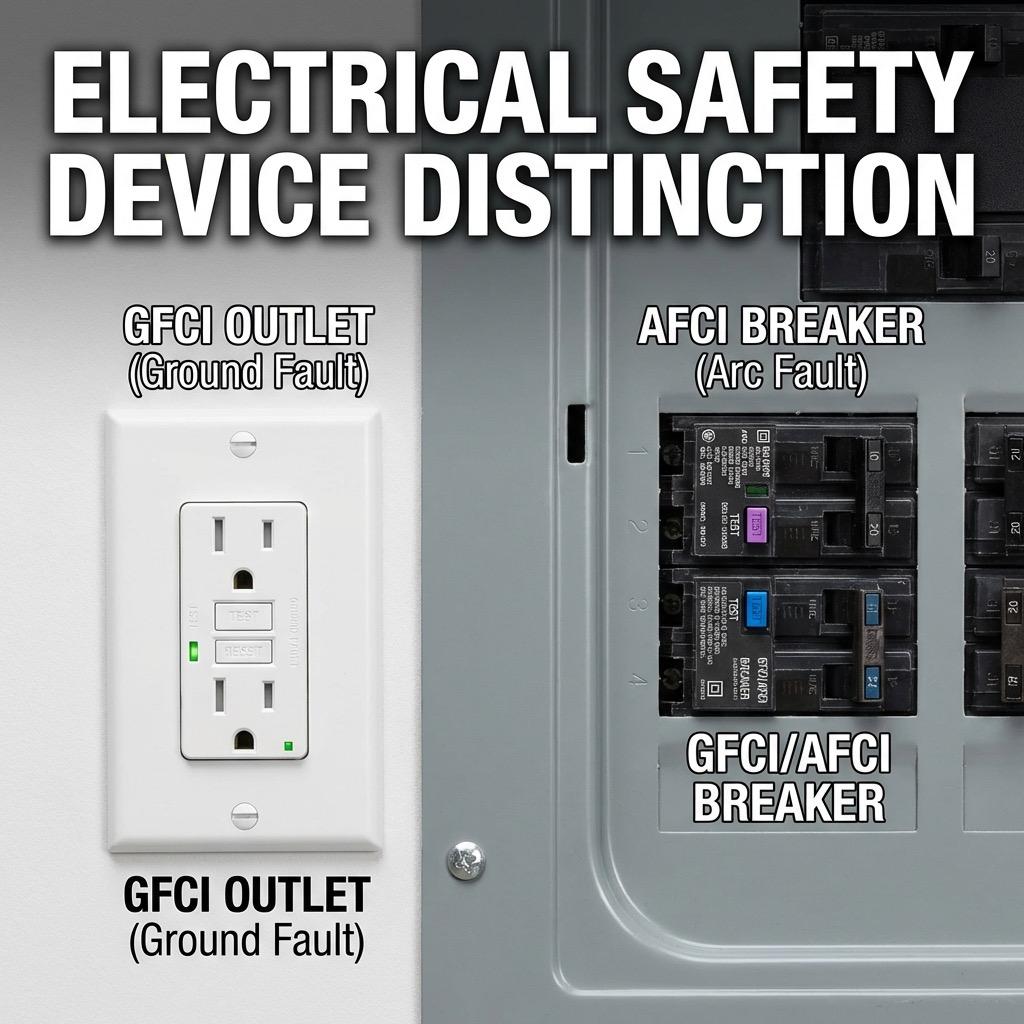
- GFCI (Ground Fault Circuit Interrupter): Protects against shock by detecting current flowing through unintended paths (like through a person).
- AFCI (Arc Fault Circuit Interrupter): Protects against fire by detecting dangerous electrical arcing in damaged or deteriorated wiring.
These technologies address completely different failure modes, which is why modern electrical code often requires both types of protection.
GFCI Protection In-Depth
How GFCI Works
A GFCI continuously monitors the current flowing out on the hot wire versus returning on the neutral wire. Under normal conditions, these currents are equal. If even a small amount of current (as little as 4-6 milliamps) flows somewhere else, like through your body to ground, the GFCI trips in 1/40th of a second, faster than your heartbeat. This rapid response can prevent electrocution.
Outdated or overloaded electrical panels are a safety risk. Our team specializes in 200-amp upgrades throughout Northern Virginia, with same-day panel assessments available. Call (703) 997-0026 to get started.
Where GFCI Is Required (2023 NEC)
GFCI protection is required for 15A and 20A, 125V receptacles in bathrooms, kitchens (all countertop receptacles and within 6 feet of sinks), garages and accessory buildings, all outdoor receptacles, crawl spaces and unfinished basements, laundry areas within 6 feet of sinks, and indoor damp/wet locations.
GFCI Implementation Options
- GFCI receptacles: Replace standard outlets ($15-$25 each). Can protect downstream outlets when wired correctly.
- GFCI breakers: Install at the panel to protect entire circuit ($30-$50 each). Simpler to install but more expensive.
- Portable GFCI devices: Plug-in protection for temporary use with tools.
AFCI Protection In-Depth
How AFCI Works
AFCI uses sophisticated electronics to analyze the current waveform on a circuit, looking for signatures of dangerous arcing. Electrical arcs create distinctive patterns, specifically random high-frequency signals superimposed on the 60Hz power waveform. The technology must distinguish between dangerous arcing (damaged wire sparking inside a wall) and normal arcing (motor brushes, switch contacts). Modern AFCI breakers use microprocessors to analyze these patterns and trip only for hazardous conditions.
Where AFCI Is Required (2023 NEC)
AFCI protection is required for all 15A and 20A, 120V branch circuits in kitchens, family rooms, dining rooms, living rooms, bedrooms, hallways, closets, laundry areas, and similar rooms. Essentially, AFCI is required throughout most living spaces in new construction.
GFCI vs AFCI: Side-by-Side Comparison
| Feature | GFCI | AFCI |
|---|---|---|
| Primary hazard protected | Electrocution / shock | Electrical fires |
| Detection method | Current imbalance (hot vs neutral) | Waveform analysis for arc signatures |
| Trip threshold | 4-6 milliamps imbalance | Arc signature detection |
| Response time | 1/40th second | Variable (depends on arc type) |
| Required locations | Wet / damp locations | Living spaces |
| Breaker cost | $30-$50 | $35-$60 |
| Receptacle option | Widely available ($15-$25) | Available but less common |
| Dual-function breaker | $45-$70 (provides both GFCI + AFCI) | |
Northern Virginia Code Note: Fairfax, Loudoun, and Prince William counties all enforce the NEC as adopted by Virginia. When you add circuits, remodel, or upgrade your panel, inspectors will require AFCI and GFCI protection in accordance with the current code cycle. Even if your existing home is grandfathered, upgrading proactively is one of the best safety investments you can make.
Dual Function AFCI/GFCI Breakers
The best of both worlds: dual function breakers provide both AFCI and GFCI protection in a single device. This is increasingly the go-to solution for areas requiring both types of protection, such as kitchens and laundry rooms. Dual function breakers cost $45-$70 each, which is less than buying separate AFCI breakers and GFCI receptacles, with simpler installation and no receptacles to test.
Common Issues and Troubleshooting
GFCI Tripping Issues
- Moisture in outdoor boxes: Water infiltration causes false trips. Use weatherproof covers.
- Long cable runs: Capacitive leakage on long circuits can cause nuisance trips.
- Shared neutral wires: Multi-wire branch circuits can cause false trips if wired incorrectly.
- Deteriorating insulation: Older wiring may have breakdown causing actual ground faults.
AFCI Tripping Issues
- Certain appliances: Some motors, dimmers, and electronics create signatures that trip AFCI breakers. Using newer AFCI models often resolves this.
- Loose connections: A common cause; the AFCI may be detecting real arcing at a loose wire nut or outlet connection.
- Damaged wiring: If AFCI keeps tripping, it may be detecting an actual hazard that needs investigation.
Pro Tip: Many older homes in Arlington, Falls Church, and inner Fairfax County have outdated panels with no AFCI protection at all. When we perform panel upgrades in these areas, we routinely install dual-function breakers on all applicable circuits, bringing decades-old wiring under modern arc-fault and ground-fault protection in one project.
Cost of Protection and When to Upgrade
Upgrading to GFCI/AFCI protection is surprisingly affordable considering the protection provided:
- GFCI receptacle installed: $75-$150
- GFCI breaker installed: $125-$200
- AFCI breaker installed: $150-$250
- Dual function breaker installed: $175-$275
GFCI and AFCI address different but equally important safety concerns. GFCI protects you from shock; AFCI protects your home from fire. Modern homes should have both types of protection in appropriate locations. If your home was built before 2014, you likely lack adequate AFCI protection. If built before 1990, you may also be missing GFCI in areas now required by code.
AJ Long Electric provides electrical safety inspections and GFCI/AFCI upgrades throughout Northern Virginia. We assess your current protection, identify any gaps, and provide affordable solutions to bring your home up to modern safety standards. Schedule your safety inspection today.
Tags:

Written by
Matt Long
Master Electrician
Our team of licensed electricians brings over 40 years of combined experience serving Northern Virginia. We're committed to providing expert electrical solutions with a focus on safety, quality, and customer satisfaction.
Reviewed by AJ Long Electric Master Electricians · VA License #2705031092 · View Credentials