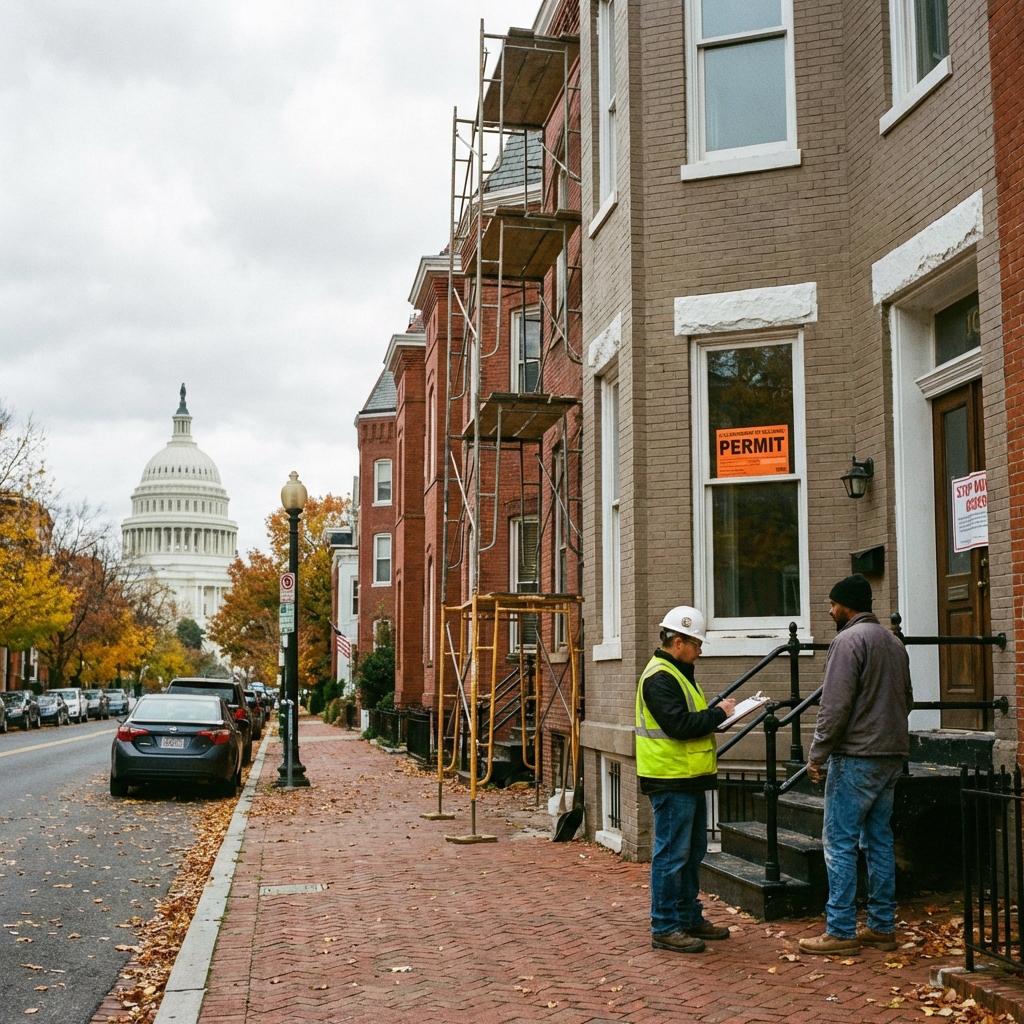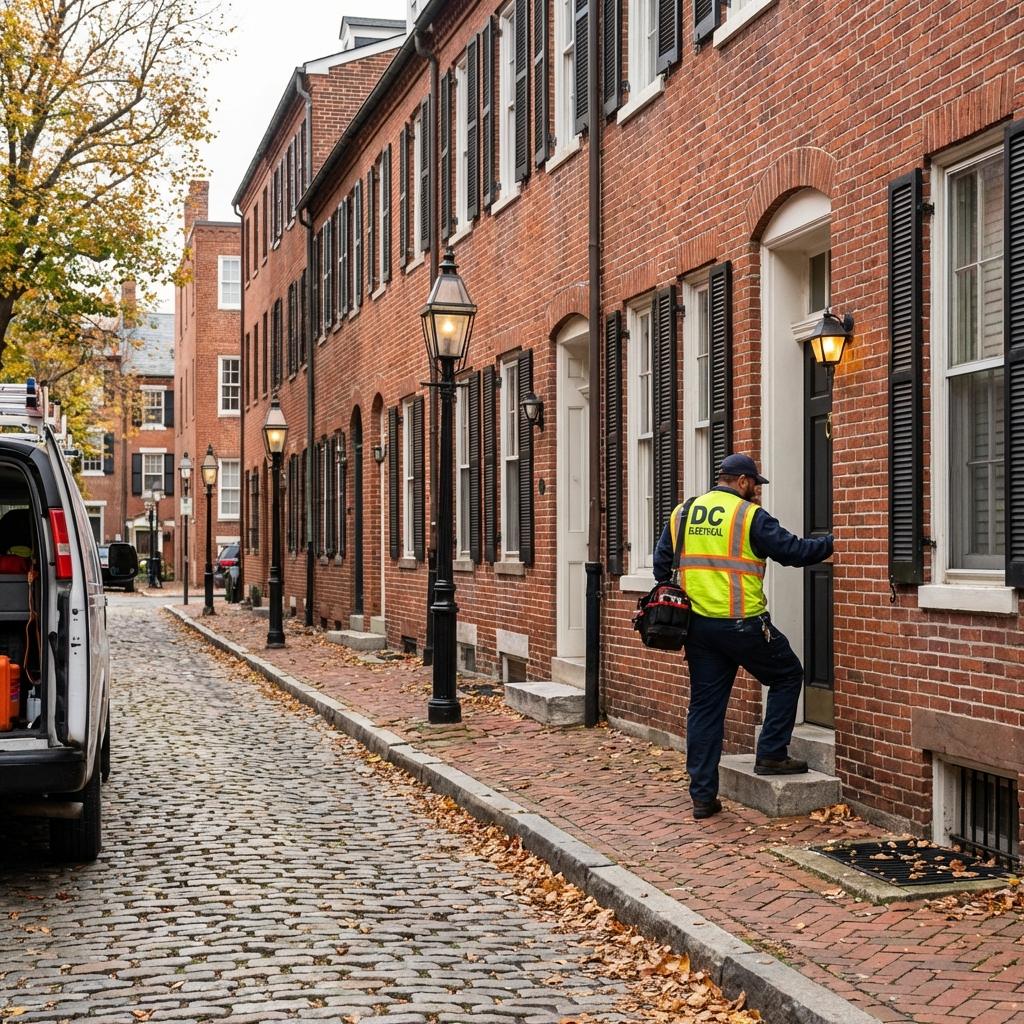
Capitol Hill is the largest residential historic district in Washington, D.C., stretching from the United States Capitol Building eastward through blocks of beautifully preserved rowhouses that represent some of the finest examples of Federal, Victorian, and Italianate residential architecture in the country. These homes, built primarily between the 1850s and 1910s, are beloved by their owners for their soaring ceilings, intricate millwork, original hardwood floors, and the sense of living within American history. However, the electrical systems in many Capitol Hill rowhouses have not kept pace with the homes' lovingly maintained exteriors. Original knob-and-tube wiring, undersized panels, ungrounded circuits, and decades of patchwork modifications create both safety concerns and practical limitations that affect daily life. Updating the wiring in a Capitol Hill rowhouse is one of the most impactful improvements a homeowner can make, providing safe, reliable, modern electrical service while preserving the historic character that makes these homes irreplaceable.
Key Takeaways
- Many Capitol Hill rowhouses still contain original knob-and-tube wiring from the late 1800s or early 1900s, which lacks grounding, cannot be buried in insulation, and may have deteriorating insulation on conductors.
- Rowhouse construction with shared party walls requires special awareness during electrical work to avoid disturbing neighboring properties or damaging shared structural elements.
- Capitol Hill's historic district designation means exterior electrical modifications may require Historic Preservation Review Board approval before building permits can be issued.
- A complete rewire of a Capitol Hill rowhouse provides decades of safe, modern electrical service and is the most comprehensive solution for homes with aging wiring.
- Modern amenities including gourmet kitchen circuits, EV charging, smart home systems, and dedicated home office power can be seamlessly integrated into Capitol Hill rowhouses by experienced electricians.
Understanding Capitol Hill Rowhouse Construction
Effective electrical work in Capitol Hill rowhouses begins with understanding how these homes were built. Capitol Hill rowhouses share common construction characteristics that directly affect how electrical work is planned and executed.
Wall Construction
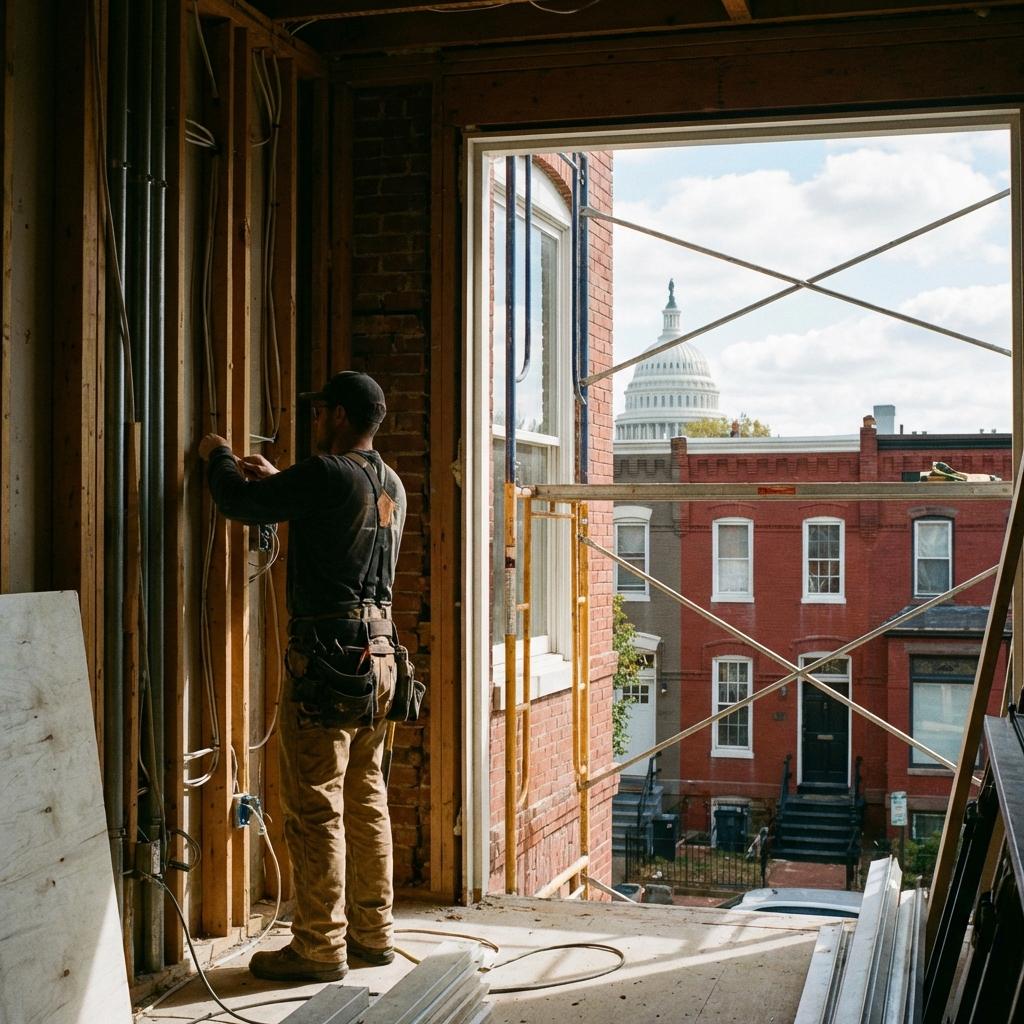
Capitol Hill rowhouses typically have brick exterior walls, brick party walls shared with neighboring rowhouses, and interior partition walls framed with wood studs and covered with plaster applied over wood lath. The party walls between adjoining rowhouses are load-bearing brick structures that cannot be penetrated for wire routing. This constraint means all wiring must be routed through interior partition walls, floor and ceiling cavities, and the home's front and rear exterior walls where they are not shared.
The plaster-over-lath construction of interior walls presents challenges for wire routing but also provides opportunities. The space between the lath and the exterior surface of the wall provides a narrow cavity that experienced electricians can use to fish wires vertically. Horizontal runs are more challenging and often require accessing the space above ceilings or below floors to route wires between rooms.
Multi-Story Layout
Most Capitol Hill rowhouses are two to four stories tall, with narrow footprints ranging from 14 to 22 feet wide and depths of 30 to 50 feet. This vertical configuration means electrical runs from a basement panel to upper-floor outlets and fixtures cover significant distances. The main vertical pathways for wiring include interior partition walls running front to back, spaces adjacent to plumbing stacks, and closet interiors where access is easiest and wall repairs are least visible.
Common Electrical Issues in Capitol Hill Rowhouses
Capitol Hill rowhouses present a predictable set of electrical issues that reflect their age and the evolution of electrical standards over the past century and a half.
Whether it is a simple repair or a major electrical project, our licensed team is ready to help. Serving all of Northern Virginia with transparent pricing and expert workmanship. Call (703) 997-0026 today.
Knob-and-Tube Wiring
Knob-and-tube wiring was the standard installation method from the 1880s through the 1930s, and it remains present in many Capitol Hill homes. This system routes individual hot and neutral conductors on ceramic knob insulators attached to framing members and through ceramic tube insulators where wires pass through structural elements. The wiring relies on air space around the conductors for heat dissipation, which means it cannot be safely buried in blown-in or batt insulation. Adding insulation over active knob-and-tube wiring creates a fire risk by preventing heat dissipation.
Even when in good condition, knob-and-tube wiring lacks a grounding conductor, limiting its ability to safely power modern electronics and appliances with three-prong plugs. Over time, the rubber and cloth insulation on knob-and-tube conductors becomes brittle, cracks, and falls away, exposing bare copper and creating shock and fire hazards. If your Capitol Hill home contains active knob-and-tube wiring, a professional evaluation is essential to determine its condition and develop a plan for replacement.
Undersized Electrical Panels
Many Capitol Hill rowhouses still operate on 60-amp or 100-amp panels that were installed decades ago. These panels were adequate when installed but cannot support modern loads including central air conditioning, modern kitchen appliances, home office equipment, EV chargers, and the general electrical demands of contemporary life. Some homes still have original fuse boxes, which provide even less protection and flexibility than breaker panels and cannot accommodate modern AFCI and GFCI protection devices.
Ungrounded Circuits
Two-prong outlets without grounding protection are extremely common in Capitol Hill rowhouses. These outlets cannot safely power modern three-prong equipment, and the common practice of using adapters without connecting the grounding tab provides no actual safety benefit. Upgrading to grounded three-prong outlets requires running a grounding conductor to each location, which is typically accomplished as part of a rewire or through the installation of GFCI protection on ungrounded circuits as a code-approved alternative.
If your Capitol Hill rowhouse has two-prong outlets and you are not ready for a complete rewire, installing GFCI receptacles or GFCI breakers on ungrounded circuits provides important shock protection even without a grounding conductor. While this does not provide equipment grounding, it does provide personal protection against electric shock and is a code-approved interim solution. Label these outlets as "No Equipment Ground" as required by code.
The Rewiring Process for Capitol Hill Rowhouses
A complete rewire is the most comprehensive solution for Capitol Hill rowhouses with aging electrical systems. The process replaces all existing wiring from the panel to every outlet, switch, and fixture with new copper NM-B cable and brings the entire home up to current electrical code standards.
Planning and Assessment
Before beginning a rewire, our team conducts a thorough assessment of the home's construction, existing wiring conditions, and the homeowner's current and anticipated electrical needs. We develop a detailed plan showing the location of every outlet, switch, and fixture; the routing path for each circuit; the panel configuration; and any special requirements for kitchens, bathrooms, home offices, or other specific areas. This planning phase ensures that the rewire addresses all current needs while also providing capacity for future additions.
Circuit Design
A rewired Capitol Hill rowhouse typically includes general purpose 15-amp circuits for bedrooms, living rooms, and other standard spaces with outlets spaced to meet code requirements; 20-amp circuits for kitchens and bathrooms as required by code; dedicated circuits for the dishwasher, garbage disposal, microwave, refrigerator, and other individual appliances; dedicated circuits for laundry equipment; circuits for bathroom ventilation fans and heated floors if applicable; lighting circuits for each floor; outdoor circuits for porch lights and receptacles; and a home office circuit if needed. All bedroom and living area circuits receive AFCI protection, and all kitchen, bathroom, basement, garage, and outdoor circuits receive GFCI protection.
Execution: Minimizing Disruption
The actual rewiring process involves running new cables from the panel to each circuit location throughout the home. Our approach emphasizes using existing pathways and minimizing wall and ceiling openings. We route vertical runs through interior partition walls, accessing the wall cavities from the basement below and the attic or upper floor above. Horizontal runs use floor and ceiling joist bays where accessible. Where wall openings are necessary, we make them as small as possible and in locations that are least visible, such as inside closets, behind future furniture locations, and in areas that will be patched and painted.
A complete rewire of a typical three-story Capitol Hill rowhouse takes approximately one to two weeks, depending on the home's size, the complexity of the construction, and the number of circuits being installed. Power is maintained on existing circuits during the work wherever possible, with the final switchover to the new panel occurring near the end of the project.
Capitol Hill Historic District Requirements
Capitol Hill is a designated historic district, and exterior electrical modifications may require review by the Historic Preservation Review Board. Interior work does not trigger HPRB review, so rewiring, panel upgrades inside the home, and interior smart home installations proceed through the standard D.C. permit process.
Exterior modifications that may require HPRB review include changes to exterior lighting fixtures visible from the street, exterior conduit installations, meter base relocations on front facades, generator installations, and EV charger installations on street-facing walls. Our approach minimizes exterior modifications through creative interior routing and placement of equipment in locations that do not affect the home's historic streetscape appearance.
Capitol Hill rowhouse owners should be aware that the party walls shared with neighboring properties are off-limits for electrical routing. Never allow an electrician to drill into or through a party wall for wire routing. Party walls are shared structural elements, and damaging them can affect your neighbor's property and create legal liability. All wiring must be routed through your own interior walls, floors, and ceilings.
Modern Amenities for Capitol Hill Rowhouses
A rewire or major electrical upgrade opens the door to modern amenities that make Capitol Hill rowhouses as functional as they are beautiful.
Gourmet Kitchen Power
Capitol Hill's renovated kitchens are showcases of modern culinary equipment, and their electrical demands are substantial. Professional-grade ranges may require 50-amp circuits, built-in wall ovens need dedicated circuits, and countertop appliance circuits must be generous enough to power everything from stand mixers to espresso machines. Under-cabinet lighting, pendant fixtures, and recessed ceiling lights require additional circuits. A well-planned kitchen electrical design ensures that every appliance and fixture has dedicated, properly protected power.
Smart Home Integration
Smart switches, automated lighting, video doorbells, and integrated security systems are popular additions to Capitol Hill rowhouses. For older homes, smart switch installation requires neutral wires at switch locations, which may or may not be present in existing wiring. During a rewire, neutral wires are automatically included at every switch location, making the home fully compatible with any smart switch system. For homes not undergoing a complete rewire, our electricians can add neutral wires to specific switch locations to enable smart switch installation.
AJ Long Electric: Capitol Hill Rowhouse Specialists
AJ Long Electric brings specialized expertise in Capitol Hill rowhouse electrical work, from complete rewires to targeted upgrades and modern amenity installations. Our D.C.-licensed team understands the construction methods, historic preservation requirements, and practical challenges unique to Capitol Hill's irreplaceable rowhouses. We deliver electrical systems that provide full modern functionality while respecting and preserving the historic character that makes Capitol Hill one of Washington's most treasured neighborhoods. Contact AJ Long Electric today for a comprehensive evaluation of your Capitol Hill rowhouse's electrical system and a detailed plan for bringing it into the modern era.
Tags:

Written by
AJ Long Electric Team
Licensed Electricians
Our team of licensed electricians brings over 40 years of combined experience serving Northern Virginia. We're committed to providing expert electrical solutions with a focus on safety, quality, and customer satisfaction.
Reviewed by AJ Long Electric Master Electricians · VA License #2705031092 · View Credentials