Electrical grounding is one of the most fundamental safety features of your home's wiring system, yet it is also one of the least understood by homeowners. In simple terms, grounding provides a safe, low-resistance path for electrical current to return to the earth in the event of a fault, such as a short circuit or equipment failure. Without proper grounding, fault current has nowhere safe to go and will seek alternative paths, which could include metal pipes, appliance housings, or even a person's body. Understanding grounding helps you appreciate why those three-prong outlets matter, why your electrician insists on proper grounding connections, and what the risks are when grounding is missing or compromised.
Key Takeaways
- Grounding provides a safe path for fault current to return to earth, preventing electrocution and enabling breakers to trip.
- The grounding system includes ground wires in each circuit, a grounding bus bar in the panel, and a grounding electrode driven into the earth.
- Homes with two-prong outlets lack equipment grounding and present elevated shock and fire risks.
- GFCI outlets can provide shock protection in ungrounded circuits but do not replace proper grounding.
- Grounding problems can cause equipment malfunctions, electrical noise, and safety hazards.
How Grounding Works
Your home's electrical system operates as a circuit. Current flows from the utility through the hot wire to your devices, then returns through the neutral wire to complete the circuit. Under normal conditions, all current flows through these two conductors and the ground wire carries no current at all. The ground wire is the safety net that activates only when something goes wrong.
The Ground Wire's Role
Consider what happens when a hot wire inside an appliance comes loose and contacts the metal housing. Without a ground wire, the housing becomes energized at full voltage. The next person who touches the appliance and any grounded surface simultaneously, such as a water pipe or a wet floor, completes the circuit through their body and receives a potentially fatal shock. With a ground wire connected to the housing, the fault current flows through the ground wire instead, which provides a much lower resistance path than a human body. This current surge through the ground wire trips the circuit breaker, shutting off power within milliseconds.
The Grounding Electrode System
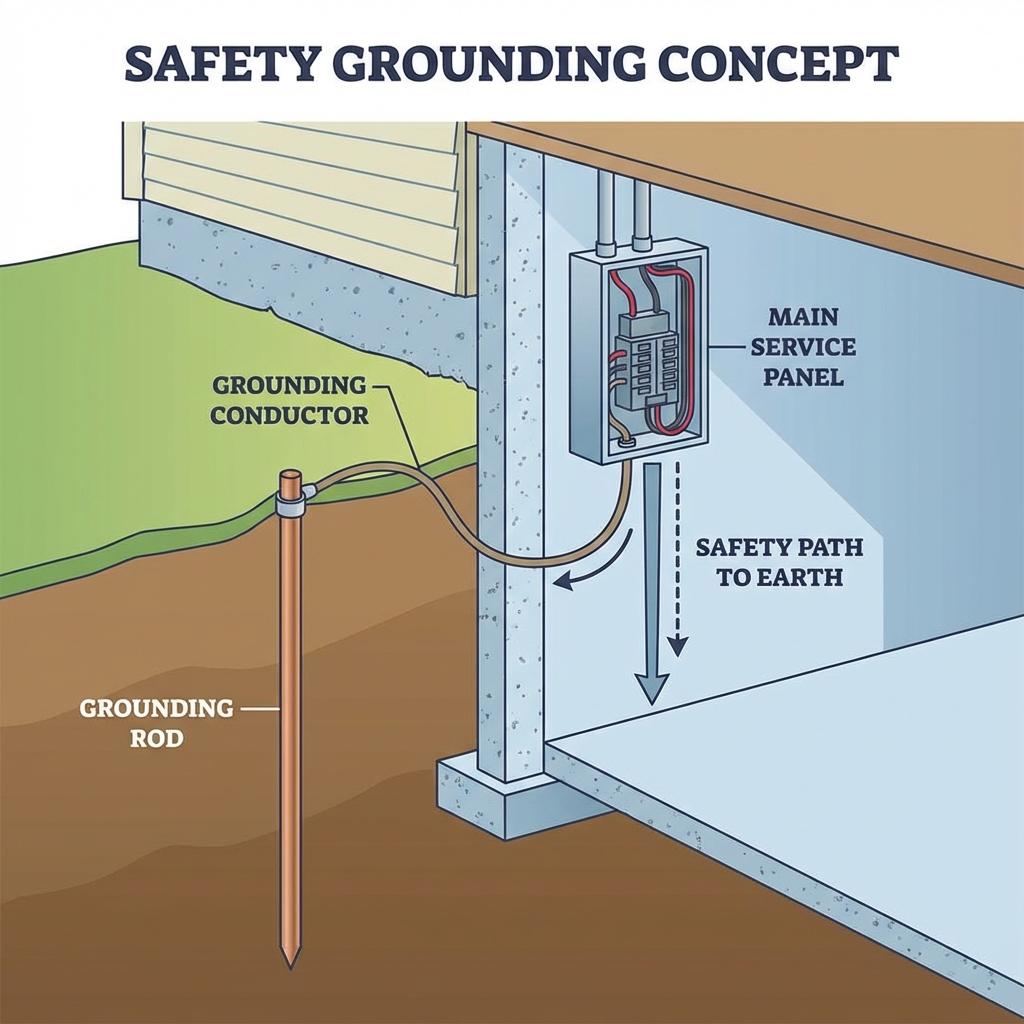
The ground wires from every circuit in your home connect to a grounding bus bar inside your electrical panel. This bus bar is connected to a grounding electrode conductor, which is a heavy copper wire that runs to a grounding electrode outside your home. The grounding electrode is typically an eight-foot copper-clad steel rod driven into the earth near the panel, though it can also be a connection to a metal water pipe or a concrete-encased electrode in the foundation. The NEC currently requires two grounding electrodes for most new installations to ensure a reliable earth connection even if one electrode is compromised.
Types of Grounding in Residential Wiring
Equipment Grounding
This is the ground wire, usually bare copper or green insulated wire, that runs with the hot and neutral wires in each circuit. It connects to the ground terminal on every outlet, switch box, and fixture along the circuit. In metal conduit systems, the conduit itself can serve as the equipment grounding path. Equipment grounding is what makes three-prong outlets safer than two-prong outlets; the third prong connects to this ground wire.
A professional electrical inspection identifies hidden hazards before they become emergencies. Our licensed electricians provide thorough safety inspections throughout Northern Virginia. Call (703) 997-0026 to schedule yours.
System Grounding
System grounding connects the neutral conductor of the electrical system to earth at the main panel. This establishes the voltage reference for the system and helps stabilize voltages during normal operation. The neutral-to-ground bond is made only at the main panel, not at sub-panels or downstream points.
Bonding
Bonding connects all metal components that could become energized during a fault, including the panel enclosure, metal water pipes, gas pipes, structural steel, and HVAC ductwork, to the grounding system. Bonding ensures that all of these components are at the same electrical potential, so no voltage difference exists between them that could cause a shock.
Many older homes in Northern Virginia were built before grounding was required by electrical code. Homes built before the mid-1960s typically have two-wire circuits with no ground conductor. While these homes have been occupied safely for decades, they lack the fault protection that grounding provides. When renovating or updating these homes, adding grounding to circuits is a priority safety improvement. In some cases, adding GFCI protection on ungrounded circuits provides an interim solution that protects against shock without requiring a complete rewire.
Why Grounding Matters
Preventing Electrical Shock
Grounding's primary purpose is protecting people from electrical shock during fault conditions. When a fault energizes an appliance housing or other metal surface, the ground wire diverts the current away from potential human contact and back to the panel where it trips the breaker. Without grounding, the fault may persist indefinitely until someone completes the circuit through their body.
Enabling Breaker Operation
A circuit breaker trips when it detects excessive current. During a ground fault, the fault current must flow through a low-resistance path to reach the magnitude needed to trip the breaker. The ground wire provides this low-resistance path. Without it, fault current may be limited by higher-resistance paths like the earth itself, and the breaker may never trip, leaving the fault energized indefinitely.
Lightning and Surge Protection
The grounding electrode system provides a path for lightning-induced surges and other transient voltages to dissipate into the earth. Without a solid grounding connection, these surges travel through your wiring and equipment, causing damage. Whole-house surge protectors depend on a good grounding system to divert surge energy effectively.
Reducing Electrical Noise
Sensitive electronic equipment, including computers, audio systems, and network equipment, can be affected by electrical noise on the power lines. Proper grounding helps stabilize voltage references and drain unwanted high-frequency noise to earth, improving equipment performance and reducing interference.
Signs of Grounding Problems
Shocks When Touching Appliances
If you feel a tingle or shock when touching an appliance, especially in combination with touching a faucet or other plumbing fixture, there may be a grounding fault. The appliance housing may be energized due to an internal fault, and the lack of a proper ground path means the fault current is seeking alternative routes, which now includes you.
GFCI Outlets That Will Not Reset
GFCI outlets monitor the balance between current on the hot and neutral conductors. Grounding faults that direct current through the ground wire instead of the neutral can cause persistent GFCI tripping. If a GFCI outlet will not stay reset, it may be detecting a genuine ground fault that needs investigation.
Buzzing or Humming Sounds
Poor grounding can cause audible buzzing in light fixtures, outlets, or the panel itself. The buzzing results from electromagnetic vibration that proper grounding would dampen. While not always dangerous, it indicates a grounding issue that should be evaluated.
Equipment Malfunctions
Computers that crash unexpectedly, audio equipment with persistent hum or buzz, and networked devices that behave erratically can all be symptoms of poor grounding. These symptoms often disappear when proper grounding is established.
You can check whether your outlets are grounded using an inexpensive outlet tester available at any hardware store. These testers plug into the outlet and use a combination of indicator lights to show whether the outlet is wired correctly, has proper grounding, and has correct polarity. However, an outlet tester only tells you about the outlet's wiring, not about the quality of the overall grounding system. A licensed electrician can test the grounding electrode system's resistance to earth, which determines how effectively your system can dissipate fault energy.
Upgrading Grounding in Older Homes
Adding Ground Wires
The most thorough approach to grounding an older home is running a ground wire from each outlet and switch back to the grounding bus bar in the panel. This can be done without replacing the existing hot and neutral wiring in some cases, particularly if the wiring runs through accessible attics, basements, or crawl spaces. This approach provides full equipment grounding at each outlet and allows the use of three-prong outlets.
GFCI Protection as an Interim Measure
The NEC allows GFCI outlets to be installed on ungrounded circuits as a replacement for two-prong outlets. The GFCI provides shock protection by detecting current imbalances, even without a ground wire. However, the outlet must be labeled "No Equipment Ground," and surge protectors connected to these outlets will not function as effectively without a ground path. GFCI protection is a practical interim measure but does not replace proper grounding for homes undergoing renovation.
Grounding Electrode Upgrades
If your home's grounding electrode system consists of a single ground rod installed decades ago, it may not provide adequate earth resistance for modern code compliance. Adding a second ground rod, separated from the first by at least six feet, is a standard upgrade. In some soil conditions common in parts of Northern Virginia, particularly areas with dense clay, additional grounding electrodes or ground enhancement materials may be needed to achieve the required earth resistance.
The Bottom Line on Grounding
Grounding is the silent protector of your electrical system. It does nothing under normal conditions and everything under fault conditions. Ensuring that your home's grounding system is complete, properly connected, and effective is one of the most important electrical safety measures you can take. If your home has two-prong outlets, if you experience shocks from appliances, or if you simply want to verify that your grounding system is performing as it should, contact AJ Long Electric at (703) 997-0026. Our licensed electricians evaluate and upgrade grounding systems for homeowners throughout Northern Virginia, providing the peace of mind that comes from knowing your safety system works when you need it.
Tags:

Written by
AJ Long Electric Team
Licensed Electricians
Our team of licensed electricians brings over 40 years of combined experience serving Northern Virginia. We're committed to providing expert electrical solutions with a focus on safety, quality, and customer satisfaction.
Reviewed by AJ Long Electric Master Electricians · VA License #2705031092 · View Credentials