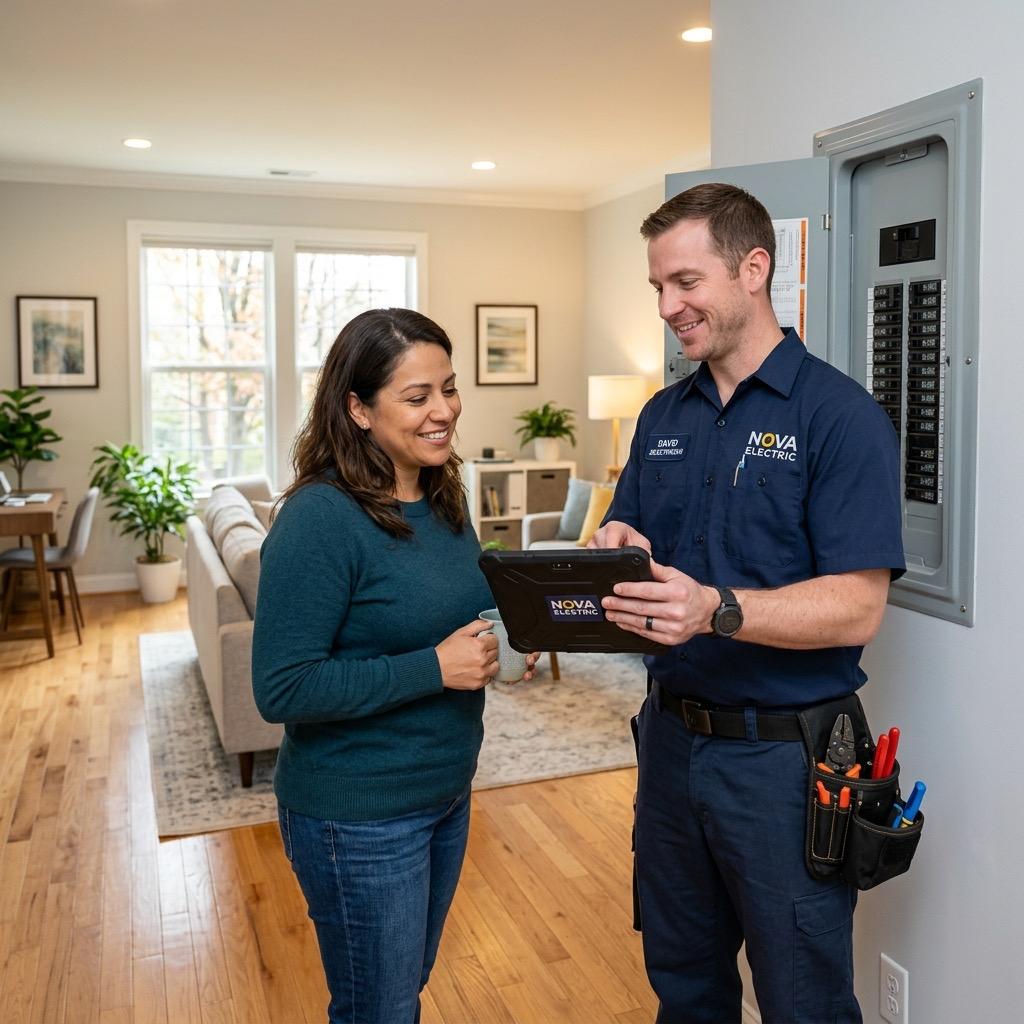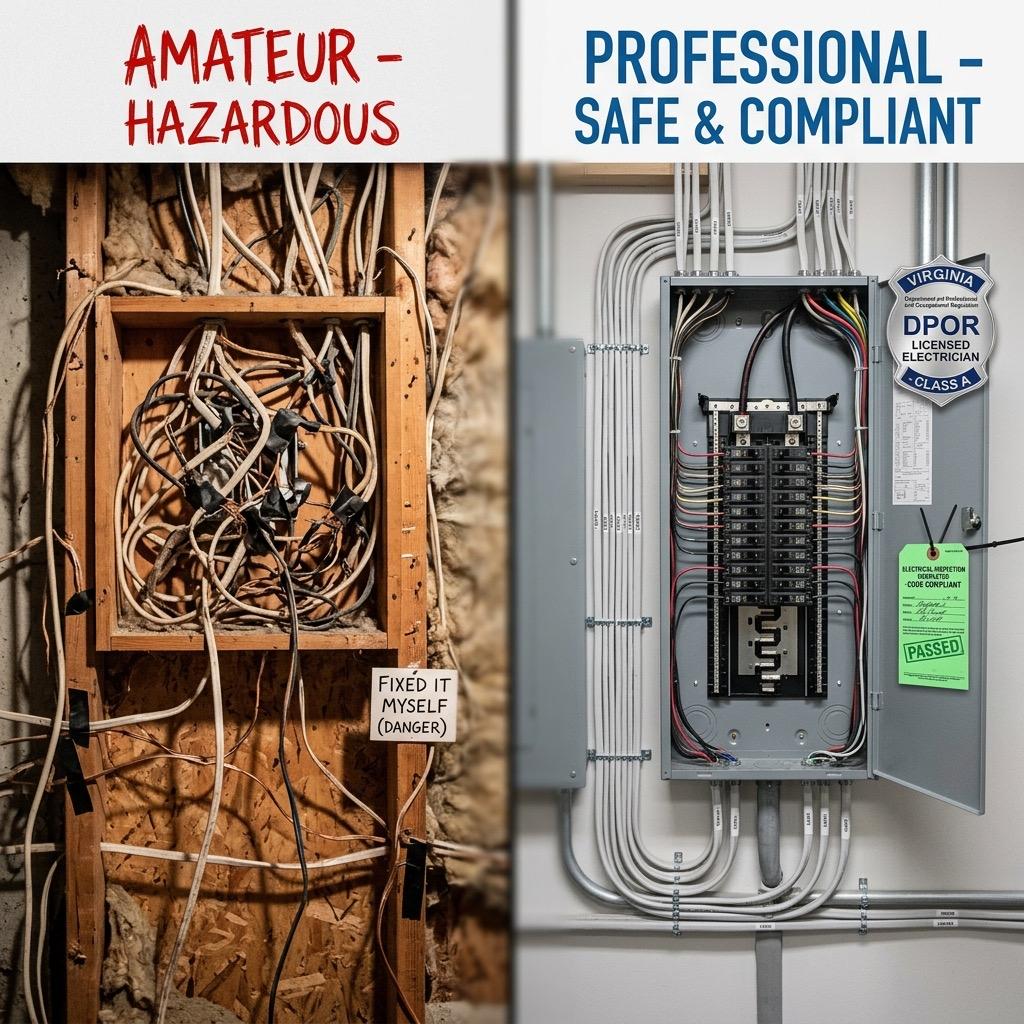
Hiring an electrician should never be a leap of faith. The right questions, asked before any contract is signed, reveal whether a contractor is truly qualified, properly insured, and the right fit for your specific project. For Fairfax County homeowners in particular, the stakes are high -- the county has some of the most rigorous electrical inspection requirements in Virginia, and work done by underqualified contractors routinely fails these inspections, leaving homeowners on the hook for expensive corrections.
Key Takeaways
- Ask for the DPOR license number upfront and verify it yourself at dpor.virginia.gov -- legitimate contractors will never hesitate to provide it.
- Fairfax County requires permits for virtually all electrical work beyond simple device replacement -- a contractor who says "we don't need a permit" for panel work, new circuits, or rewiring is almost certainly wrong.
- Workers' compensation coverage is not optional -- if an uninsured worker is injured on your property, you may be liable under Virginia law.
- Asking for local references from Fairfax County specifically weeds out contractors who may be licensed but unfamiliar with the county's specific inspection process and code interpretations.
- Payment structure matters -- reputable contractors require a modest deposit (10--15%) with the balance due after satisfactory completion, not full payment upfront.
After more than 15 years serving Fairfax County homeowners from our base in Northern Virginia, AJ Long Electric has heard every variation of these questions. The homeowners who ask them upfront almost always have better outcomes. The ones who don't often call us later to fix problems created by contractors who should never have been hired.
Question 1: Can I See Your DPOR License Number?
This is the first and most important question, and the answer should come without hesitation. Virginia requires every electrician to hold a current license from the Department of Professional and Occupational Regulation. Ask specifically for the license number, not just a verbal assurance of licensure. Then verify it yourself at dpor.virginia.gov before the contractor leaves your home.
The right answer gives you the license number immediately and invites you to verify it. Any deflection -- "I have it in my truck," "my company handles that," or "you can trust me" -- is a serious red flag. In 2025, Fairfax County Building and Development Services reported that approximately 12% of electrical permits pulled in the county involved violations related to license discrepancies or unlicensed subcontractors.
Red Flag: If an electrician says their license is "in process" or "being renewed," do not hire them for any work that requires a permit. In Virginia, a lapsed license means the contractor is legally prohibited from performing or supervising electrical work.
Question 2: Do You Carry General Liability and Workers' Compensation Insurance?
Liability insurance protects your property; workers' compensation protects you from being held liable if a worker is injured. Both are non-negotiable. Ask for certificates of insurance -- actual documents, not verbal assurances -- and verify that the coverage limits are adequate for your project.
A professional electrical inspection identifies hidden hazards before they become emergencies. Our licensed electricians provide thorough safety inspections throughout Northern Virginia. Call (703) 997-0026 to schedule yours.
For most residential work in Fairfax County, $1 million in general liability is the minimum acceptable threshold. Commercial work warrants $2 million or more. Workers' compensation coverage should match the number of employees the contractor regularly deploys. Virginia law requires workers' comp for any employer with three or more employees, but many smaller contractors try to avoid it by misclassifying employees as independent contractors.
Question 3: Will You Pull the Required Permits?
Fairfax County requires permits for virtually all electrical work beyond simple device replacement (swapping an outlet, replacing a switch). Panel upgrades, new circuits, EV charger installations, whole-home generators, and rewiring all require permits and inspections. A contractor who suggests bypassing the permit process is not saving you time or money -- they are shifting enormous risk onto you.
Unpermitted electrical work can void your homeowner's insurance, create liability issues if a fire occurs, and must be disclosed when you sell your home. Fairfax County has become increasingly aggressive in pursuing unpermitted work, with enhanced tools to identify suspicious patterns in permit records. The permit fee on a typical residential project is a small fraction of the total project cost -- there is no legitimate reason for a professional to skip it.
Pro Tip: You can verify open permits and inspection results for any address in Fairfax County through the county's online permit portal at fairfaxcounty.gov/permits. This also lets you confirm that a contractor actually pulled the permit they claimed to pull.
Question 4: Who Will Be On-Site Doing the Work?
Many electrical contractors operate as general contractors who subcontract the actual work to others. The licensed electrician who quoted your job may never set foot on your property. Ask specifically whether the crew that performs the work will be employees of the company, and whether a licensed electrician (not an apprentice working alone) will be on-site throughout the project.
Virginia DPOR regulations require that a licensed electrician supervise all electrical work performed by apprentices or journeymen in training. This supervision must be active and direct -- not a phone call away. Projects where unsupervised apprentices perform work are a code violation and a safety risk, even when the principal contractor holds a valid Master Electrician license.
Question 5: Can You Provide References From Similar Projects in Fairfax County?
References from comparable projects in the same jurisdiction are significantly more valuable than generic testimonials. Fairfax County has its own code amendments, specific inspector preferences, and inspection scheduling processes that contractors learn through experience. A contractor who has completed dozens of panel upgrades in McLean, Reston, or Burke will navigate the Fairfax County inspection process far more efficiently than someone who primarily works in Prince William or Loudoun County.
Ask for two or three references from projects completed in the past 12 months. Call them. Ask not just whether the work was done correctly, but whether it passed inspection on the first attempt, whether the timeline was honored, and how the contractor handled any unexpected issues.
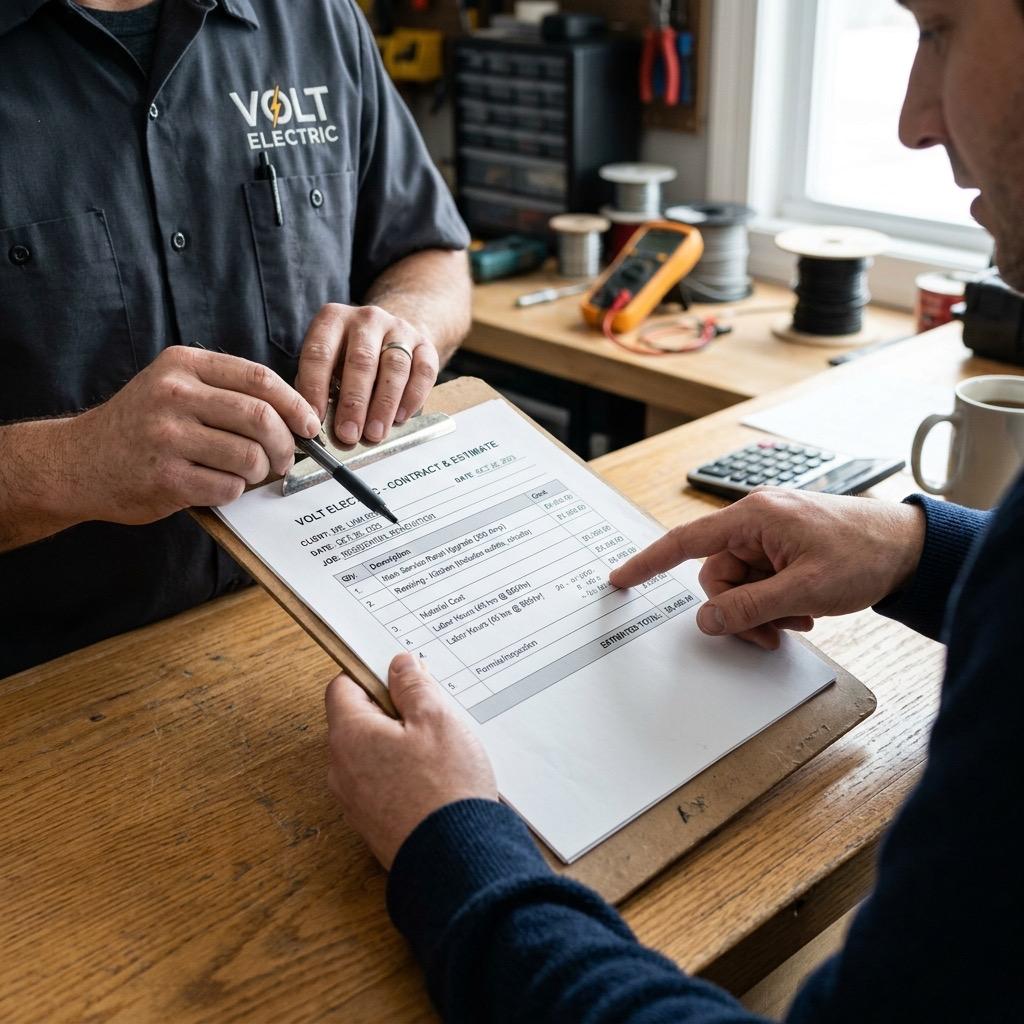
Question 6: What Is Included in Your Written Quote?
A professional quote should itemize labor, materials, permit fees, and any contingencies. It should specify the grade of materials (residential-grade vs. commercial-grade breakers, for example), the payment schedule, and what happens if unexpected conditions are discovered once work begins. Vague quotes are an invitation to disputes.
According to the Better Business Bureau's 2024 data for the Washington DC metro area, billing disputes were the most common complaint category for electrical contractors -- accounting for 38% of all complaints filed. The majority of these disputes involved homeowners who accepted verbal quotes or imprecise written estimates without itemized breakdowns.
Fairfax County Context: Panel upgrades in Fairfax County typically run $3,500--$5,500 for a 200-amp service with permit and inspection. New circuit installation runs $350--$650 per circuit depending on complexity and access. EV charger installations (Level 2, dedicated 240V circuit) typically run $800--$1,500 including the outlet and permit.
Question 7: What Is Your Timeline and How Do You Handle Delays?
Electrical projects often reveal unexpected conditions -- aluminum wiring in older homes, undersized service entrances, or code violations from previous work. Ask how the contractor communicates unexpected findings and what the process is for adjusting scope and price. A contractor who cannot articulate a clear communication protocol for change orders is a contractor who will create unpleasant surprises.
Also ask about inspection scheduling. Fairfax County's inspection scheduling can add days to a project timeline, and experienced local contractors build this into their estimates. A contractor who quotes a two-day timeline for a panel upgrade without accounting for inspection scheduling has likely not worked extensively in the county.
Question 8: Do You Offer a Written Warranty?
Most reputable electricians in Northern Virginia offer a one-year workmanship warranty on their labor. Some extend this to two years for major projects like panel upgrades or whole-home rewiring. Materials are typically covered by manufacturer warranties, which a professional contractor will register on your behalf. Get any warranty terms in writing, including what is covered, what voids the warranty, and how to file a claim.
Question 9: What Are Your Payment Terms?
Industry-standard payment terms for residential electrical work in Northern Virginia call for a deposit of 10--15% to schedule the job, with the balance due on satisfactory completion. Be cautious of contractors who require 50% or more upfront, and never pay in full before work is complete. Cash-only contractors who cannot accept check or credit card should raise immediate concern, as they often lack the business infrastructure of legitimate contractors.
Question 10: How Long Have You Been Operating in Northern Virginia?
Longevity in a specific market is a meaningful indicator of quality and reliability. A contractor who has operated in Fairfax County for ten or more years has navigated multiple code cycles, built relationships with local inspectors, and developed systems for consistent quality. New entrants to the market are not automatically unqualified, but a track record of local work is a valuable differentiator.
AJ Long Electric has operated in Northern Virginia since 2010 and can answer every one of these questions with documentation in hand. We are DPOR-licensed, fully insured, and pull permits on every job. Call us at (703) 997-0026 to schedule a free estimate for your Fairfax County home or business -- we serve McLean, Reston, Burke, Springfield, Herndon, Vienna, and all surrounding communities.
Tags:

Written by
Matt Long
Master Electrician
Our team of licensed electricians brings over 40 years of combined experience serving Northern Virginia. We're committed to providing expert electrical solutions with a focus on safety, quality, and customer satisfaction.
Reviewed by AJ Long Electric Master Electricians · VA License #2705031092 · View Credentials