Every year, hundreds of Virginia homeowners discover the hard way that the electrician they hired was never licensed at all. The consequences range from expensive reinspection and corrective work to insurance claim denials, failed home sales, and in the worst cases, electrical fires traced to substandard work. In a region where the cost-of-living premium makes unlicensed contractors tempting, understanding the real risks is essential before any hiring decision.
Key Takeaways
- Virginia law requires DPOR licensure for all electrical work beyond basic homeowner repairs -- hiring an unlicensed contractor is illegal and exposes you to serious financial and legal risk.
- Unlicensed work almost never gets permitted or inspected, meaning failures may stay hidden until they cause fires, fails home inspections, or trigger insurance disputes.
- Homeowner's insurance policies typically exclude coverage for damage caused by or related to unlicensed contractor work -- a fire from unlicensed wiring could leave you with no coverage.
- Virginia Code allows DPOR to pursue civil penalties against unlicensed contractors, but recovery is difficult -- many operate without assets or disappear after the job.
- The upfront savings from an unlicensed contractor (typically 20--40%) are routinely wiped out by corrective work, failed inspections, and insurance complications.
AJ Long Electric regularly receives calls from Northern Virginia homeowners who need code-compliant corrections to work done by unlicensed contractors. The pattern is consistent: the initial price looked appealing, the work seemed fine visually, but something eventually went wrong -- a tripped breaker that wouldn't reset, a burning smell from a wall, a failed home inspection that uncovered unpermitted wiring. This post is designed to help you avoid becoming one of those calls.
What Virginia Law Actually Requires
Virginia Code Title 54.1 and the regulations administered by DPOR establish clear requirements for electrical contractor licensing in the Commonwealth. Anyone who performs electrical work for compensation -- other than a licensed homeowner performing work on their own primary residence -- must hold a current DPOR electrical license. There are no exceptions for "handymen," "general contractors who know electrical," or "my brother-in-law who does this on the side."
Virginia's licensing tiers for electricians are: Apprentice (must work under direct supervision), Journeyman (can work independently, cannot pull permits), and Master Electrician (can pull permits, design systems, supervise all work). Any permitted electrical project in Virginia requires a Master Electrician as the responsible party. Permits cannot be legally obtained by anyone holding only a Journeyman license or no license at all.
DPOR's enforcement division investigates complaints against unlicensed contractors and can assess civil penalties of up to $2,500 per violation. In 2024, DPOR issued penalties totaling more than $890,000 against unlicensed contractors statewide, with Northern Virginia accounting for approximately 35% of all enforcement actions. Unlicensed electrical work was among the most frequently cited categories.
Virginia Law Alert: Under Virginia Code § 54.1-1115, it is unlawful to engage in the business of contracting without the appropriate license. This applies to the contractor -- but homeowners who knowingly hire unlicensed contractors for permitted work can face complications with local building departments, insurance carriers, and future buyers. Document your contractor's license verification before authorizing any work.
The Insurance Trap: Why Unlicensed Work Voids Your Coverage
Most homeowners assume their homeowner's insurance covers everything that goes wrong in their home. This assumption is dangerously wrong when unlicensed electrical work is involved. A standard homeowner's insurance policy contains exclusions for damage caused by or attributable to work performed in violation of applicable laws and regulations -- and in Virginia, unlicensed electrical work is a violation of applicable law.
A professional electrical inspection identifies hidden hazards before they become emergencies. Our licensed electricians provide thorough safety inspections throughout Northern Virginia. Call (703) 997-0026 to schedule yours.
The practical consequence: if an unlicensed contractor wires a new circuit incorrectly and an arc fault causes a fire two years later, your insurance carrier has strong grounds to deny the claim if they discover the work was unpermitted and unlicensed. The investigation that follows a major fire almost always includes a review of electrical permits and inspection records. A gap in that record is a red flag that adjusters are trained to pursue.
A 2023 study by the Insurance Information Institute found that insurance carriers denied fire claims related to unpermitted work at a rate of approximately 18% nationally -- and in states with active enforcement like Virginia, that rate was higher. In the DC metro area, where home values frequently exceed $600,000 to $1 million or more, an 18% chance of claim denial represents a catastrophic financial risk.
The Hidden Cost of Failed Inspections
When unlicensed contractors skip the permit process -- which they almost always do, since they cannot legally obtain permits -- the work is never inspected. This creates a time bomb: code violations that are invisible until they cause a problem or are discovered by a home inspector or future electrician.
In Fairfax County, Loudoun County, and Arlington County, home inspectors increasingly flag electrical work that appears to have been performed without permits. Buyers' agents in Northern Virginia have become sophisticated about pulling permit history for properties, and unexplained electrical improvements without corresponding permits are a standard disclosure and negotiation issue. Sellers who have unlicensed work in their homes often face one of three outcomes: price reductions, required corrective work before closing, or deals that fall apart entirely.
The corrective work itself is almost always more expensive than a legitimate permitted job would have been. Opening walls to inspect hidden wiring, having the work redone by a licensed contractor, pulling retroactive permits (not always possible), and scheduling multiple inspections can easily double or triple the original cost of the work.
Northern Virginia Real Estate Impact: In the 2024 NoVA real estate market, homes with unpermitted electrical work disclosed at inspection sold for an average of 2.3% below listing price after negotiation -- on a $750,000 home, that's $17,250. Corrective electrical work to bring unpermitted systems into code compliance in Fairfax County averaged $4,800 per project in 2024 data from local permit records.
Safety Consequences: What Unlicensed Work Actually Looks Like
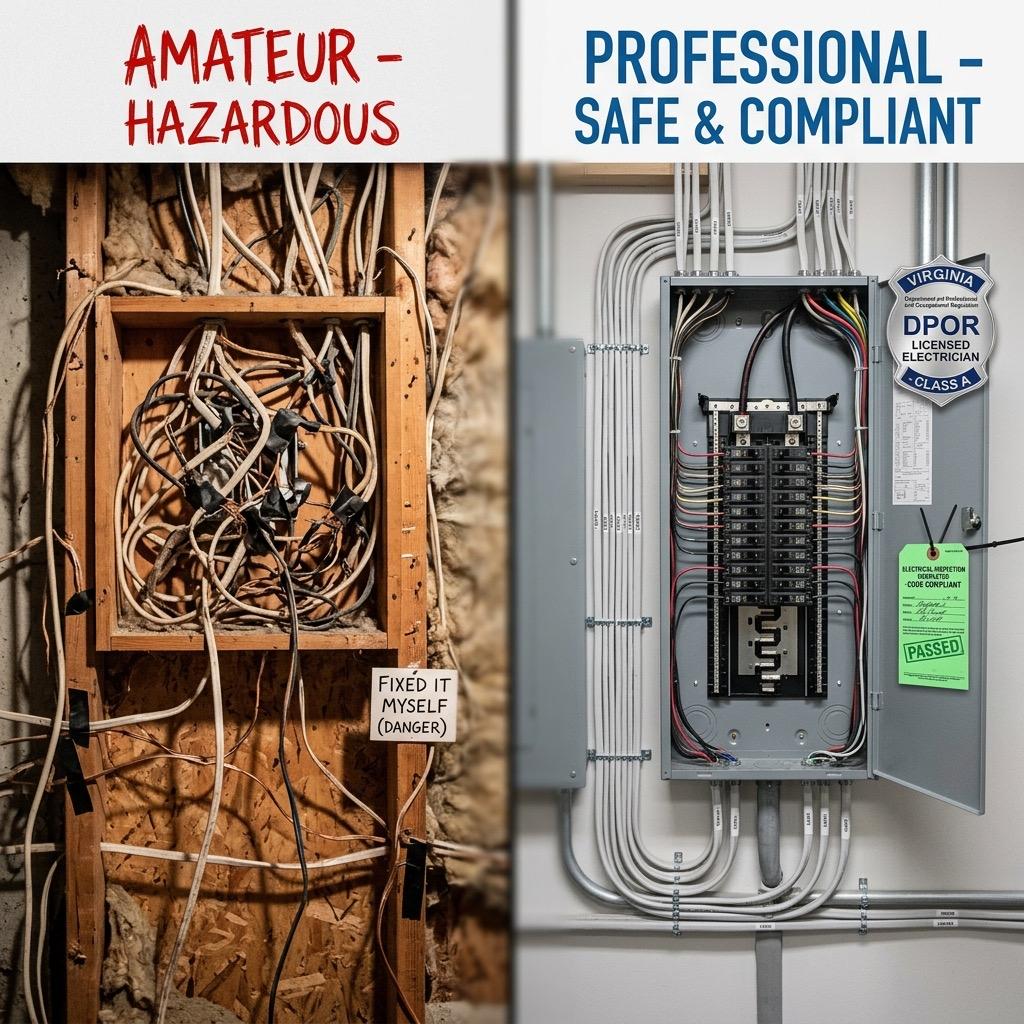
Unlicensed electrical contractors operate without the training, examination, and ongoing education requirements of licensed electricians. The results are often visually indistinguishable from properly licensed work -- until something goes wrong. Common deficiencies found in unlicensed work include incorrect wire gauge for circuit amperage, missing arc-fault (AFCI) protection in required locations, improper splices outside of accessible junction boxes, undersized neutrals on multi-wire branch circuits, and amateur panel modifications that violate clearance, labeling, and installation requirements.
These deficiencies don't always cause immediate problems. A wire that's one gauge undersized for its circuit load may run safely for years under normal conditions and fail catastrophically under peak load. A missing AFCI breaker may never be noticed until an arc fault occurs. This is precisely why the inspection process exists -- trained inspectors are specifically looking for these subtle but dangerous deviations from code.
The NFPA estimates that electrical fires cause approximately $1.5 billion in property damage annually in the United States. A disproportionate share of these fires occurs in homes where unpermitted, uninspected work has been performed. In Northern Virginia, where home values and density amplify the stakes, the argument for licensed, permitted work is overwhelming.
How to Identify Unlicensed Contractors Before You Hire
Unlicensed contractors are not always obvious. Many have professional-looking websites, glowing reviews (often from customers who don't know their contractor was unlicensed), and plausible-sounding explanations for why a permit isn't necessary. Here's how to protect yourself:
- Always ask for the DPOR license number and verify it yourself at dpor.virginia.gov. The lookup is free and takes two minutes.
- Be skeptical of contractors who say permits aren't required for panel work, new circuits, EV charger installation, generator hookup, or rewiring -- these almost always require permits in Northern Virginia jurisdictions.
- Unusually low bids warrant investigation -- if a quote is 30--50% below other estimates, determine exactly why before accepting it.
- Cash-only payment requirements are a consistent indicator of unlicensed or underinsured operation.
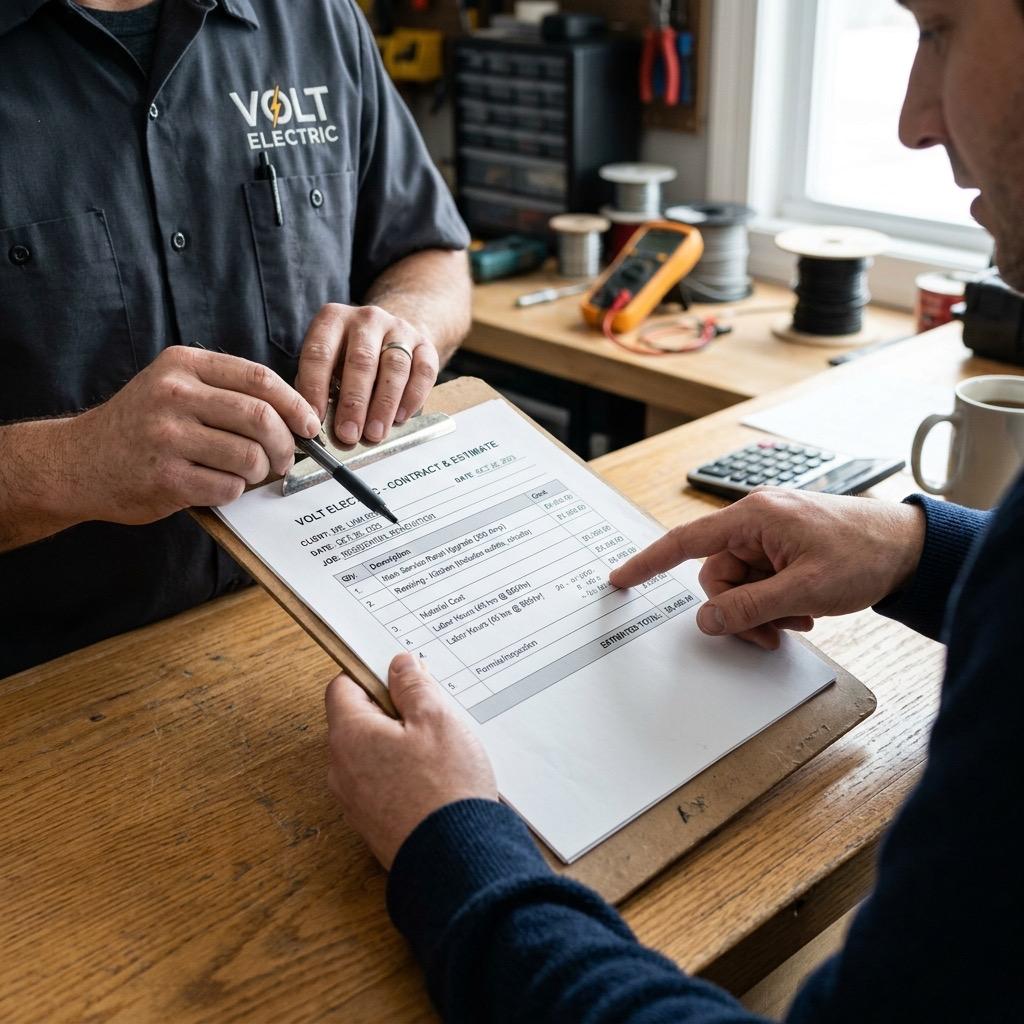
- No written contract or itemized quote is a serious professional red flag, regardless of licensing status.
Quick Verification: Go to dpor.virginia.gov, click "License Lookup" under the Consumers tab, and search by the contractor's name or company name. You'll see their license type, number, expiration date, and any disciplinary history. This takes less than two minutes and can save you from a very expensive mistake.
The Bottom Line: Licensed Work Is Always the Right Investment
The apparent savings from unlicensed electrical work -- typically 20--40% less than a properly licensed and permitted job -- evaporate quickly when you factor in the risks: corrective work after a failed home inspection, insurance complications, potential code enforcement actions, and the safety risk to your family. Over a 10-year ownership horizon, homeowners who consistently use licensed, permitted electrical contractors spend less, have fewer problems, and sell their homes more easily than those who cut corners.
AJ Long Electric is fully licensed with Virginia DPOR, carries comprehensive liability and workers' compensation insurance, and pulls permits on every job in Northern Virginia. If you've had unlicensed work done and need a professional assessment, or if you want a quote on upcoming work from a contractor you can trust, call us at (703) 997-0026. We serve Fairfax County, Arlington, Alexandria, Loudoun County, Prince William County, and all surrounding communities in the greater DC metro area.
Tags:

Written by
Matt Long
Master Electrician
Our team of licensed electricians brings over 40 years of combined experience serving Northern Virginia. We're committed to providing expert electrical solutions with a focus on safety, quality, and customer satisfaction.
Reviewed by AJ Long Electric Master Electricians · VA License #2705031092 · View Credentials