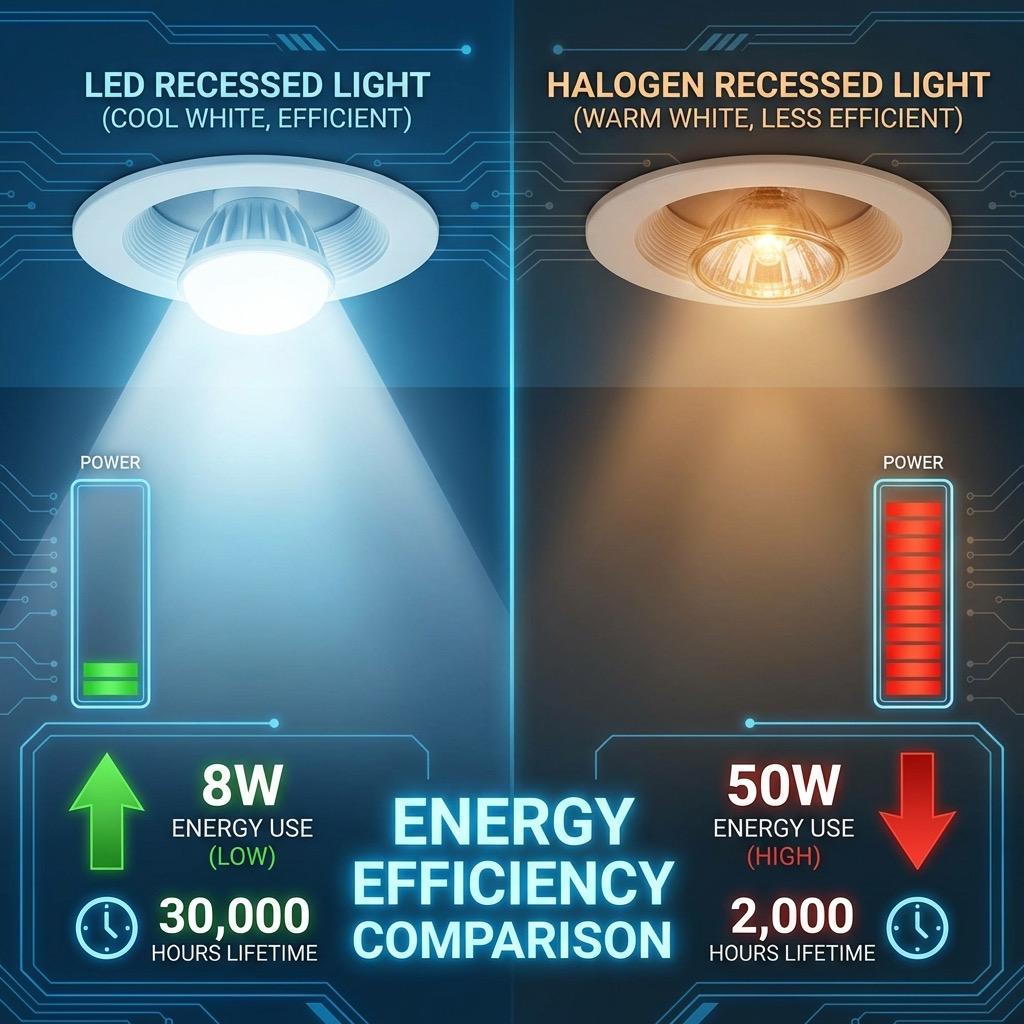
If your home was built before 2015, chances are you have halogen recessed lights throughout. While halogens served us well for decades, LED technology has advanced dramatically, offering compelling reasons to upgrade. Let us explore whether converting to LED makes sense for your Northern Virginia home.
Key Takeaways
- LED recessed lights use 75-80% less energy than halogen, saving a typical NoVA home with 20 fixtures around $280 per year on electricity alone.
- LEDs last 25,000-50,000 hours versus 2,000-4,000 for halogen, meaning you may never replace them again.
- Halogen bulbs convert roughly 90% of energy into heat, increasing summer cooling costs and posing insulation fire risks. LEDs run cool.
- The investment pays for itself in approximately 1.5-2.5 years, after which you save $400+ annually.
- Modern LEDs achieve CRI 90-95 and offer tunable color temperatures, smart home integration, and smooth dimming.
Understanding the Technology
How Halogen Lights Work
Halogen bulbs are an improved version of traditional incandescent lights. A tungsten filament inside a halogen gas-filled envelope heats up to produce light. This technology is proven and produces warm, high-quality light, but at a cost of significant energy consumption and heat generation.
How LED Lights Work
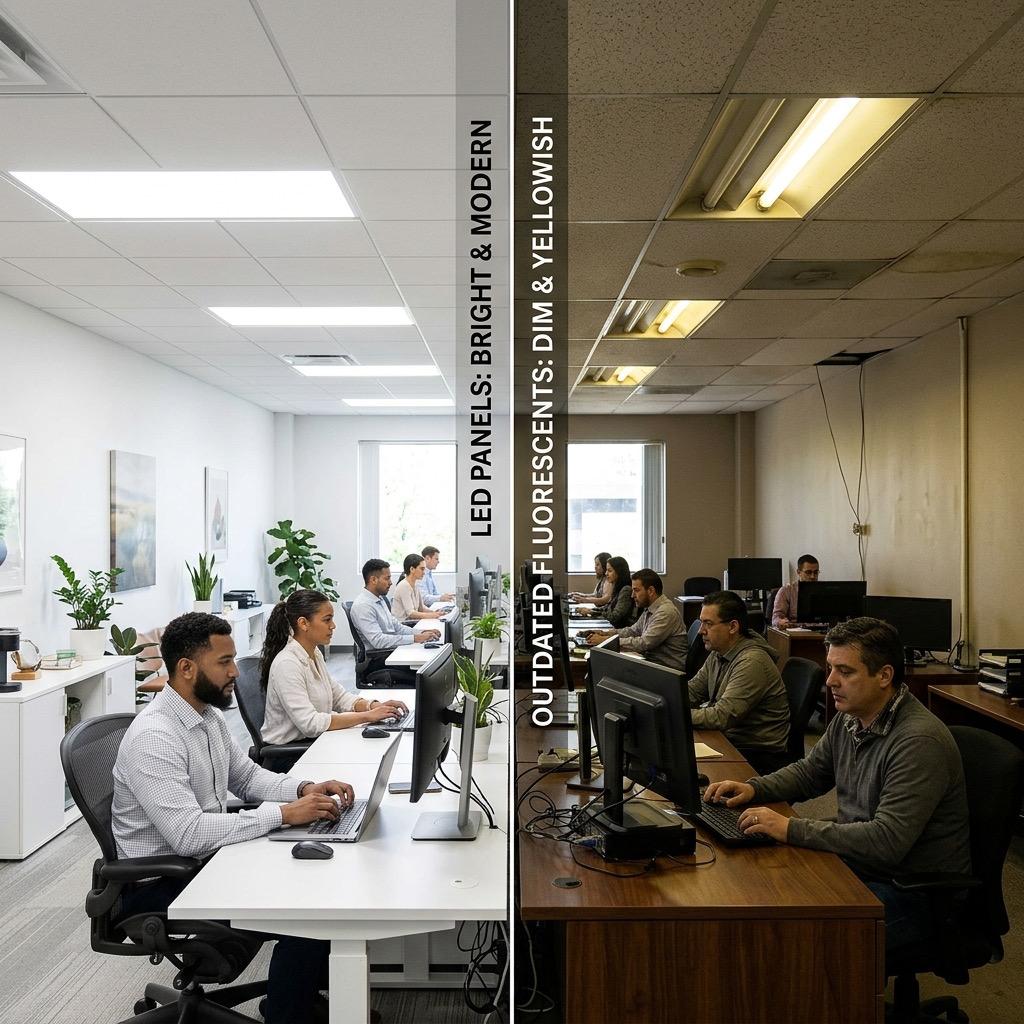
LED (Light Emitting Diode) technology creates light through electroluminescence, where electrons moving through a semiconductor material emit photons. This process is inherently more efficient, producing light with minimal heat. Modern LED recessed lights can match or exceed halogen light quality while using 75-80% less energy.
LED vs Halogen: Complete Comparison
| Feature | Halogen Recessed | LED Recessed |
|---|---|---|
| Wattage (equivalent brightness) | 65W | 8-12W |
| Lifespan | 2,000-4,000 hours | 25,000-50,000 hours |
| Annual cost (20 fixtures, 5 hrs/day) | ~$331 | ~$51 |
| Color Rendering Index (CRI) | 100 | 90-95 (quality brands) |
| Heat output | High (~90% of energy) | Low (minimal) |
| Dimming | Smooth with any dimmer | Smooth with compatible dimmer |
| Color temperature options | Warm only (~3000K) | 2700K-5000K selectable |
| Smart home integration | None | Available on many models |
| Bulb cost per unit | $3-$8 | $15-$40 (retrofit kit) |
| Replacement frequency (5 hrs/day) | Every 1-2 years | Every 13-27 years |
Energy Savings Breakdown
The most compelling reason to switch to LED is energy savings. A typical 65-watt halogen PAR30 bulb can be replaced by an 8-12 watt LED producing equivalent light output. For a home with 20 recessed lights used 5 hours daily with Dominion Energy rates:
Whether it is a simple repair or a major electrical project, our licensed team is ready to help. Serving all of Northern Virginia with transparent pricing and expert workmanship. Call (703) 997-0026 today.
- Halogen annual cost: 20 lights x 65W x 5 hours x 365 days x $0.14/kWh = $331/year
- LED annual cost: 20 lights x 10W x 5 hours x 365 days x $0.14/kWh = $51/year
- Annual savings: $280 on electricity alone
When you factor in reduced AC costs from less heat output ($50-$100/year) and fewer bulb replacements ($100/year), total annual savings reach $430-$480.
Pro Tip: When upgrading to LED recessed lights, always replace your old halogen dimmers with LED-compatible dimmers like Lutron Caseta or Diva. Using old dimmers with LEDs commonly causes flickering and buzzing. We upgrade three to four dimmers per LED conversion project on average across our Northern Virginia service area.
Heat Reduction and Safety
Halogen recessed lights are essentially small heaters in your ceiling. A 65-watt halogen bulb converts about 90% of its energy into heat, creating several problems: increased air conditioning costs in summer, potential fire hazard if insulation contacts the fixture, discoloration of ceiling paint around fixtures, and uncomfortable heat in rooms with many fixtures. LED lights run cool to the touch, eliminating these concerns entirely.
In many Northern Virginia homes built in the 1990s and 2000s, we find halogen cans pushed up against attic insulation. Converting to IC-rated LED fixtures or retrofit kits removes this fire risk completely.
Conversion Options and Costs
Option 1: LED Retrofit Kits
The simplest upgrade path uses LED retrofit kits that screw into your existing halogen cans. These kits include the LED module and a new trim ring. Installation takes about 5 minutes per fixture. Cost: $15-$40 per fixture. Best for DIY homeowners and budget-conscious upgrades.
Option 2: Integrated LED Fixtures
For new construction or major renovations, integrated LED fixtures replace the entire recessed housing. These offer the best efficiency and light distribution but require electrical work. Cost: $40-$100 per fixture plus installation.
Option 3: Canless LED Downlights
Modern canless LED lights mount directly to the ceiling without traditional recessed housing. They are thinner, more efficient, and easier to install in retrofit situations with low-clearance ceilings. Cost: $25-$60 per fixture plus installation.
ROI Calculation: A typical 20-light LED conversion in Northern Virginia costs $620-$1,020 including retrofit kits, dimmer upgrades, and optional professional installation. With $430-$480 in annual savings, the investment pays for itself in 1.5-2.5 years. After that, every dollar saved goes straight to your bottom line.
What to Look for in LED Recessed Lights
Essential Specifications
- Lumens: Match halogen output (650-700 lumens replaces 65W halogen)
- Color temperature: 2700K-3000K for warm residential lighting
- CRI: 90+ for best color rendering
- Dimmable: Ensure compatibility with your dimmers
- IC-rated: Safe for insulation contact if needed
- Warranty: Minimum 5-year warranty
Recommended Brands
Based on our installation experience across thousands of Northern Virginia homes, these brands consistently perform well: Halo (Cooper Lighting) for excellent retrofit kits, Lithonia for great value, WAC Lighting for premium quality with exceptional dimming, and Philips for strong smart home integration options.
Our Verdict
For most homeowners, upgrading from halogen to LED recessed lights is a clear win. The combination of 75% energy savings, dramatically longer lifespan, reduced heat, and improved lighting control makes LED the obvious choice. The only scenarios where keeping halogen might make sense are if you are selling your home within 1-2 years and will not recoup the investment, if you have specialized art lighting requiring perfect CRI 100 rendering, or if you use the lights very infrequently.
AJ Long Electric provides professional LED conversion services throughout Northern Virginia. We assess your existing fixtures, recommend the right products, upgrade your dimmers, and ensure perfect dimming performance. Contact us for a free lighting consultation.
Tags:

Written by
Matt Long
Master Electrician
Our team of licensed electricians brings over 40 years of combined experience serving Northern Virginia. We're committed to providing expert electrical solutions with a focus on safety, quality, and customer satisfaction.
Reviewed by AJ Long Electric Master Electricians · VA License #2705031092 · View Credentials