Virginia is one of the fastest-growing EV markets on the East Coast, and Northern Virginia homeowners are installing Level 2 chargers at a record pace. Whether you drive a Tesla Model Y, Ford F-150 Lightning, or Rivian R1T, the first question your electrician will ask is: hardwired or plug-in? The answer affects your charging speed, flexibility, costs, and long-term options more than most people realize. Here is the complete comparison for Virginia homeowners.
Key Takeaways
- Hardwired chargers connect permanently to a dedicated circuit and can deliver up to 80 amps (19.2 kW), while plug-in chargers on a NEMA 14-50 outlet are code-limited to 40 amps (9.6 kW) continuous.
- Installation costs in Northern Virginia are similar — $800–$1,500 for either approach — but plug-in adds the cost of a commercial-grade outlet ($50–$100) and slightly reduces maximum charging speed.
- Virginia Code and NEC 625 require EV charging circuits to be rated for continuous load: the breaker must be rated at 125% of the charger's maximum draw.
- Homeowners who may move, rent their home, or want to upgrade chargers without an electrician benefit significantly from plug-in installation.
- Dominion Energy Virginia offers rebates up to $125 for Level 2 charger installation; both hardwired and plug-in qualify.
The Core Difference Between Hardwired and Plug-In EV Chargers
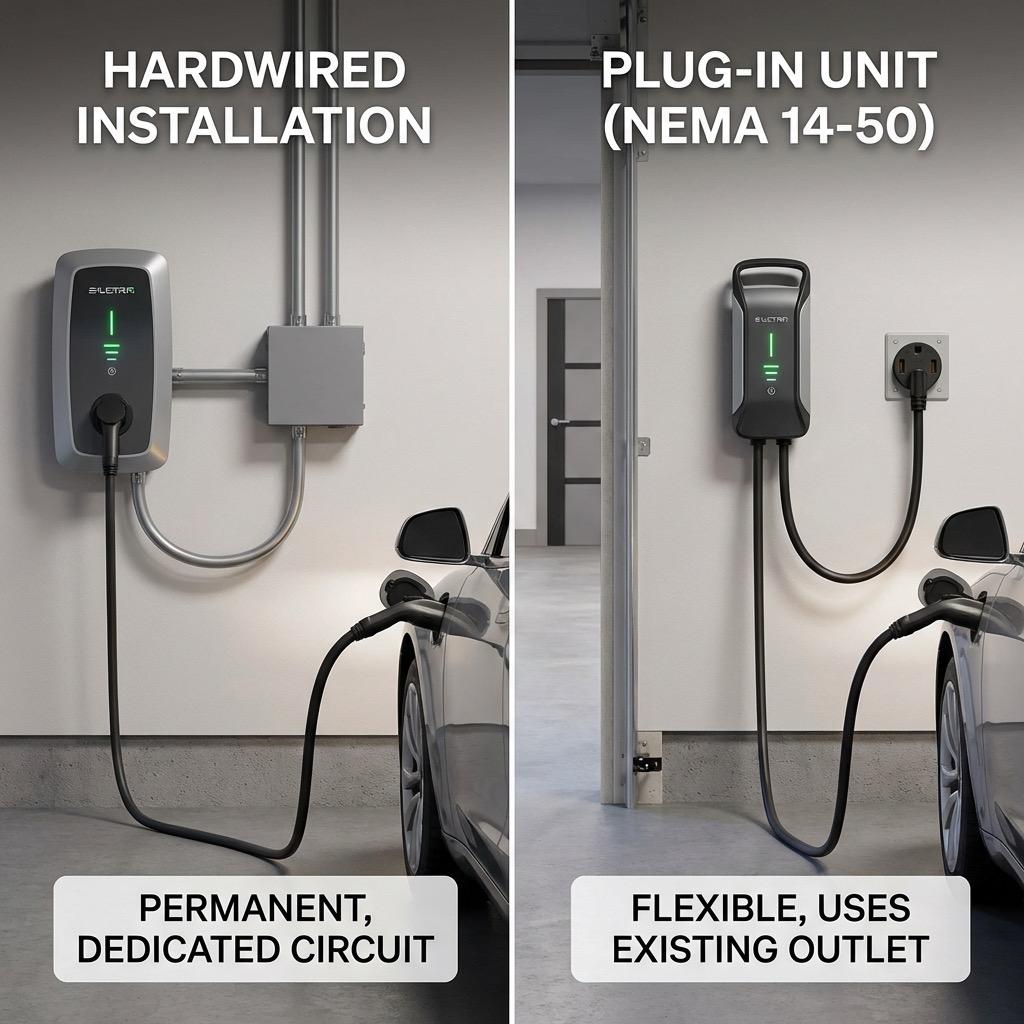
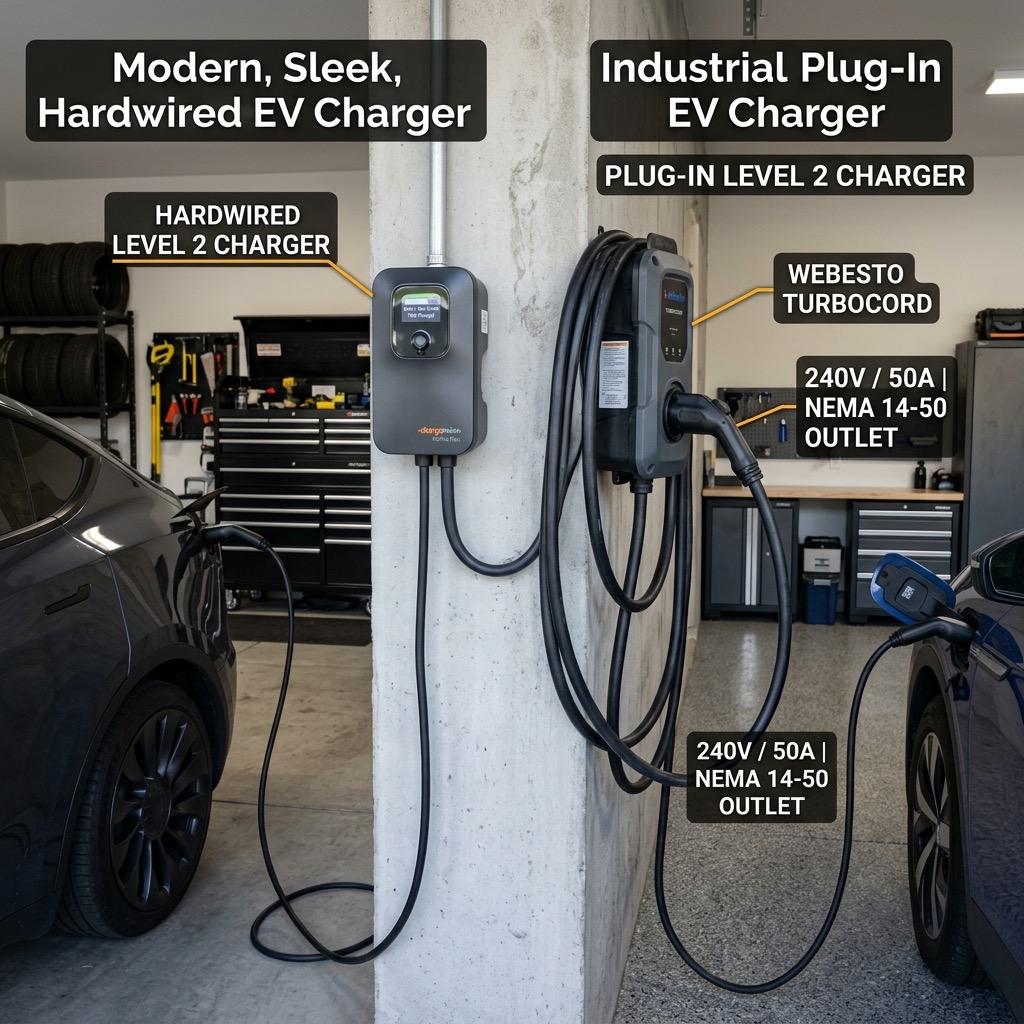
A hardwired EV charger — also called a directly connected or permanently wired charger — has its supply cable connected directly to a junction box or conduit system terminating inside the unit, with no plug or outlet involved. The charger becomes a fixed appliance, like a built-in oven. By contrast, a plug-in EV charger uses a molded plug (most commonly NEMA 14-50 or NEMA 6-50) that inserts into a matching high-capacity receptacle mounted in the garage. Pull the plug and the charger moves with you.
According to the Electric Vehicle Institute, approximately 80% of EV charging in the United States occurs at home, making this installation decision one of the most consequential you will make as an EV owner. In Virginia, where average round-trip commutes in Fairfax and Loudoun counties exceed 45 miles, having a robust home charging setup is not optional — it is essential.
Hardwired vs Plug-In: Full Virginia Comparison
| Factor | Hardwired Installation | Plug-In (NEMA 14-50 / 6-50) |
|---|---|---|
| Max continuous amperage | Up to 80A (charger dependent) | 40A (80% of 50A outlet) |
| Max charging speed | Up to 19.2 kW (80A x 240V) | 9.6 kW (40A x 240V) |
| Miles of range added per hour | Up to 60–65 mph | Up to 25–30 mph |
| Installation cost (NoVA) | $900–$1,600 | $850–$1,500 |
| Charger portability | Stays with the house | Unplugs and moves with you |
| Charger swap (upgrade/replace) | Requires electrician | DIY plug-and-play |
| NEC 625 compliance path | Direct wiring, requires OCPD sizing | Listed receptacle + cord-connected charger |
| Dominion Energy rebate eligible | Yes | Yes |
| Appearance | Cleanest — no visible plug | Plug visible at outlet |
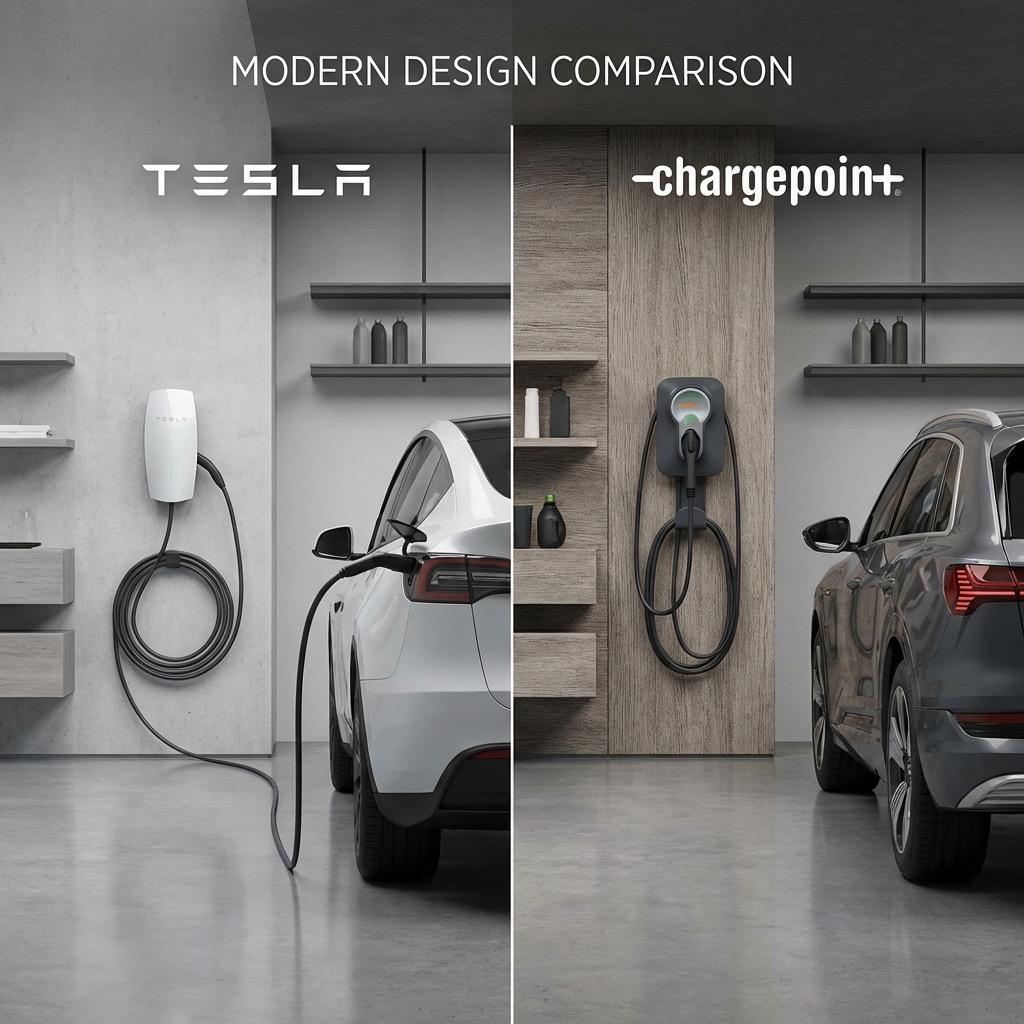
| Best charger brands | Tesla Wall Connector, Wallbox Pulsar Plus | ChargePoint Home Flex, JuiceBox 48 |
Virginia Rebate Program: Dominion Energy's EV charging incentive program currently offers $125 toward a Level 2 charger purchase and installation for qualified residential customers on time-of-use rates. Both hardwired and plug-in installations qualify, and the rebate can be combined with the federal 30% Alternative Fuel Vehicle Refueling Property tax credit (up to $1,000 for residential). AJ Long Electric handles the rebate paperwork for every installation we complete.
Our licensed electricians have installed hundreds of EV chargers across Northern Virginia. We handle everything from panel evaluation to permit filing. Call (703) 997-0026 or request your free estimate online.
Charging Speed in Real-World Virginia Commutes
The speed difference between hardwired and plug-in matters most for high-mileage drivers. At 40 amps (plug-in maximum), a Level 2 charger adds approximately 25–30 miles of range per hour. An overnight 8-hour charge adds 200–240 miles — more than enough for the average daily commute of 37 miles in the Washington metropolitan area. At 80 amps (hardwired maximum), that same 8-hour window adds 480–520 miles.
For most commuters in Reston, Centreville, Manassas, and Sterling, plug-in at 40 amps fully recovers each day's driving every night. Where hardwired speed matters: households with two EVs sharing one charger (one charges while the other depletes), drivers with long regional drives (Richmond and back on some days), and commercial or rideshare drivers who need maximum recovery speed.
Pro Tip: If you choose plug-in installation, never use a standard residential-grade NEMA 14-50 outlet. EV charging is a continuous load — the charger draws maximum amperage for hours every night. Residential outlets are tested for intermittent use. Specify a commercial-grade NEMA 14-50 receptacle rated for continuous duty from Hubbell (HBL9450A), Leviton (279), or Pass & Seymour (3814). The cost difference is $40–$80 and the reliability difference is significant over years of nightly charging in Northern Virginia garages.
Virginia Code and NEC 625 Requirements
The 2023 Virginia Uniform Statewide Building Code adopts the 2020 NEC, including Article 625 (Electric Vehicle Charging Systems). Key requirements for both installation types include:
Continuous load sizing: EV chargers are classified as continuous loads under NEC 625.42. The overcurrent protective device (breaker) must be rated at no less than 125% of the charger's maximum output. A 40-amp charger requires a 50-amp breaker; a 48-amp charger requires a 60-amp breaker.
Dedicated circuit: NEC 625.40 requires a separate branch circuit for each EV charger. No other outlets or loads may share the circuit.
Permit required: All EV charger installations in Fairfax County, Loudoun County, Prince William County, and the cities of Alexandria and Falls Church require an electrical permit and final inspection. Un-permitted installations can void homeowner's insurance coverage and complicate home sales.
GFCI protection: Required for EV chargers in garages and outdoor locations per NEC 210.8. Most modern Level 2 EVSE units include integrated GFCI protection that satisfies this requirement.
Matching Installation Type to Your Situation
There is no single right answer — the best choice depends on your specific circumstances. Consider these scenarios:
Own your home, one EV, plan to stay 5+ years: Hardwired. The clean installation, maximum future amperage headroom, and permanent solution align well with your long-term ownership. If you ever upgrade to a faster charger, an electrician visit is a minor inconvenience.
Plan to move within 3 years: Plug-in. The outlet remains a valuable amenity for the next owner of your home (regardless of their EV brand), and you take your charger to your new house. In the Northern Virginia real estate market, a garage NEMA 14-50 outlet is increasingly listed as a feature.
Rent your home or garage: Plug-in. Many landlords in Arlington, Alexandria, and Fairfax city prefer this approach because the outlet serves multiple tenants with any EV brand and the charger is tenant-owned rather than a landlord fixture.
Multiple EVs or planning to add a second: Plan for hardwired dual-charger setup or a 400-amp service upgrade. Two plug-in chargers at 40 amps each simultaneously may stress a 200-amp panel without load management.
Warning: Never use a standard 120V extension cord or standard outlet for regular EV charging. NEMA 5-15 (standard household) outlets are rated for 15 amps, and running 12 amps continuously for 8+ hours nightly creates a serious fire risk. The National Fire Protection Association reports that charging equipment misuse is a leading cause of EV-related electrical fires. Always use a dedicated circuit sized for your charger.
Installation Process and Typical Timelines
A standard EV charger installation by AJ Long Electric follows this process: load calculation to confirm your panel has capacity, conduit routing plan from panel to garage or outdoor mounting location, permit pull with your jurisdiction (typically same-day to 2 business days in NoVA), installation day (3–5 hours for most residential jobs), and final inspection by county inspector (scheduled 3–10 business days after rough-in for Fairfax County, 5–15 days for Loudoun County).
Total time from first call to operational charger is typically 1–3 weeks in Northern Virginia. If your panel needs a circuit added (very common in older homes in McLean, Vienna, and Great Falls), add a few hours of work but no additional permit delay.
Our Recommendation
For most Northern Virginia homeowners who own their home and plan to stay, hardwired installation provides the cleanest, most future-proof result. For renters, frequent movers, or those who value the ability to upgrade their EVSE without an electrician visit, plug-in is equally safe and code-compliant with a minor speed trade-off most drivers will never notice. Either way, use a licensed electrician, pull a permit, and specify commercial-grade components.
AJ Long Electric specializes in EV charger installations throughout Northern Virginia. We serve Fairfax, Loudoun, Prince William, Arlington, and Alexandria jurisdictions. Call (703) 997-0026 for a free installation quote and help navigating the Dominion Energy rebate process.
Tags:

Written by
Matt Long
Master Electrician
Our team of licensed electricians brings over 40 years of combined experience serving Northern Virginia. We're committed to providing expert electrical solutions with a focus on safety, quality, and customer satisfaction.
Reviewed by AJ Long Electric Master Electricians · VA License #2705031092 · View Credentials