The most common question we hear at AJ Long Electric is simple: "How much does a whole-house generator cost?" The honest answer involves more variables than a single number — but in Northern Virginia in 2026, most homeowners pay between $12,000 and $18,000 fully installed for a gas-powered standby generator. This guide breaks down every cost component so there are no surprises in your quote.
Key Takeaways
- Generator equipment alone ranges from $3,500 (10kW) to $12,000+ (26kW) before installation in 2026.
- Installation labor, permits, transfer switch, gas line, and pad add $4,500–$9,000 to the equipment cost.
- Propane installations cost $3,000–$6,000 more than natural gas due to tank requirements.
- Fairfax County permits run $180–$320; Loudoun County permits run $150–$280 for standard residential installs.
- Annual maintenance costs $200–$400/year and is required to keep the warranty valid.
Generator Equipment Costs by Size (2026 Prices)
The generator unit itself — the equipment before any installation labor — varies significantly by output capacity. These are current 2026 wholesale-to-consumer prices for the most popular residential standby generators in the Northern Virginia market. Actual prices depend on the specific model and any dealer promotions.
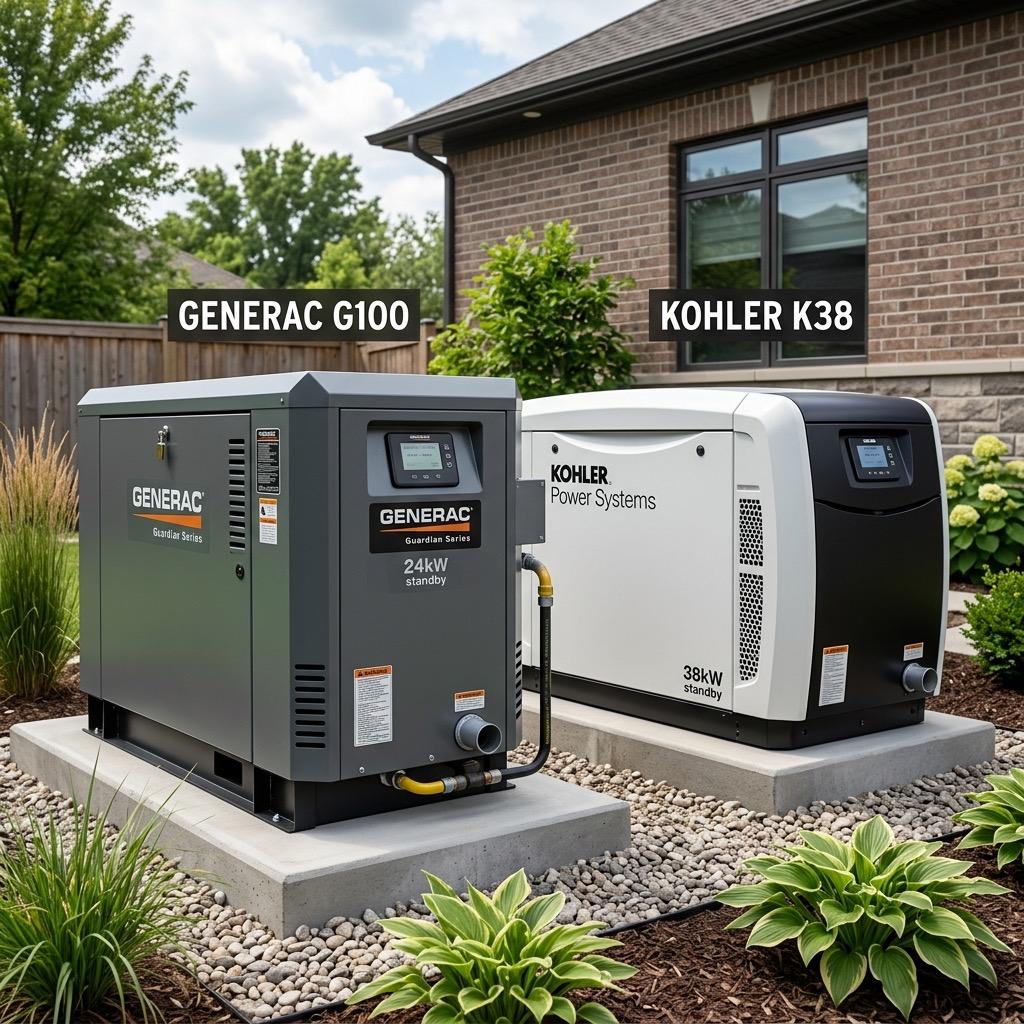
A 10kW unit (suitable for essential circuits in a smaller home) runs $3,500–$5,000. The 16kW tier — covering most loads in a 2,000 sq ft home with gas heat — runs $5,000–$7,000. The popular 20–22kW range, appropriate for most Fairfax County single-family homes, costs $6,500–$9,000 for the generator unit. A 26kW generator for large homes with electric HVAC or multiple zones runs $9,000–$12,000+.
Why Bigger Isn't Always Better: An oversized generator runs at low load during exercises, which can cause carbon buildup ("wet stacking") in diesel units and reduced efficiency in gas units. A properly sized 20kW generator for a 3,000 sq ft home will outperform a 26kW unit running at 40% capacity. Load analysis by a licensed electrician is worth the time before you commit to a size.
Installation Cost Components in Northern Virginia
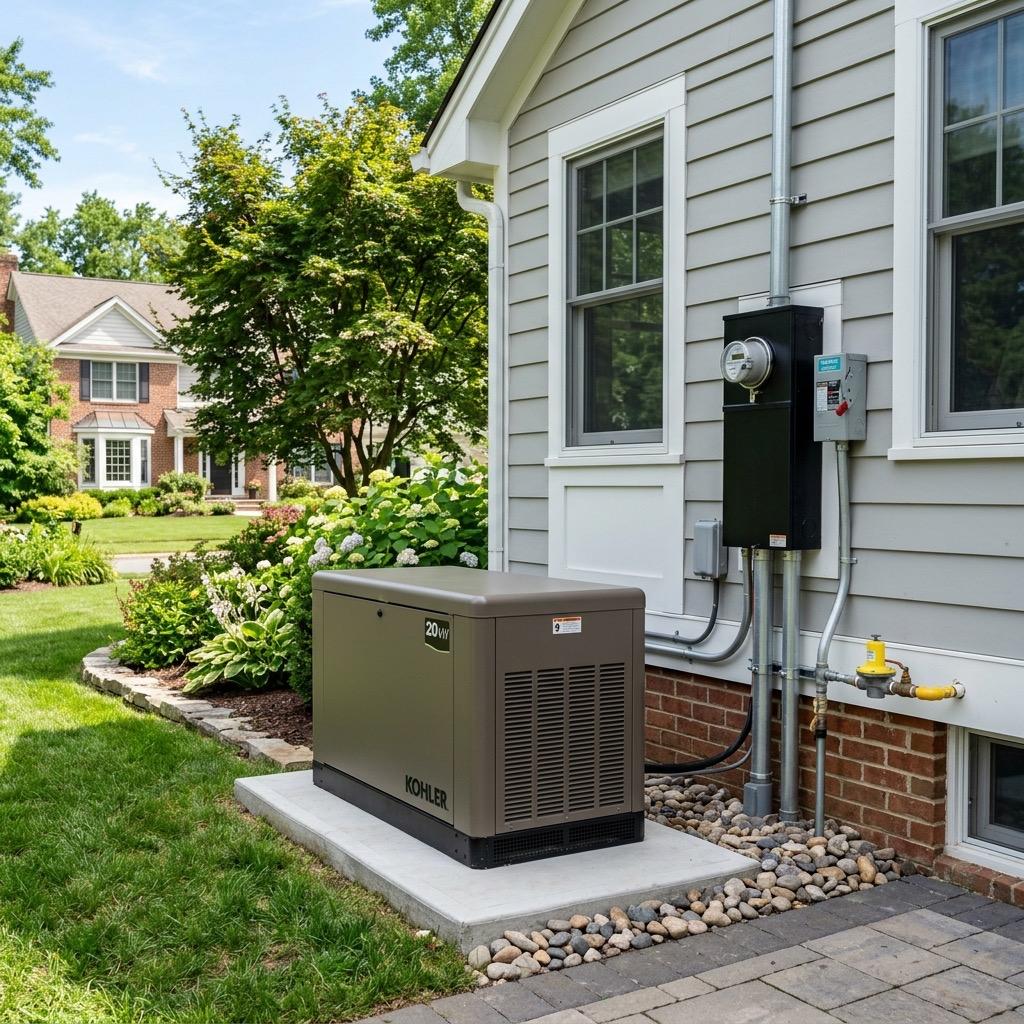
Equipment is only half the story. Installation in Northern Virginia involves several distinct cost components, each of which varies by your specific property. Here's a breakdown of what goes into a typical Fairfax or Loudoun County installation.
Never lose power again. We are authorized Generac installers serving all of Northern Virginia. From sizing to installation to maintenance, we handle every step. Call (703) 997-0026 for a free in-home assessment.
Transfer Switch: $800–$2,500
A 200-amp automatic transfer switch (ATS) is required to safely connect the generator to your home's electrical system. Standard ATS units run $800–$1,200 installed. Whole-house transfer switches with load management capabilities (which allow a smaller generator to handle higher demand by shedding non-critical loads) run $1,500–$2,500. In NoVA, whole-house transfer switches are required when the generator serves the full home panel rather than a sub-panel.
Concrete or Composite Pad: $400–$900
All standby generators require a level, load-bearing pad. Pre-poured composite pads from the manufacturer run $400–$600 installed. Poured concrete pads — required by some HOAs for permanence — run $600–$900 depending on size and site access. The pad must meet setback requirements from your home, property line, and utility connections.
Gas Line Extension: $500–$3,000
Connecting the generator to your natural gas or propane supply requires a dedicated gas line run. Distance is the primary cost driver. If your gas meter is within 20 feet of the ideal generator location, line costs run $500–$900. Runs of 50–100 feet — common when the ideal placement is on the opposite side of the house from the meter — cost $1,200–$2,000. Runs requiring trenching through landscaping or crossing a driveway add $500–$1,000. Washington Gas coordinates the meter upgrade (from 250 to 400 CFH) at no additional charge for most residential installations.
Electrical Work: $800–$2,000
Beyond the transfer switch, the installation requires conduit runs from the generator to the transfer switch, proper grounding, and connection to the home's electrical panel. In most Northern Virginia homes with an accessible basement or crawl space, this runs $800–$1,200. Finished basements or homes requiring exterior conduit runs can push this to $1,500–$2,000.
Permits: $180–$600
Fairfax County requires both a building permit and an electrical permit for standby generator installations. Building permits run $150–$200; electrical permits run $100–$130 for standard residential work. Loudoun County has similar fees. Prince William County fees run slightly lower at $130–$280 total. Arlington County, due to its urban density, occasionally requires additional review for noise and placement — budget $50–$100 extra for potential variance applications there.
Ask for an Itemized Quote: Any reputable generator installer in Northern Virginia should provide a written, itemized quote that separates equipment, labor, permits, and sub-contractor costs (gas line, concrete). A single lump-sum quote with no breakdown makes it impossible to compare contractors fairly or understand what you're paying for. AJ Long Electric provides fully itemized written estimates within 48 hours of a site visit.
Propane vs. Natural Gas: How Fuel Type Affects Installation Cost
Natural gas generators are simpler and less expensive to install in areas with existing gas service — most of inner Fairfax County, Arlington, Alexandria, and the established Loudoun suburbs of Ashburn and Leesburg. Propane installations require a storage tank, which adds $1,500–$3,000 for tank purchase (or $400–$800/year for rental) plus the cost of the initial propane fill ($800–$1,500 for 500 gallons at current prices).
In western Loudoun and Fauquier County, propane is the only option, so the cost premium is unavoidable. Over a 10-year ownership period, propane fuel costs for exercises and outages will typically run $3,000–$6,000 more than equivalent natural gas costs, making the total cost of ownership gap significant even if the installation costs are similar.
Financing and Incentives Available in 2026
Several financing options are available to Northern Virginia homeowners. Generac offers promotional 18-month same-as-cash financing through its dealer network on qualifying equipment purchases — a useful tool for spreading the cost without interest if paid within the promotional period. Personal home improvement loans through local credit unions (Northwest Federal, Apple Federal Credit Union, John Marshall Bank) typically run 7–10% APR for qualified borrowers in the $10,000–$20,000 range.
Tax incentives for standby generators are limited in 2026 — the federal residential clean energy credit does not cover conventional gas-powered generators. However, if you combine a generator installation with a battery backup system (such as the Generac PWRcell), the battery storage component may qualify for the 30% federal tax credit under IRS Form 5695. This hybrid approach is increasingly popular in Fairfax County.
Beware of Unusually Low Quotes: If you receive a generator installation quote in Northern Virginia that is more than 20% below the range outlined here, ask detailed questions. Common ways low quotes become high final bills: unlicensed subcontractors (who can't pull permits), using a smaller transfer switch than your panel requires, not including the gas line in the quote, or planning an installation that doesn't meet setback requirements and must be redone. Lowest bid is rarely the best value for a 20-year asset.
Get an Accurate Generator Quote for Your Northern Virginia Home
Pricing varies enough by property that there is no substitute for a site visit. AJ Long Electric provides free, no-obligation site assessments and written itemized quotes within 48 hours for homeowners throughout Fairfax County, Loudoun County, Arlington, Alexandria, and Prince William County. We're a licensed Virginia contractor (Class A) with full permit-pulling authority in all NoVA jurisdictions.
Call us at (703) 997-0026 or use our online scheduling tool to book your site assessment. Most installations are completed within 2–4 weeks of permit approval — and we handle the permits so you don't have to.
Tags:

Written by
Matt Long
Master Electrician
Our team of licensed electricians brings over 40 years of combined experience serving Northern Virginia. We're committed to providing expert electrical solutions with a focus on safety, quality, and customer satisfaction.
Reviewed by AJ Long Electric Master Electricians · VA License #2705031092 · View Credentials