If you have ever tried to install a new appliance, set up a workshop, or add an EV charger to your home, you have probably encountered the terms 120 volts and 240 volts. These are the two standard voltages available in every residential electrical system in the United States, and understanding the difference between them is essential for knowing what your appliances require, why certain outlets look different from others, and what is involved when you need to add a new high-power circuit. This guide explains the practical differences between 120V and 240V in terms every homeowner can understand.
Key Takeaways
- Standard US homes receive 240 volts from the utility, which is split into two 120-volt legs at the panel.
- Most general-purpose outlets in your home are 120V, powering lights, electronics, and small appliances.
- Large appliances like dryers, ranges, water heaters, and EV chargers use 240V for greater power delivery.
- You cannot convert a 120V outlet to 240V without running new wiring from the panel.
- 240V circuits use different outlet configurations, wire gauges, and breaker types than 120V circuits.
How Your Home Gets Its Electricity
Understanding the 120V and 240V distinction starts at the utility transformer on the pole or pad near your home. The transformer steps down high-voltage utility power to 240 volts and delivers it to your home through three wires: two hot conductors and one neutral. Each hot conductor carries 120 volts relative to the neutral. Between the two hot conductors, the voltage is 240 volts. This is called a split-phase electrical service, and it is the standard for virtually every residential property in the United States.
Inside Your Electrical Panel
Inside your main electrical panel, the two hot conductors connect to two bus bars that run down the center of the panel. Single-pole breakers connect to one bus bar, providing 120 volts on their circuit. Double-pole breakers span both bus bars, providing 240 volts on their circuit. This elegant arrangement allows your home to have both voltage levels available from a single service entrance, with the breaker configuration determining which voltage each circuit receives.
120V Circuits: The Standard
Where 120V Is Used
The vast majority of outlets and circuits in your home operate at 120 volts. Standard duplex outlets in living rooms, bedrooms, hallways, and offices are 120V circuits. Lighting circuits are 120V. Kitchen countertop outlets are 120V, though they are typically on dedicated 20-amp circuits rather than the 15-amp circuits used elsewhere. Bathroom outlets, garage outlets, and outdoor outlets are also 120V, with GFCI protection required in these locations.
Whether it is a simple repair or a major electrical project, our licensed team is ready to help. Serving all of Northern Virginia with transparent pricing and expert workmanship. Call (703) 997-0026 today.
What Runs on 120V
Devices and appliances designed for 120V include televisions, computers, and home electronics, lamps and light fixtures, phone and tablet chargers, kitchen countertop appliances like toasters, blenders, and coffee makers, vacuum cleaners, and window fans. These devices have standard two-prong or three-prong plugs that fit the familiar 120V outlets found throughout your home. The maximum power available from a standard 120V, 15-amp circuit is about 1,800 watts, though continuous loads should be limited to 80 percent of that, or about 1,440 watts.
240V Circuits: The Heavy Hitters
Where 240V Is Used
240V circuits are reserved for appliances and equipment that require substantial power. Because power equals voltage times current, doubling the voltage allows you to deliver twice the power with the same wire size and breaker rating. This is why large appliances use 240V rather than simply using a larger 120V circuit.
Common 240V Appliances
Appliances and equipment that typically require 240V circuits include electric clothes dryers at 5,000 to 5,500 watts, electric ranges and ovens at 8,000 to 12,000 watts, central air conditioning systems, heat pumps, electric water heaters at 4,500 watts, Level 2 EV chargers at 7,600 to 11,520 watts, electric furnaces and heat strips, hot tubs and spas, welders and large shop equipment, and well pumps. Each of these items requires its own dedicated circuit with appropriately sized wiring and a double-pole breaker in your panel.
In Northern Virginia, the growing popularity of electric vehicles has made EV charger installation one of the most common reasons homeowners need a new 240V circuit. A Level 2 EV charger typically requires a 240V, 50-amp circuit with 6-gauge copper wiring run from your panel to your garage or driveway area. If your panel is full or your service is too small, an upgrade may be needed first.
240V Outlet Types
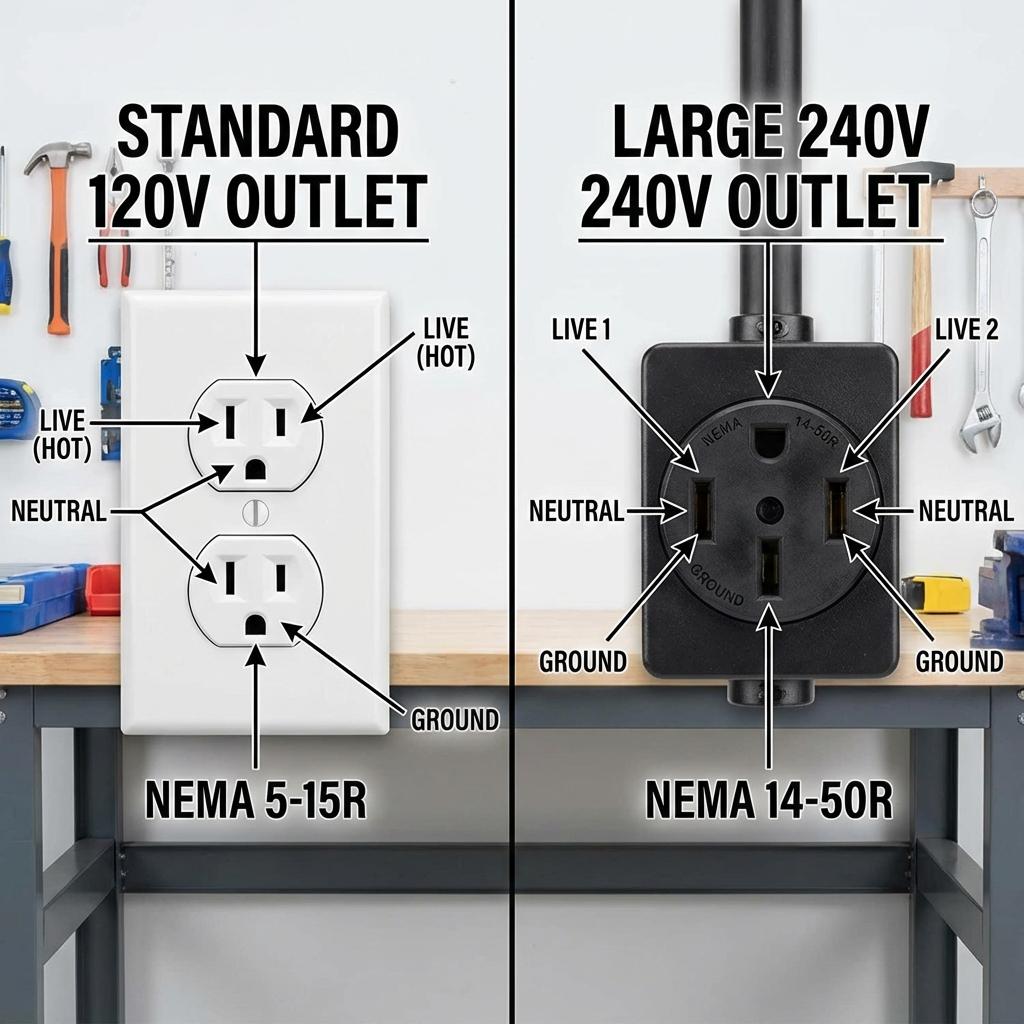
Unlike the universal 120V outlet, 240V outlets come in several configurations depending on the amperage and whether a neutral conductor is present. NEMA 14-30 outlets are used for electric dryers and deliver 30 amps. NEMA 14-50 outlets are the most versatile 240V outlet, used for ranges, EV chargers, and large appliances at 50 amps. NEMA 6-20 and NEMA 6-50 outlets are used for equipment that does not need a neutral conductor, such as some welders and shop tools. Each configuration has a unique plug and receptacle shape that prevents you from accidentally plugging a device into the wrong type of outlet.
Key Differences Between 120V and 240V
Wiring Requirements
A 120V circuit uses three conductors: one hot wire (typically black), one neutral wire (white), and one ground wire (green or bare copper). A 240V circuit uses four conductors: two hot wires (typically black and red), one neutral wire (white), and one ground wire (green or bare copper). Some 240V-only loads that do not need a neutral, like baseboard heaters, use three conductors. The wire gauge depends on the circuit amperage. A 15-amp 120V circuit uses 14-gauge wire, a 20-amp circuit uses 12-gauge, a 30-amp 240V circuit uses 10-gauge, and a 50-amp 240V circuit uses 6-gauge.
Breaker Configuration
A 120V circuit uses a single-pole breaker that occupies one slot in your panel. A 240V circuit uses a double-pole breaker that occupies two slots, because it must connect to both bus bars to deliver the full 240 volts. This means 240V circuits consume twice as many panel slots as 120V circuits, which matters when your panel is nearing capacity.
Safety Considerations
Both voltages are dangerous and can cause serious injury or death. However, 240V circuits carry more energy and can cause more severe injuries from shock. Additionally, 240V circuits power high-draw appliances that generate more heat, making proper installation and connection quality even more critical. All 240V appliance installations should be performed by a licensed electrician.
If you are planning multiple 240V additions such as an EV charger, a hot tub, and a workshop welder, have your electrician perform a load calculation before starting any of the individual projects. It is far more cost-effective to plan and size a single panel upgrade that accommodates all planned additions than to discover partway through that you need yet another upgrade.
Can You Convert 120V to 240V?
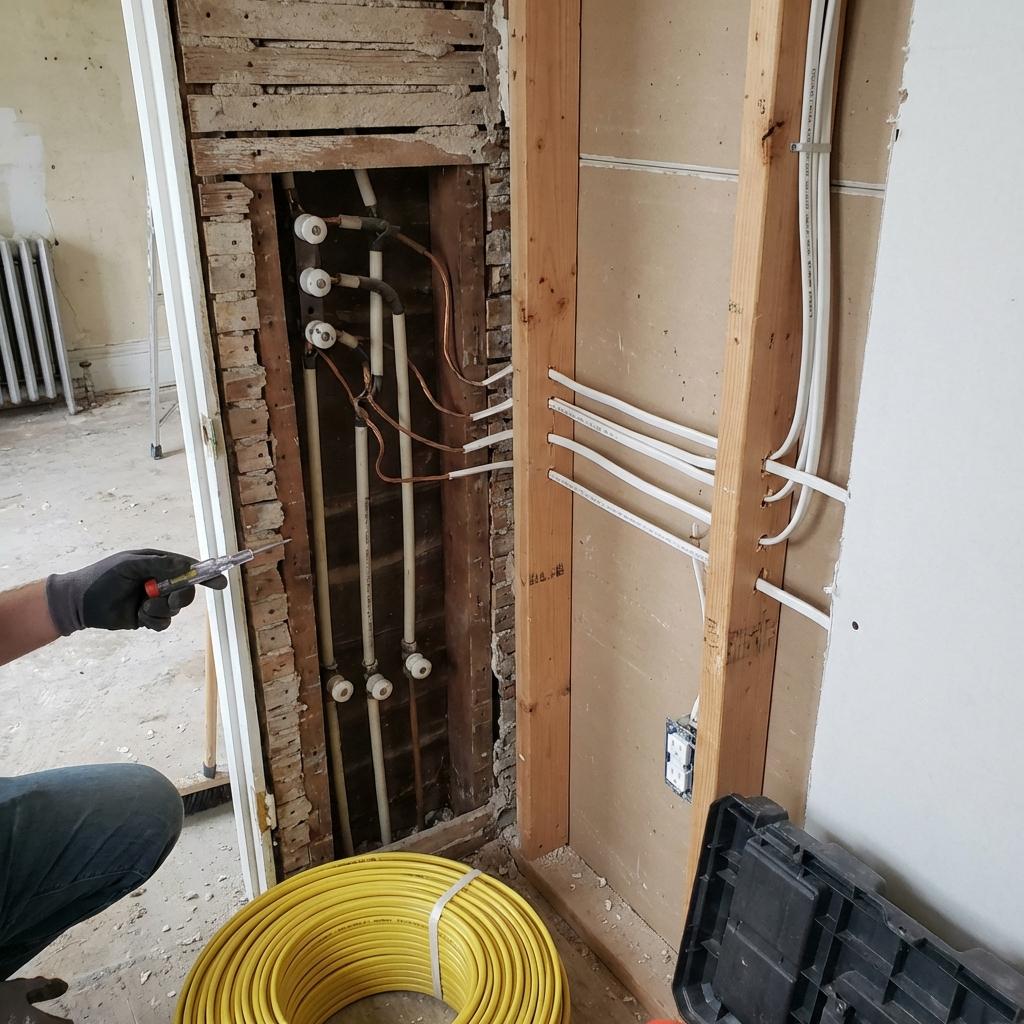
This is one of the most common questions we receive, and the answer is that you cannot simply convert an existing 120V outlet to 240V. The wiring for a 120V circuit contains only one hot conductor, while a 240V circuit requires two. You also need a double-pole breaker instead of a single-pole breaker, and the wire gauge must be appropriate for the 240V circuit's amperage rating. In practice, adding a 240V outlet means running entirely new wiring from your panel to the outlet location, installing a new double-pole breaker, and installing the appropriate 240V receptacle. This is a job for a licensed electrician.
What About Step-Up Transformers?
Small step-up transformers that convert 120V to 240V do exist and are sometimes used for imported appliances. However, they are not appropriate for powering major appliances like dryers, ranges, or EV chargers. They are limited in capacity, can overheat, and do not provide the safety features of a proper 240V circuit with appropriately sized wiring and breaker protection.
Planning for Your Electrical Needs
As homes become more electrified with EV chargers, heat pumps, electric cooking, and other high-power equipment, the demand for 240V circuits continues to grow. If you are building a new home or planning a major renovation, think ahead about where you might need 240V service in the future. Running conduit or additional wires during construction or renovation is far less expensive than opening finished walls later.
Whether you need a new 240V circuit for an EV charger, a kitchen range, a workshop, or any other high-power application, the electricians at AJ Long Electric can help. We serve homeowners throughout Northern Virginia with professional 240V circuit installation, from the load calculation and panel assessment through the final inspection. Call us at (703) 997-0026 to discuss your project.
Tags:

Written by
AJ Long Electric Team
Licensed Electricians
Our team of licensed electricians brings over 40 years of combined experience serving Northern Virginia. We're committed to providing expert electrical solutions with a focus on safety, quality, and customer satisfaction.
Reviewed by AJ Long Electric Master Electricians · VA License #2705031092 · View Credentials