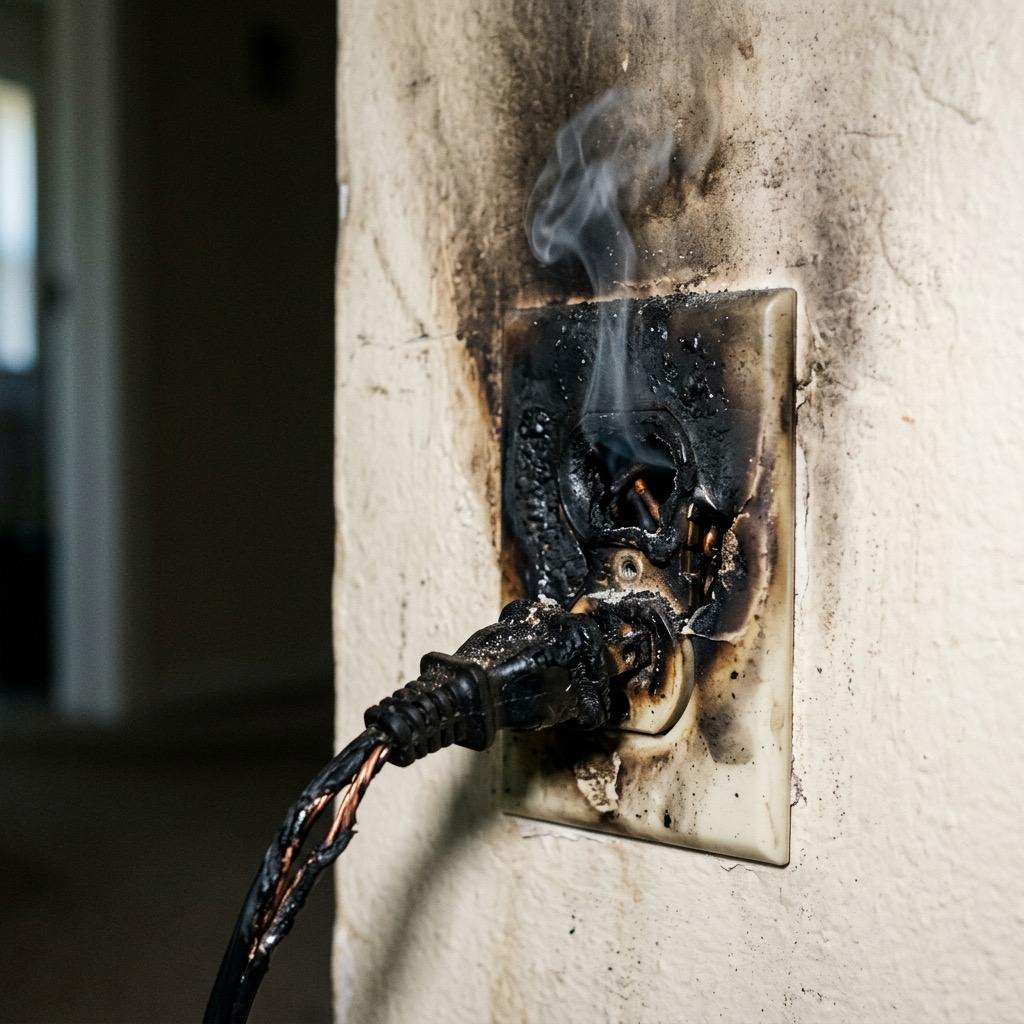
A burning smell from an electrical outlet is one of the most serious warning signs your home can give you. It means something inside the outlet box, behind the wall, or on the circuit is overheating — and an electrical fire may already be smoldering where you can't see it. This guide tells you exactly what to do in the next 10 minutes, what not to do, and when to make the call that matters most.
Key Takeaways
- A burning smell from an outlet — even without visible smoke — can indicate an active fire inside the wall. Treat it as an emergency, not a minor inconvenience.
- Shut off the breaker for the affected circuit immediately — this is the single most important step you can take before any electrician arrives.
- Do not use the outlet, plug anything into it, or attempt to remove the outlet cover to inspect the wiring yourself.
- If the smell intensifies, spreads to other areas, or you see discoloration on the wall near the outlet, evacuate and call 911.
- AJ Long Electric responds to burning smell emergencies throughout Northern Virginia 24 hours a day — call (703) 997-0026.
Why a Burning Smell from an Outlet Is Always an Emergency
The burning smell most homeowners describe from a troubled outlet is the odor of overheated plastic insulation — specifically, the PVC jacket surrounding the copper conductors inside the outlet box and behind the wall. PVC insulation begins to soften at around 140°F and degrades rapidly above 167°F. Once the insulation degrades, the bare conductor can arc against adjacent wiring, the metal box, or the wood framing surrounding it. Wood ignites at approximately 451°F — and a small electrical arc can reach temperatures exceeding 35,000°F in microseconds. The gap between "I smell something" and "there's a fire in my wall" can be minutes or hours depending on conditions. This is why the smell is never something to investigate tomorrow.
According to the NFPA, electrical fires cause an estimated 51,000 home fires annually in the United States. Of those, roughly 15% originate at outlets and switches — the exact scenario this guide addresses. In Northern Virginia homes with older wiring (common in Arlington, Falls Church, and pre-1980 Fairfax neighborhoods), the risk is elevated because aging backstab outlet connections — a common but inferior wiring method from the 1970s and 1980s — loosen over time and arc at exactly the conditions that produce the burning smell homeowners report.
Step 1: Do Not Use the Outlet — Shut Off the Breaker
The moment you smell burning from an outlet, stop using it. Unplug anything currently in the outlet — do this quickly and without touching the outlet plate itself. Then go directly to your electrical panel and shut off the breaker for the affected circuit. If you can't immediately identify which breaker controls that outlet (panel labeling is often incomplete or outdated), shut off the main breaker. This is not an overreaction — you can restore power once the electrician has cleared the circuit. Leaving a potentially arcing circuit energized while you wait for an electrician is the dangerous choice.
A professional electrical inspection identifies hidden hazards before they become emergencies. Our licensed electricians provide thorough safety inspections throughout Northern Virginia. Call (703) 997-0026 to schedule yours.
To locate your panel: in most Northern Virginia homes, the main electrical panel is in the utility room, basement, or garage. In older Arlington and Falls Church homes, panels are sometimes in closets or hallways. Open the panel door — you're looking for a bank of circuit breakers. Each breaker controls a circuit; look for a label near the affected outlet's location. If the panel is labeled clearly, flip that breaker to OFF. If not, flip the main breaker — it's the large double breaker at the top or bottom of the panel.
Do Not Reset the Breaker If It Has Already Tripped: If the circuit breaker for the affected circuit has already tripped to the center position, do not reset it. A tripped breaker means the circuit has already detected an overcurrent condition. Resetting it restores power to wiring that may be actively damaged. Leave it in the tripped position and call AJ Long Electric immediately.
Step 2: Assess Whether to Stay or Evacuate
After shutting off the breaker, spend 60 seconds assessing the situation. Place your hand near (not on) the wall surrounding the outlet — if the wall surface feels warm or hot, there may be active fire smoldering inside the wall cavity. Check the outlet cover and surrounding wall for discoloration, scorch marks, or bubbling paint — visual evidence of heat exposure. Note whether the burning smell is getting stronger, weaker, or staying the same. If it's getting stronger after you've cut power to the circuit, the fire may have spread beyond the initial arc point and could be burning independently. In this case: evacuate the home, call 911, and stay out.
If the smell was localized, is dissipating after you cut power, and there are no signs of wall heating or discoloration, you can stay in the home — but keep the circuit off and call AJ Long Electric for an emergency response. Do not go to bed assuming the problem has resolved. An electrician needs to open the outlet box and inspect the wiring before you restore power to that circuit.
Step 3: What the Electrician Will Find and Fix
When an AJ Long Electric electrician responds to a burning outlet call in Northern Virginia, the diagnostic process is methodical. The outlet cover comes off first — the electrician inspects the outlet body, the wiring connections, and the inside of the box for evidence of arcing (small burn marks, melted plastic, discolored copper). Backstab connections — where the wire is pushed into a spring clip on the back of the outlet rather than wrapped around a screw terminal — are a common culprit; they handle initial installation fine but loosen with the thermal cycling of years of use.
If the outlet box shows arcing damage, the electrician opens the wall cavity above and below to inspect the wiring run for evidence of damage spread. In the worst cases — particularly in homes with older wiring — heat damage can extend several feet along a cable run. The repair in a straightforward case is: replace the damaged outlet with a spec-grade or commercial-grade outlet using screw-terminal connections, tighten all connections at adjacent junction boxes on the circuit, and test the full circuit before restoring power. In cases where wiring damage has spread, partial rewiring may be required. Thermal imaging cameras allow electricians to inspect adjacent wall sections without opening them, limiting the scope of invasive repair work.
Spec-Grade vs. Residential-Grade Outlets: Standard outlets sold at big-box retailers are residential-grade — they're rated for 10,000 insertion cycles and use spring-clip backstab connections by default. Spec-grade outlets (about $6–$10 vs. $2–$3) are rated for 20,000 cycles and are designed for screw-terminal-only connection. When AJ Long Electric replaces an outlet, we use spec-grade or commercial-grade devices as standard practice. Ask your electrician what grade they're installing.
Common Causes of Burning Outlet Smells in Northern Virginia Homes
Several specific failure modes produce the burning smell complaint. Loose backstab connections are by far the most common, particularly in Northern Virginia homes built between 1965 and 1995 when backstab connections were standard practice. Overloaded circuits — too many high-draw devices on a single circuit — cause sustained elevated temperatures that degrade insulation. In Northern Virginia kitchens, this often occurs on counter circuits where coffee makers, toasters, microwaves, and air fryers share circuits designed for far smaller loads. Aluminum wiring oxidation at outlets is specific to homes built between 1965 and 1973 — oxidized aluminum connections have dramatically increased resistance, generating heat at every connection point. Failed outlet devices — the internal components of an outlet itself can fail after years of use, generating heat internally without a visible external cause. Finally, foreign objects — insects nesting in outlet boxes, particularly in rural Loudoun County and Prince William County homes — can cause smells that homeowners initially mistake for electrical problems, though the resolution is quite different.
After the Repair: Preventing Recurrence
Once the immediate repair is complete, two follow-up measures significantly reduce the risk of recurrence. Request that the electrician install an arc-fault circuit interrupter (AFCI) breaker for the repaired circuit — an AFCI detects arcing and shuts down the circuit before it can cause a fire, providing the protection that standard breakers do not. In bedrooms and most living areas of Northern Virginia homes, AFCIs are now required by code for new construction; retrofitting them to existing circuits costs $55–$85 per breaker and can be done during the same service call. Second, if the home has backstab connections throughout (common in any home where the original outlets have never been replaced), consider a whole-home outlet replacement with screw-terminal spec-grade devices. This is a one-time job that eliminates the most common failure mode systemically. Cost for a typical three-bedroom Northern Virginia home: $800–$1,500, depending on outlet count and accessibility.
Call AJ Long Electric Now — Don't Wait on This One
A burning smell from an outlet is the kind of warning sign that, if ignored, can result in a house fire while you sleep. AJ Long Electric responds to burning outlet emergencies throughout Fairfax, Arlington, Loudoun, Prince William, and Alexandria 24 hours a day. We take these calls seriously and we move quickly. Call (703) 997-0026 now — our dispatcher will assess the urgency, advise on immediate safety steps, and get a licensed electrician to your home as fast as possible. Don't let an urgent problem turn into a catastrophic one.
Tags:

Written by
Matt Long
Master Electrician
Our team of licensed electricians brings over 40 years of combined experience serving Northern Virginia. We're committed to providing expert electrical solutions with a focus on safety, quality, and customer satisfaction.
Reviewed by AJ Long Electric Master Electricians · VA License #2705031092 · View Credentials