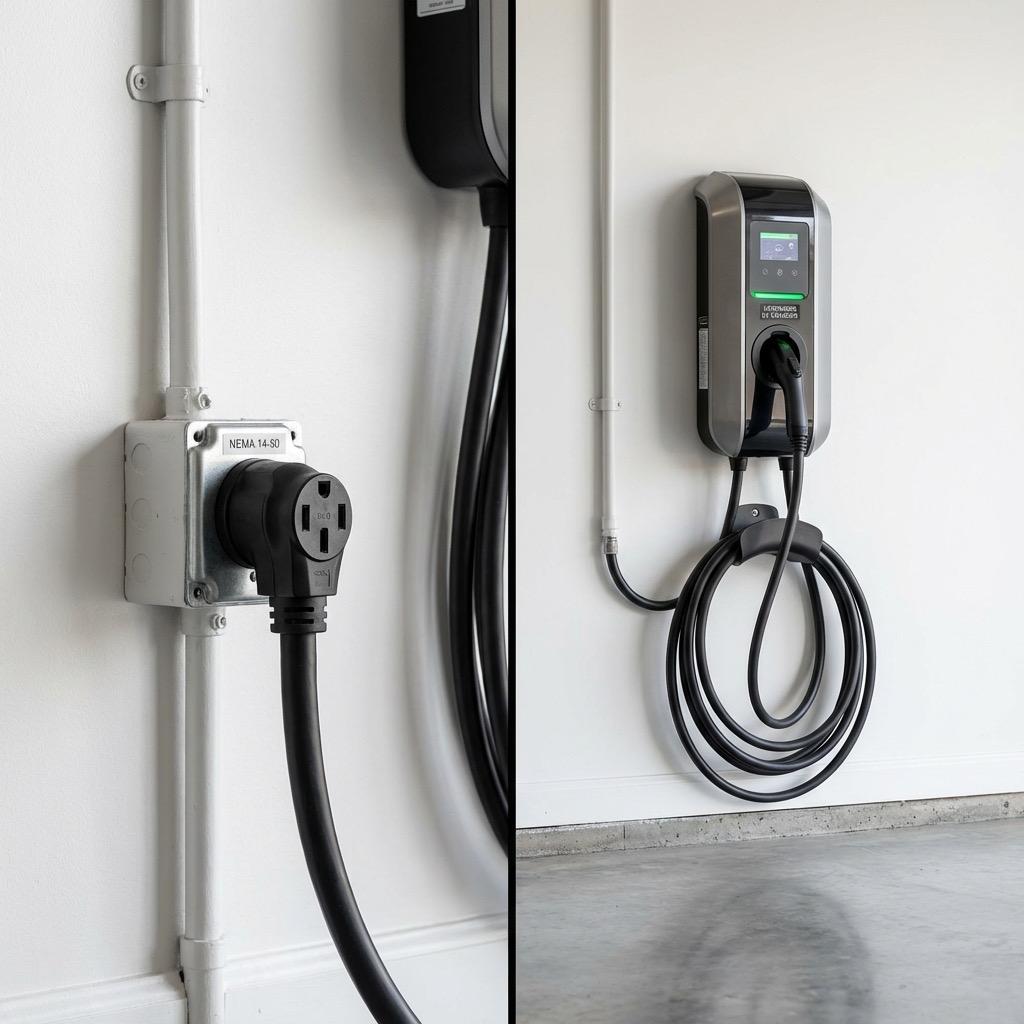
One of the most common decisions EV charger buyers face is whether to install a NEMA 14-50 outlet for a plug-in charger or hardwire the charger directly to the circuit. Both approaches are safe and code-compliant when installed correctly, but they offer different advantages in terms of flexibility, cost, appearance, and maximum charging speed. For Northern Virginia homeowners weighing their options, understanding the trade-offs helps you make the right choice for your current situation and future plans. This guide breaks down the pros, cons, and code requirements of each approach.
Key Takeaways
- A NEMA 14-50 outlet allows you to unplug your charger if you move and supports easy charger upgrades.
- Hardwired installations provide a cleaner appearance and are required for chargers drawing more than 40 amps continuously.
- NEC code limits NEMA 14-50 receptacles to a maximum 40-amp continuous load (50-amp circuit at 80%).
- For 48-amp chargers like the Tesla Wall Connector at full power, hardwiring on a 60-amp circuit is required.
- Both options require the same dedicated circuit, permit, and inspection in all Northern Virginia jurisdictions.
Understanding NEMA 14-50 Outlets
The NEMA 14-50 is a four-prong 240-volt outlet commonly used for electric ranges and RV hookups. In the EV charging world, it has become the de facto standard receptacle for plug-in chargers. If you have ever seen a large outlet in an RV park or behind an electric stove, you have seen a NEMA 14-50.
How NEMA 14-50 Works with EV Chargers
A plug-in EV charger comes with a NEMA 14-50 plug on one end and a J1772 (or Tesla NACS) connector on the other. You install the NEMA 14-50 outlet on the wall, and the charger simply plugs into it. The charger can be unplugged and moved at any time, much like any other appliance. This straightforward setup is why NEMA 14-50 installations are the most popular choice for EV charging in Northern Virginia homes.
NEMA 14-50 Advantages
- Portability: If you move to a new home, you unplug the charger and take it with you. The outlet remains as a selling point for the next homeowner. In Northern Virginia's active real estate market, a pre-installed EV outlet adds genuine appeal to prospective buyers in areas like Ashburn, Reston, and Arlington.
- Easy upgrades: As EV charger technology improves, you can swap to a newer model by simply unplugging the old charger and plugging in the new one. No electrician needed for the changeover.
- Multi-purpose use: A NEMA 14-50 outlet can power other 240V equipment when the charger is not in use, including portable welders, air compressors, and RV connections. This versatility adds value beyond EV charging.
- Slightly lower installation cost: Installing an outlet is marginally less expensive than hardwiring because the electrician terminates at a receptacle rather than running wire directly into the charger enclosure.
NEMA 14-50 Limitations
- 40-amp continuous maximum: NEC code limits any receptacle-connected appliance to 80% of the circuit rating for continuous loads. On a 50-amp circuit, this means a maximum of 40 amps continuous. For most chargers, this is perfectly adequate, but it does prevent you from running a 48-amp charger at full speed.
- Visible outlet: The outlet is always visible on the wall, which some homeowners find less aesthetically pleasing than a clean hardwired installation.
- Outdoor weatherproofing: For outdoor installations, the NEMA 14-50 outlet requires a weatherproof in-use cover (the bubble-style cover that encloses the plug while it is inserted). These covers add cost and bulk to the installation.
Understanding Hardwired Installation
A hardwired EV charger connects directly to the electrical circuit without a receptacle. The wire runs from the breaker panel through conduit and terminates directly inside the charger's junction box. The charger becomes a permanent fixture, similar to how your central air conditioning or electric water heater is connected.
Our licensed electricians have installed hundreds of EV chargers across Northern Virginia. We handle everything from panel evaluation to permit filing. Call (703) 997-0026 or request your free estimate online.
Hardwired Advantages
- Maximum charging speed: Hardwired chargers can draw up to 48 amps on a 60-amp circuit, since the NEC receptacle limitation does not apply. For chargers like the Tesla Wall Connector or JuiceBox 48 at full output, hardwiring is the only option for maximum speed.
- Cleaner appearance: No visible outlet or plug, just the charger mounted flush against the wall with the conduit entering from behind or below. Many homeowners in communities like McLean, Great Falls, and Aldie prefer this streamlined look.
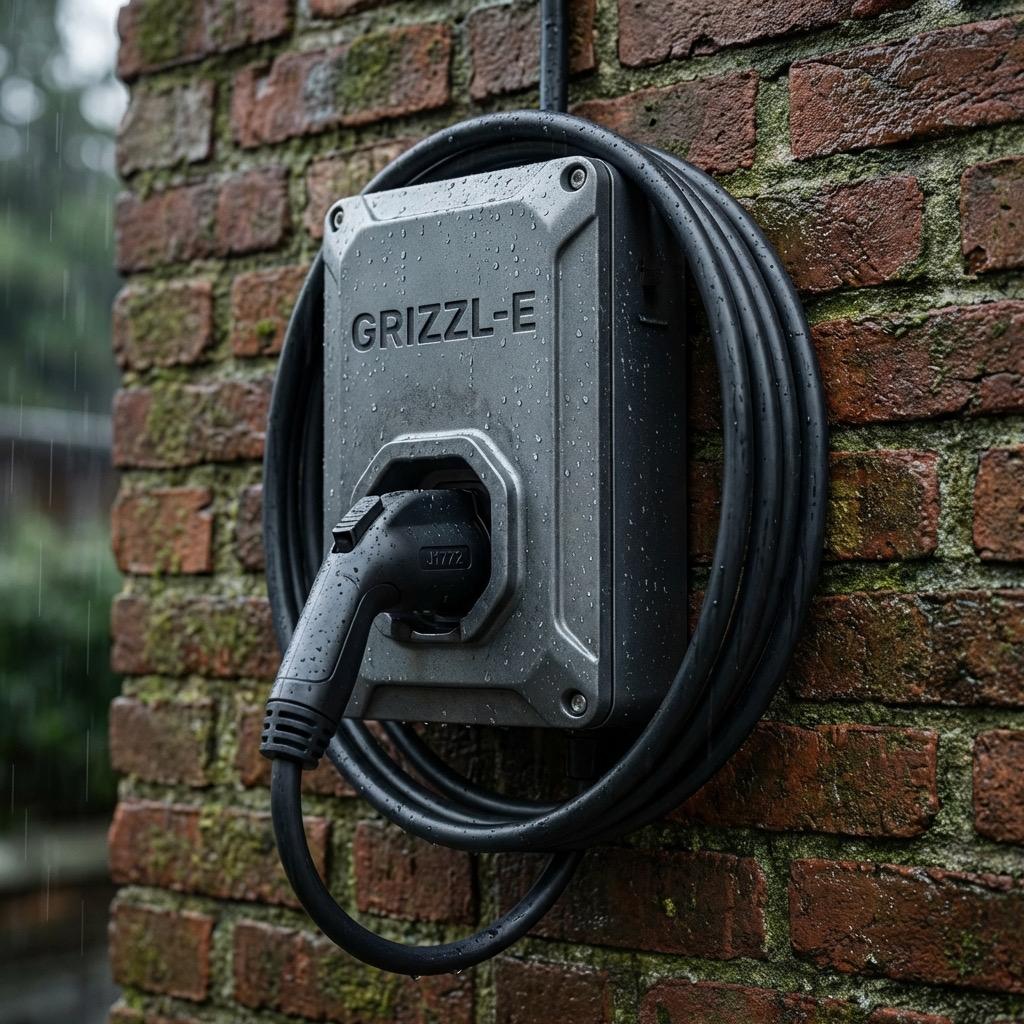
- Better for outdoor installations: Without an outlet to weatherproof, hardwired outdoor installations are simpler and more robust. The conduit enters the charger directly, and the charger's own NEMA rating handles all weather protection.
- Marginally more reliable: Eliminating the plug-to-receptacle connection removes one potential point of resistance, corrosion, or loosening over time. While modern NEMA 14-50 connections are very reliable, hardwiring provides the most direct electrical path.
Hardwired Limitations
- Not portable: A hardwired charger stays with the house when you move. While this adds value for the buyer, you cannot take the charger with you without hiring an electrician to disconnect it and cap the wires.
- Charger upgrades require an electrician: Replacing a hardwired charger means disconnecting the old unit and wiring the new one, which requires a licensed electrician and may require a new permit depending on the scope of work.
- Slightly higher installation cost: Hardwired installation takes marginally longer as the electrician must open the charger, route wire into the junction box, and make terminal connections inside the unit.
NEC Code Requirements: What the Rules Say
The National Electrical Code governs how EV chargers can be connected, and understanding these requirements is essential for a safe, compliant installation.
The 80% Continuous Load Rule
NEC Article 210.21(B)(2) and 625.41 establish that EV charging is a continuous load, defined as a load running for three or more hours. For continuous loads on receptacles, the load must not exceed 80% of the receptacle and circuit rating. On a 50-amp circuit with a NEMA 14-50 outlet, maximum continuous load is 40 amps. On a 60-amp circuit with hardwired connection, maximum continuous load is 48 amps.
Practical Impact
For a 40-amp charger (the most common home setting), a NEMA 14-50 on a 50-amp circuit is perfectly code-compliant. For a 48-amp charger at full output, hardwiring on a 60-amp circuit is required. Many homeowners choose a 40-amp charger with a NEMA 14-50 because the marginal speed difference between 40 and 48 amps (roughly 30 vs. 37 miles of range per hour) is negligible for overnight charging.
NEMA 6-50 Alternative
The NEMA 6-50 is a three-prong 240V outlet (no neutral conductor) that serves as an alternative to the 14-50. It supports the same 40-amp continuous load on a 50-amp circuit. Some EV chargers use 6-50 plugs instead of 14-50 plugs. The 6-50 is slightly less versatile since it cannot power appliances that require a neutral conductor, but it is marginally less expensive to install because it requires three wires instead of four.
Which Should You Choose? Decision Framework
Your decision depends on your specific circumstances. Here is a practical framework.
Choose NEMA 14-50 If:
- You may move within the next 5-7 years and want to take your charger with you
- You want the flexibility to upgrade chargers without an electrician
- A 40-amp charging speed is sufficient for your vehicle and driving patterns
- You want the outlet to serve double duty for other 240V equipment
- You are renting a home with landlord approval for the outlet installation
Choose Hardwired If:
- You are in your long-term home and do not plan to move the charger
- You want the maximum 48-amp charging speed
- You prefer the cleanest possible appearance
- You are installing outdoors and want to simplify weatherproofing
- Your chosen charger is hardwired only (like certain Tesla Wall Connector configurations)
Installation Costs Compared
The cost difference between NEMA 14-50 and hardwired installation is relatively small, as both require the same dedicated circuit from your panel.
- NEMA 14-50 installation: Typically $800-$2,000 for the complete circuit and outlet, depending on run length and panel capacity.
- Hardwired installation: Typically $900-$2,200 for the complete circuit and charger connection, slightly more due to the additional work of wiring into the charger enclosure.
The difference is usually $100-$200, which should not be a primary factor in your decision. Focus on the practical advantages that matter most to your situation.
Get Expert Installation Advice
AJ Long Electric installs both NEMA 14-50 outlets and hardwired EV chargers across Northern Virginia. During our site assessment, we discuss your driving habits, future plans, and preferences to recommend the approach that best fits your needs. Whether you live in a starter townhouse in Centreville or a forever home in Great Falls, we ensure your installation is safe, code-compliant, and optimized for your situation. Contact AJ Long Electric at (703) 481-3732 to schedule your consultation.
Tags:

Written by
Matt Long
Master Electrician
Our team of licensed electricians brings over 40 years of combined experience serving Northern Virginia. We're committed to providing expert electrical solutions with a focus on safety, quality, and customer satisfaction.
Reviewed by AJ Long Electric Master Electricians · VA License #2705031092 · View Credentials