The kitchen has evolved from a purely utilitarian workspace to the heart of the modern home, serving as a place for cooking, gathering, working, and entertaining. This multifunctional nature demands lighting that adapts to different activities throughout the day. A well-designed kitchen lighting scheme combines multiple layers to provide both the bright, even illumination needed for meal preparation and the softer ambiance desired for casual dining and entertaining. At AJ Long Electric, we have designed and installed kitchen lighting for hundreds of homes across Fairfax, Arlington, Loudoun, and Prince William counties, and this guide shares the best practices we have developed for creating kitchens that are both beautiful and brilliantly functional.
Key Takeaways
- Effective kitchen lighting requires three layers: ambient for overall illumination, task for work surfaces, and accent for visual interest and depth.
- Plan for 50-75 lumens per square foot of ambient light and position under cabinet fixtures 1-2 inches from the front edge for optimal counter coverage.
- Use 2700K-3000K color temperature with CRI of 90 or higher for accurate food color rendering and a warm, inviting atmosphere.
- Every lighting layer should be dimmable with LED-compatible dimmers to provide flexibility for cooking, dining, and entertaining.
- Involve an electrician early in kitchen renovations since wiring for under cabinet lights, recessed fixtures, and pendants must be roughed in before drywall.
The Three Layers of Kitchen Lighting
Ambient Lighting
Ambient lighting provides overall illumination, the base layer that ensures the kitchen is never in darkness. Ceiling-mounted fixtures, recessed lights, and LED panels are common ambient sources. The goal is even, shadow-free illumination that makes the entire space visible and comfortable. For ambient lighting, plan for approximately 50-75 lumens per square foot in kitchens. A 200-square-foot kitchen needs 10,000-15,000 lumens of ambient light. This can come from multiple recessed lights, a central fixture, or a combination of sources. Consider using multiple switches or dimmers to adjust ambient light levels based on the activity.
Task Lighting
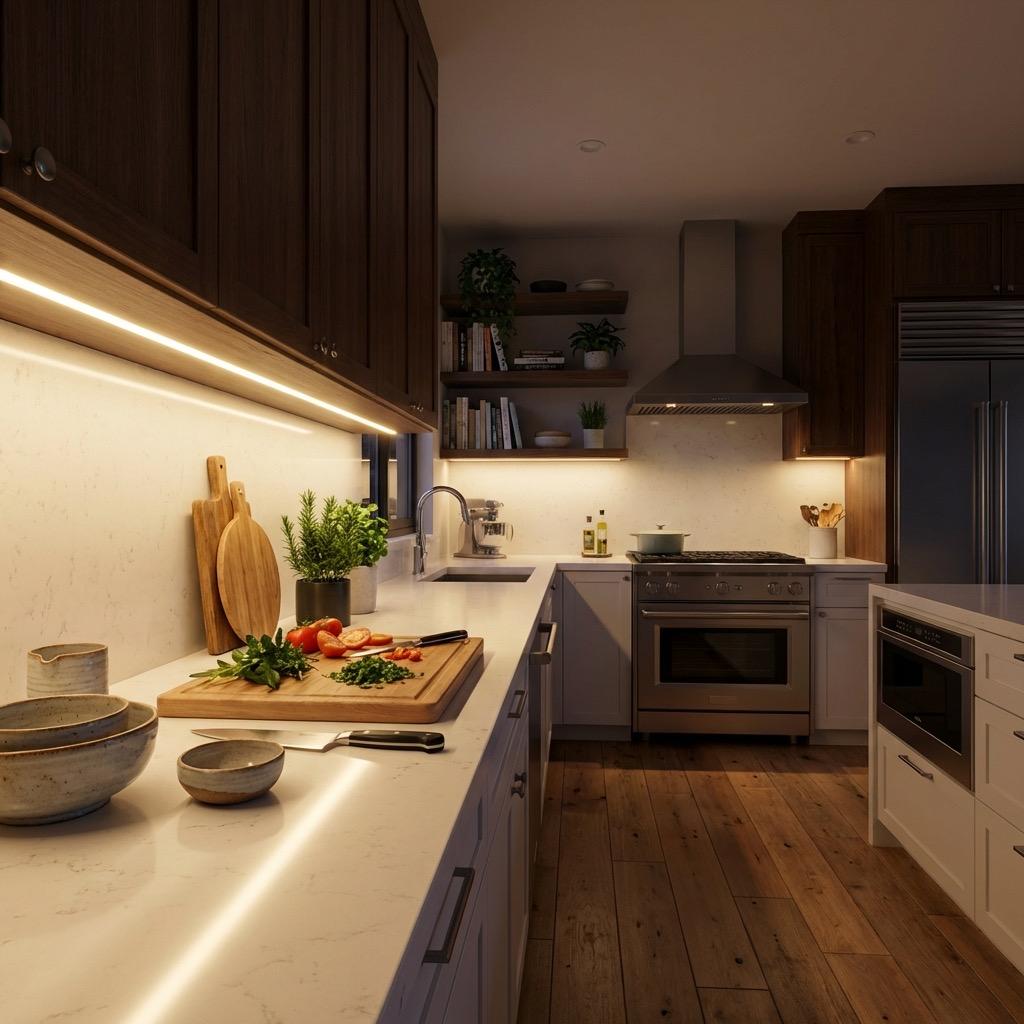
Task lighting provides focused illumination for specific work areas. In kitchens, the primary task zones are countertops, the sink, the stove, and often an island or peninsula. Task lighting should be bright enough to see clearly while performing detailed work such as chopping vegetables, reading recipes, or inspecting food for doneness. Under cabinet lighting is the most common form of kitchen task lighting, illuminating the primary work surfaces. Pendant lights over islands serve both task and decorative purposes.
Accent Lighting
Accent lighting adds depth, visual interest, and personality to kitchen design. It highlights architectural features, draws attention to display areas, and creates ambiance. In-cabinet lighting shows off dishware or collectibles behind glass doors. Toe-kick lighting adds a floating effect to islands or base cabinets. Cove lighting washes walls or ceilings with soft, indirect light. While ambient and task lighting are functional necessities, accent lighting is what transforms a kitchen from ordinary to extraordinary.
Pro Tip: When planning a kitchen renovation in Northern Virginia, start your lighting design at the same time you select cabinets and countertops. The type of cabinet finish, countertop material, and backsplash color all influence how light behaves in the space. Dark granite countertops absorb light and need brighter task lighting, while white quartz reflects light and may need less intensity.
Key Kitchen Lighting Zones
Counter and Prep Areas
Every inch of countertop used for food preparation should be well-illuminated with minimal shadows. Under cabinet lighting is essential. Position fixtures toward the front of cabinets, 1-2 inches from the door edge, to maximize counter coverage. LED strip lights or light bars provide even illumination across the full counter length. Avoid the common mistake of placing recessed lights directly above counter edges where they cast shadows when you are working at the counter. Instead, position recessed lights 20-24 inches from the wall so light falls on the work surface rather than your back.
Whether it is a simple repair or a major electrical project, our licensed team is ready to help. Serving all of Northern Virginia with transparent pricing and expert workmanship. Call (703) 997-0026 today.
Kitchen Island
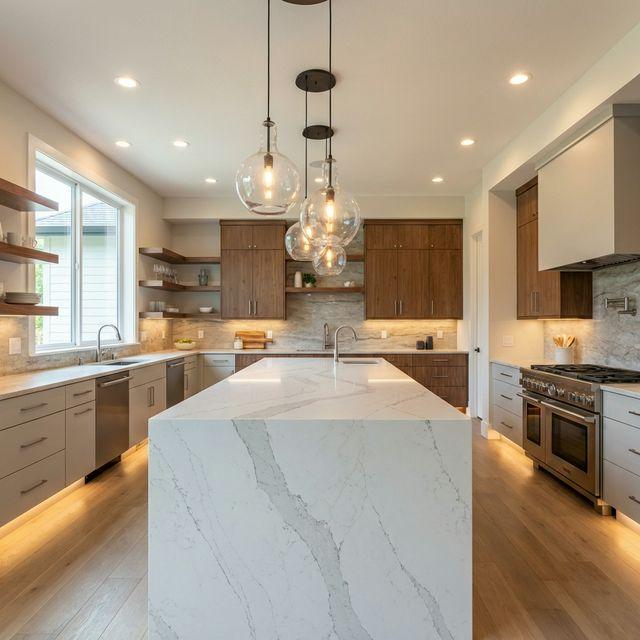
Islands serve multiple functions including prep space, casual dining, and gathering point, and their lighting should reflect this versatility. Pendant lights are the most popular island lighting choice, providing both task illumination and a decorative focal point. Size pendants appropriately so the total width of pendant fixtures is about two-thirds the island length. For single large pendants, ensure adequate light distribution across the entire island surface. Multiple smaller pendants typically provide more even task lighting. Consider mounting height carefully, as pendants should be 30-36 inches above the counter surface, high enough not to obstruct sightlines but low enough to illuminate effectively.
Sink, Range, and Pantry Areas
The sink is a primary work zone requiring good visibility for washing, food prep, and cleanup. Position a recessed light or small pendant directly above the sink center. Most range hoods include integrated lighting that illuminates the cooking surface, but if your range lacks adequate hood lighting, position recessed lights to supplement. Avoid placing recessed lights directly over burners where rising heat and grease may cause premature fixture failure. Walk-in pantries need their own light source, typically a ceiling fixture controlled by a switch at the door. Motion-activated lights in pantries are a convenient upgrade many Northern Virginia homeowners appreciate.
Choosing the Right Light Sources
Color Temperature and CRI
Color temperature dramatically affects how your kitchen looks and feels. For kitchens, most designers recommend 2700K-3000K warm white for a comfortable, inviting atmosphere. This range flatters both food and people, making it ideal for kitchens that double as social spaces. Some homeowners prefer slightly cooler 3500-4000K lighting for its clean, contemporary feel and improved visibility. Avoid going above 4000K, which can feel harsh and clinical in residential settings. Whatever temperature you choose, maintain consistency across all fixtures to avoid a disjointed appearance.
Color Rendering Index measures how accurately a light source displays colors. In kitchens, high CRI matters for judging food freshness and doneness. Look for LED bulbs with CRI of 90 or higher. Budget LEDs with CRI of 80-85 may distort reds and make food look less appetizing.
Dimming Capabilities
Every layer of kitchen lighting should be dimmable. This flexibility allows bright light for cooking and meal prep, reduced light for casual dining, ambient evening light while the kitchen is visible from living areas, and complete darkness when the kitchen is not in use. Install LED-compatible dimmers and ensure all LED bulbs and fixtures are rated for dimming.
Did You Know? In open-concept floor plans common in newer Loudoun and Prince William County homes, kitchen lighting is visible from the living and dining areas. Using dimmers allows you to transition from bright task lighting during cooking to soft ambient glow during a dinner party, all without leaving the conversation. Many of our Northern Virginia clients request separate dimmer zones for counter, island, and accent lighting.
Common Kitchen Lighting Mistakes
- Single central fixture: One ceiling light cannot adequately illuminate a kitchen. Multiple fixture types and locations are necessary for proper function.
- Forgetting the counter fronts: Recessed lights placed at the room's perimeter, not near the wall, leave counters in shadow.
- Inadequate island lighting: Pendants chosen for aesthetics rather than function may leave islands under-lit for task work.
- Mismatched color temperatures: Using different color temperature bulbs creates an inconsistent, unprofessional appearance.
- No dimming capability: Without dimmers, kitchens are either fully lit or completely dark, with no flexibility for different occasions.
- Ignoring vertical surfaces: Lighting only horizontal surfaces makes kitchens feel cave-like. Include some vertical illumination from cabinet lighting or wall fixtures.
Kitchen Lighting for Different Styles
Traditional Kitchens
Traditional kitchens pair well with decorative fixtures such as chandeliers, lantern pendants, and classic recessed lights with decorative trims. Warm 2700K lighting enhances wood cabinetry and classic finishes. Under cabinet lights should be hidden from view, with only the light visible. Many historic homes in Arlington and Alexandria feature traditional kitchens that benefit from this warm, layered approach.
Contemporary and Transitional Kitchens
Modern kitchens can showcase sculptural pendant fixtures and sleek linear elements. Slightly cooler color temperatures at 3000K complement the clean lines of contemporary design. Integrated LED fixtures that disappear into architecture suit minimalist aesthetics. Transitional designs blend traditional warmth with contemporary simplicity, and simple pendant shapes in brass or bronze bridge the style gap effectively.
Professional Kitchen Lighting Design in Northern Virginia
Effective kitchen lighting requires planning before construction or renovation begins. Create a lighting plan that identifies all fixture locations, switch positions, and circuit needs. Consider how the kitchen connects to adjacent spaces so lighting transitions smoothly without jarring contrasts. Work with an electrician early in the design process, as wiring for under cabinet lights, recessed cans, and island pendants needs to be roughed in before drywall installation.
At AJ Long Electric, our kitchen lighting specialists understand both the electrical and design aspects of creating perfectly lit kitchens. We work with homeowners and their designers throughout Fairfax, Arlington, Loudoun, and Prince William counties to develop comprehensive lighting plans, select appropriate fixtures, and install systems that provide years of reliable, beautiful illumination. Contact us for a kitchen lighting consultation and discover the difference thoughtful lighting design makes in your home.
Tags:

Written by
AJ Long Electric Team
Licensed Electricians
Our team of licensed electricians brings over 40 years of combined experience serving Northern Virginia. We're committed to providing expert electrical solutions with a focus on safety, quality, and customer satisfaction.
Reviewed by AJ Long Electric Master Electricians · VA License #2705031092 · View Credentials