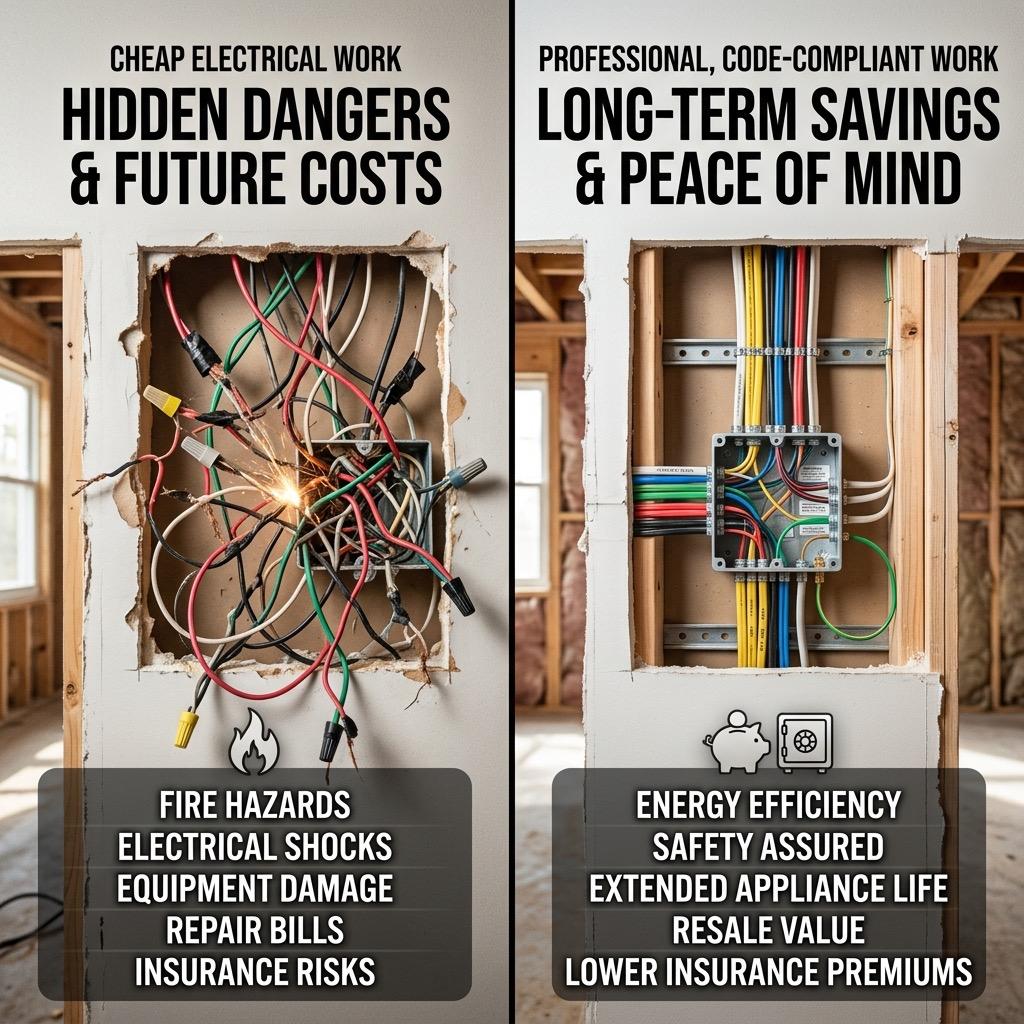
The average Northern Virginia electrical project runs 18-32% over the original quoted price when hidden costs emerge. This is not always contractor dishonesty — many additional costs are genuinely discovered during the work. But some contractors systematically exclude predictable costs from initial quotes to appear competitive. Knowing the 12 most common hidden costs in Northern Virginia electrical projects lets you ask better questions, get truly comparable quotes, and budget with realistic contingency funds.
Key Takeaways
- Keep a 20-25% contingency budget for electrical projects in older NoVA homes (pre-1985 construction)
- Permit fees ($75-$300) are legally required and should always be included in written quotes — never skip them
- Code upgrade requirements (AFCI breakers, GFCI protection, grounding) can add $300-$1,500 to panel projects
- Service entrance replacement adds $700-$1,500 and is discovered as often as 30% of the time during panel upgrades
- Drywall repair and painting are almost never included in electrical quotes — budget $300-$1,200 separately
- Homes in Arlington, Falls Church, and older Fairfax communities have above-average rates of hidden-cost discoveries
Permit Fees: The Most Commonly Omitted Cost
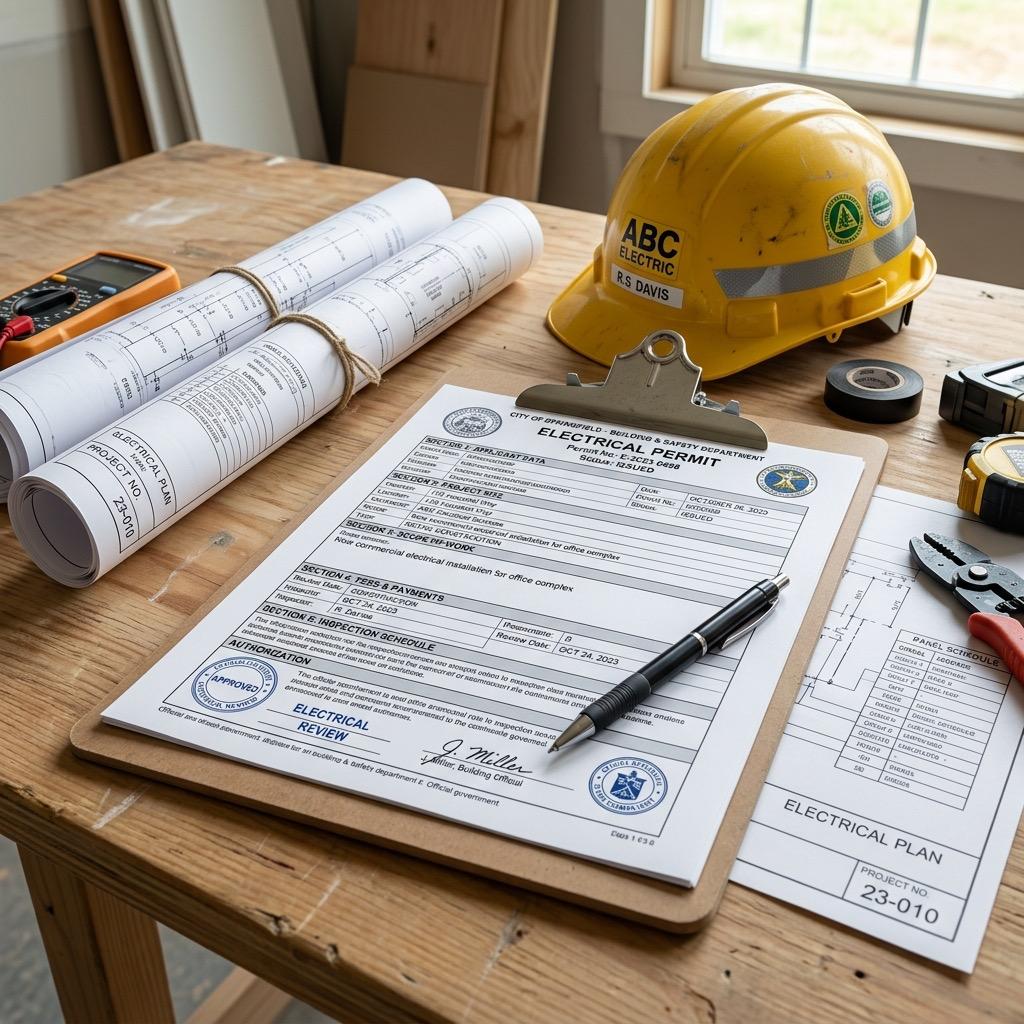
Electrical permits are legally required for panel upgrades, new circuits, EV charger installations, generator hookups, and any other significant electrical work in Northern Virginia. Despite this, permit fees are among the most commonly omitted line items in contractor quotes — sometimes through oversight, sometimes deliberately. Permit costs in the four major NoVA counties range from $75 to $300 for typical residential projects.
| County | Typical Permit Fee Range | Fee Structure | Online Portal? |
|---|---|---|---|
| Fairfax County | $160-$250 | Value-based with minimum | Yes (LDS Portal) |
| Arlington County | $95-$225 | $95 base + $7.50-$9.50 per $1,000 value | Yes |
| Loudoun County | $85-$175 | Flat fee by project type | Yes |
| Prince William County | $75-$165 | Flat fee by project type | Yes |
| City of Alexandria | $100-$220 | Value-based | Yes |
| City of Falls Church | $90-$195 | Value-based | Yes |
When comparing quotes, always confirm: "Is the permit fee included?" If a contractor says permits are not needed, that is a serious red flag — Virginia law requires permits for virtually all electrical work beyond basic device replacement. Unpermitted electrical work voids homeowner's insurance coverage for related damage and creates costly complications during home sales.
Code Upgrade Costs Triggered by Electrical Work
The National Electrical Code (NEC) requires that new and modified work meet current standards. This "current code" rule means that work you did not originally plan to do — and did not budget for — can become required once an electrician starts a project. These code-driven additions are legitimate and important for safety, but they are also among the most common sources of surprise costs in Northern Virginia.
A professional electrical inspection identifies hidden hazards before they become emergencies. Our licensed electricians provide thorough safety inspections throughout Northern Virginia. Call (703) 997-0026 to schedule yours.
The most frequently triggered code upgrades in the region, with their typical added costs:
- AFCI breakers (Arc-Fault Circuit Interrupters): Required for bedrooms, living rooms, dining rooms, hallways, and most other living spaces. At $42-$58 each in 2026, a panel project requiring 15 AFCI breakers adds $630-$870 above standard breaker costs. Fairfax and Arlington counties adopted the 2023 NEC in 2024-2025, requiring AFCI protection in nearly all habitable rooms.
- GFCI protection: Required within 6 feet of water sources in kitchens, bathrooms, garages, outdoor areas, and laundry rooms. Upgrading existing outlets adds $135-$195 per location. A typical whole-panel project may identify 8-15 locations needing GFCI upgrades.
- Grounding system deficiencies: NEC 250.53 requires two ground rods at minimum 6 feet apart for the grounding electrode system. Many homes built before 1975 have one or zero proper ground rods. Correcting this adds $165-$425.
- Tamper-resistant receptacles: All newly installed or replaced outlets must now be tamper-resistant. These cost $3-$5 more per outlet than standard receptacles — modest per unit, but noteworthy on large projects.
- Smoke and CO detector requirements: Some Northern Virginia jurisdictions require interconnected smoke and carbon monoxide detectors throughout the home when an electrical permit is pulled for panel work. Budgeting $115-$185 per detector installation position is prudent.
Service Entrance and Meter Base Discoveries
Service entrance upgrades are the single largest unplanned cost in Northern Virginia panel projects. When an electrician removes an old panel and inspects the service entrance — the wiring from your utility meter to the panel — they sometimes discover undersized, damaged, or outdated conductors that must be replaced to safely support the new panel. This happens on approximately 22-30% of panel upgrade projects in homes built before 1985 in Fairfax and Arlington counties.
Service entrance replacement costs in Northern Virginia range from $700 to $1,500 depending on the distance from the meter to the panel and the extent of work required. If Dominion Energy or NOVEC must disconnect the service for meter base replacement, add 2-5 business days to the project timeline and sometimes a utility coordination fee of $0-$300. Request that your electrician visually inspect (or at minimum, describe) the condition of your service entrance before issuing a final quote.
Drywall, Patching, and Painting
Electrical work regularly requires opening walls and ceilings to route new wiring. Experienced electricians minimize damage using strategic access points and wire-fishing techniques, but some cuts are unavoidable — particularly for long circuit runs and rewiring projects. The critical fact: almost no electrical contractor in Northern Virginia includes drywall repair in their quote unless you specifically negotiate it in writing.
Typical drywall-related costs that follow electrical work:
- Small access hole patch (under 12 inches): $150-$350 per hole, for materials and drywall contractor labor
- Large wall section repair: $350-$750 per section
- Ceiling patch with texture match: $275-$650 per location
- Complete room repaint after patching: $400-$1,200 depending on room size
- Total drywall/paint cost for a rewiring project: $1,500-$5,000 for a typical Northern Virginia home
When getting your electrical quote, ask explicitly: "Will your work require opening walls or ceilings? If so, is drywall repair included?" Get the answer in writing.
Access Difficulty Surcharges
Northern Virginia's diverse housing stock creates challenging access conditions that add time and cost to electrical projects. Panel locations in tight closets, wiring paths that run through stone foundations in older Falls Church homes, crawl spaces with limited clearance common in 1950s Fairfax County ranchers, and parking/access challenges at dense Arlington condo buildings all generate legitimate surcharges. Common access-related additions:
- Panel in tight space with limited clearance: $75-$200 labor premium
- Attic work in summer (safety slow-down required): $50-$150 premium
- Crawl space wiring in confined area: $50-$175 premium
- High-rise or secured building parking / access fees: $35-$100 per visit
- Travel surcharge for remote Loudoun or Prince William addresses: $50-$150 for locations over 30 miles from contractor base
Landscaping, Utility Locating, and Trenching
Projects involving underground wiring for outdoor lighting, detached garages, generator installations, or EV charging in driveways require trenching. Trenching costs $8-$18 per linear foot for standard depth (18-24 inches), which means a 40-foot run from house to detached garage adds $320-$720 just for the trench. Restoring disturbed landscaping — grass seeding, mulch replacement, paver resetting — is almost always excluded from electrical quotes and adds $200-$800 or more for larger disturbance areas.
Virginia law requires a call to Miss Utility (811) before any digging. Most reputable electricians handle this automatically, but confirm it is included. The 811 locating service is free and legally required — it is not an added cost, but confirming your contractor manages it is important.
How to Protect Yourself from Hidden Costs
The best defense against budget overruns is a detailed, written scope of work that explicitly addresses potential additions. Ask every contractor bidding your project these five questions: (1) Are permit fees included in this quote? (2) What code upgrades might be required and are they included? (3) What happens if the service entrance needs replacement — is there a defined cost for that scenario? (4) Will any drywall need to be opened, and if so, is repair included? (5) What are your access surcharge policies for tight spaces or remote locations? Get the answers in writing as part of your contract.
Keep a 20-25% contingency budget above the quoted price for projects in homes built before 1985. For newer construction, 10-15% is usually sufficient. If the contingency is not needed, it is a pleasant bonus. If it is needed, you will be grateful for the planning. Contact AJ Long Electric at (703) 997-0026 — we walk through every potential additional cost during our free assessment and give you realistic estimates for the scenarios most likely to apply to your specific home and project.
Tags:

Written by
Matt Long
Master Electrician
Our team of licensed electricians brings over 40 years of combined experience serving Northern Virginia. We're committed to providing expert electrical solutions with a focus on safety, quality, and customer satisfaction.
Reviewed by AJ Long Electric Master Electricians · VA License #2705031092 · View Credentials