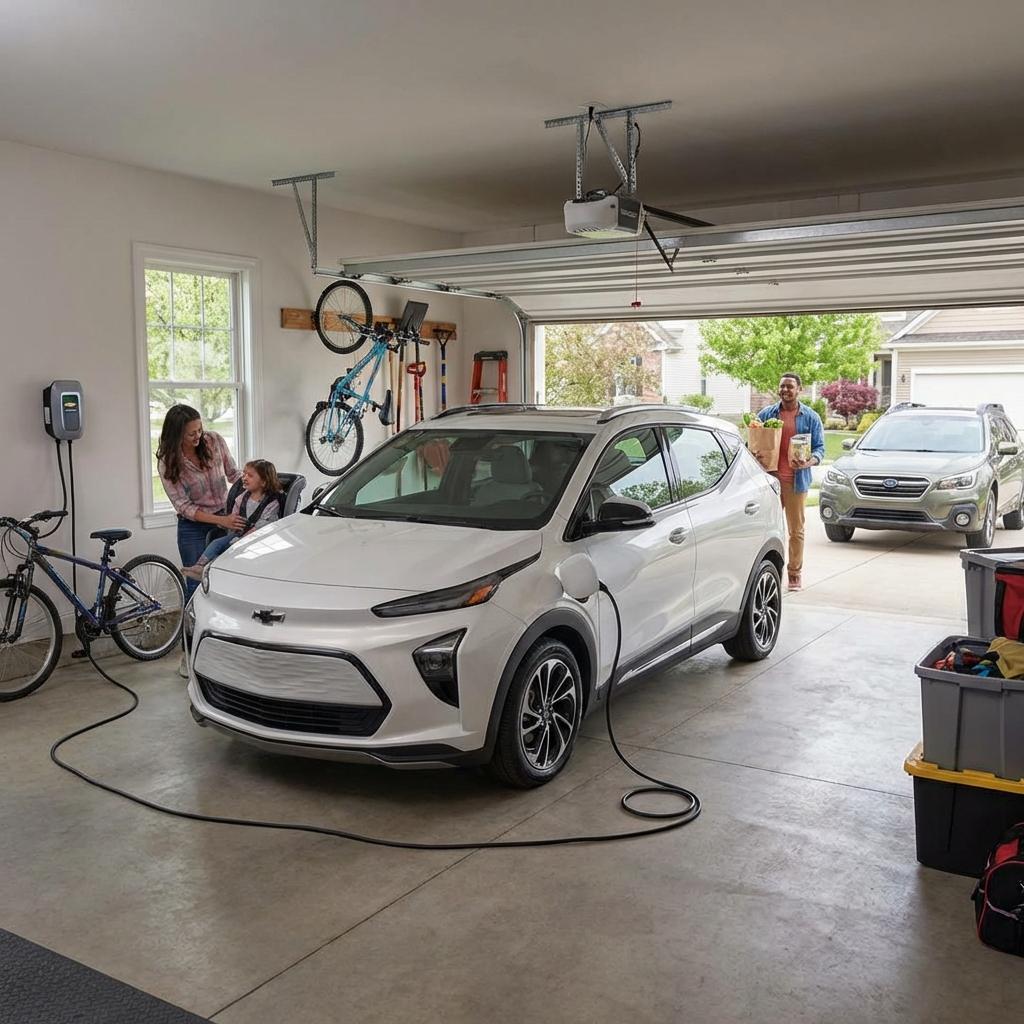
The Chevrolet Bolt EV and Bolt EUV have been among the most affordable and practical electric vehicles available to Northern Virginia drivers, offering genuine electric driving capability at a price point that makes EV ownership accessible to a wide range of budgets. Whether you drive a first-generation Bolt with its 7.2 kW onboard charger or a 2022+ model with the upgraded 11.5 kW charger, proper home charging infrastructure ensures you start every morning with a full battery, ready for your commute through Fairfax County, along Route 28, or into Washington DC. This guide covers the Bolt's specific charging capabilities across model years, the best home charger recommendations, and installation details for Northern Virginia homeowners.
Key Takeaways
- The 2022+ Bolt EV/EUV features an 11.5 kW onboard charger supporting 48 amps; earlier models have a 7.2 kW charger supporting 32 amps.
- Knowing your model year determines the optimal charger and circuit sizing for your home.
- A ChargePoint Home Flex with adjustable amperage is the ideal choice for Bolt owners who may upgrade vehicles in the future.
- A 50-amp circuit accommodates all Bolt model years; a 40-amp circuit is sufficient for pre-2022 models.
- The myChevrolet app provides scheduling, preconditioning, and remote charge monitoring.
Chevrolet Bolt Charging Specifications by Model Year
The Bolt's charging capabilities changed significantly between model generations, making it important to know which version you own.
2017-2021 Bolt EV
The first-generation Bolt EV comes with a 7.2 kW onboard charger that accepts up to 32 amps at 240 volts on Level 2. At maximum speed, it adds approximately 25 miles of range per hour. The 60 kWh battery charges from 20% to 100% in about 7-8 hours on a 32-amp charger, fitting into an overnight window. Installing a charger rated higher than 32 amps does not provide any speed benefit for these models, as the vehicle's onboard charger is the limiting factor.
2022+ Bolt EV and Bolt EUV
The refreshed 2022 model year brought an upgraded 11.5 kW onboard charger that accepts up to 48 amps on Level 2. This increases charging speed to approximately 32 miles of range per hour. The 65 kWh battery charges from 20% to 100% in about 6-7 hours. The Bolt EUV (the slightly larger crossover variant) shares the same charging hardware and battery capacity.
Charge Port Location
All Bolt models have the charge port on the driver's side front fender. Position your charger to reach this location comfortably. The included portable charger uses a J1772 connector, and all home Level 2 chargers with J1772 connectors are compatible.
Recommended Home Chargers for the Chevrolet Bolt
The right charger depends on your model year and whether you plan to keep the Bolt long-term or may upgrade to a different EV in the future.
Our licensed electricians have installed hundreds of EV chargers across Northern Virginia. We handle everything from panel evaluation to permit filing. Call (703) 997-0026 or request your free estimate online.
For 2017-2021 Bolt EV Owners
Since the pre-2022 Bolt maxes out at 32 amps, you do not need a 40 or 48-amp charger for maximum speed. However, buying a higher-capacity charger future-proofs your installation for a future vehicle that may accept more power.
- Best value: A 32-amp charger like the Lectron V-Box 32 provides exactly the speed your Bolt can accept at the lowest price point.
- Best for future-proofing: The ChargePoint Home Flex set to 32 amps now, with the ability to increase to 50 amps for a future vehicle, provides maximum flexibility.
- Best budget option: The Grizzl-E Classic at 40 amps delivers more than the pre-2022 Bolt needs (the Bolt simply draws 32 amps from the available 40) while providing a rugged, reliable charger at an excellent price.
For 2022+ Bolt EV/EUV Owners
The upgraded onboard charger warrants a 48-amp home charger for maximum speed. Our recommended options include the ChargePoint Home Flex at 50 amps for full speed plus smart features, the JuiceBox 48 for equivalent speed with strong app integration, and the Grizzl-E Classic at 40 amps for a budget option that delivers 90% of maximum speed.
Circuit Requirements for Bolt Home Charging
Matching your circuit to your Bolt's needs ensures safe, efficient charging without overinvesting in infrastructure you do not need.
For Pre-2022 Bolt (32 Amps Max)
A 32-amp continuous load requires a 40-amp circuit breaker (32 times 1.25 equals 40). Wire with 8-gauge copper for runs under 50 feet, or 6-gauge for longer runs. This is a relatively modest circuit that most Northern Virginia panels, including older 150-amp panels common in Burke, Springfield, and Annandale, can accommodate without issues. Installation cost for a 40-amp circuit is typically $700-$1,500.
For 2022+ Bolt (48 Amps Max)
A 48-amp continuous load requires a 60-amp circuit breaker with 6-gauge copper wire (or 4-gauge for runs over 50 feet). This is the same circuit specification required for Tesla Wall Connectors and other 48-amp chargers. Installation cost runs $900-$2,000 depending on run length and panel capacity.
Future-Proof Option
If you own a pre-2022 Bolt but may upgrade to a vehicle requiring 48 amps in the future, consider installing a 50-amp circuit now (supporting 40 amps continuous) with the option to upgrade to a 60-amp circuit later. The 6-gauge wire used for a 50-amp circuit is the same gauge needed for a 60-amp circuit, so only the breaker needs to change. This saves you from rewiring in the future.
myChevrolet App and Charging Management
The myChevrolet mobile app provides comprehensive charging management for all Bolt models.
Charging Scheduling
Schedule charging to begin during off-peak Dominion Energy hours to minimize electricity costs. The app allows you to set departure times, and the Bolt calculates when to start charging to reach your target level by departure. This feature works with any home charger, not just the GM-branded option.
Hilltop Reserve and Target Charge Level
The Bolt offers a "Hilltop Reserve" or "Target Charge Level" setting that limits charging to less than 100%, typically around 90%. This preserves long-term battery health by avoiding the stress of sitting at maximum charge. For daily driving in Northern Virginia, setting an 80-90% target provides ample range while extending battery lifespan.
Preconditioning
During cold Northern Virginia winters, use the app to precondition the cabin 10-15 minutes before departure. When plugged in, preconditioning uses grid power rather than battery power, preserving your driving range. The Bolt's heat pump (on newer models) makes this process particularly efficient.
Remote Monitoring
Check charge status, current battery level, and estimated range from anywhere through the app. Verify your Bolt is plugged in and charging while you are at work in Tysons or Reston, ensuring you always come home to a charged vehicle.
Bolt-Specific Installation Considerations
A few unique factors affect Bolt charging installations.
Battery Conditioning Delays
In extreme cold or heat, the Bolt may delay charging while it conditions the battery to an acceptable temperature. This is normal behavior controlled by the battery management system. It does not indicate a problem with your charger or installation. During Northern Virginia summer heat waves, you may notice a brief delay before charging begins if the vehicle has been sitting in direct sun.
One-Pedal Driving and Regenerative Braking
While not directly related to home charging, the Bolt's efficient one-pedal driving mode helps maximize your range, reducing how much energy you need to replace each night. Northern Virginia's stop-and-go traffic on I-66 and I-495 is actually ideal for regenerative braking, helping the Bolt recapture energy that gas cars simply waste as heat.
Get Your Bolt Home Charger Installed
AJ Long Electric has set up home charging for dozens of Bolt EV and EUV owners across Northern Virginia. We match the circuit and charger to your specific model year, ensuring you get exactly the right level of performance without overinvesting. Our team handles permits and inspections across Fairfax, Arlington, Loudoun, and Prince William counties. Contact AJ Long Electric at (703) 481-3732 to set up home charging for your Chevrolet Bolt.
Tags:

Written by
Matt Long
Master Electrician
Our team of licensed electricians brings over 40 years of combined experience serving Northern Virginia. We're committed to providing expert electrical solutions with a focus on safety, quality, and customer satisfaction.
Reviewed by AJ Long Electric Master Electricians · VA License #2705031092 · View Credentials